


Clearing vs Settlement vs Execution: Understanding the Full Trade Lifecycle
You click “buy,” and within a second your broker app shows a filled order. It feels finished. However, that instant confirmation is only the first step of a much longer journey. Behind the screen, your trade still has to be verified, guaranteed, and finally completed.
Many traders use the words execution, clearing, and settlement as if they mean the same thing. They don’t. Each stage has its own job, its own players, and its own risks. Understanding the clearing vs settlement difference, along with where execution fits, can make you a more informed and careful market participant.
In this guide, we’ll walk through the full trade lifecycle step by step. By the end, you’ll know exactly what happens to your order after you press that button.
What Is the Trade Lifecycle?
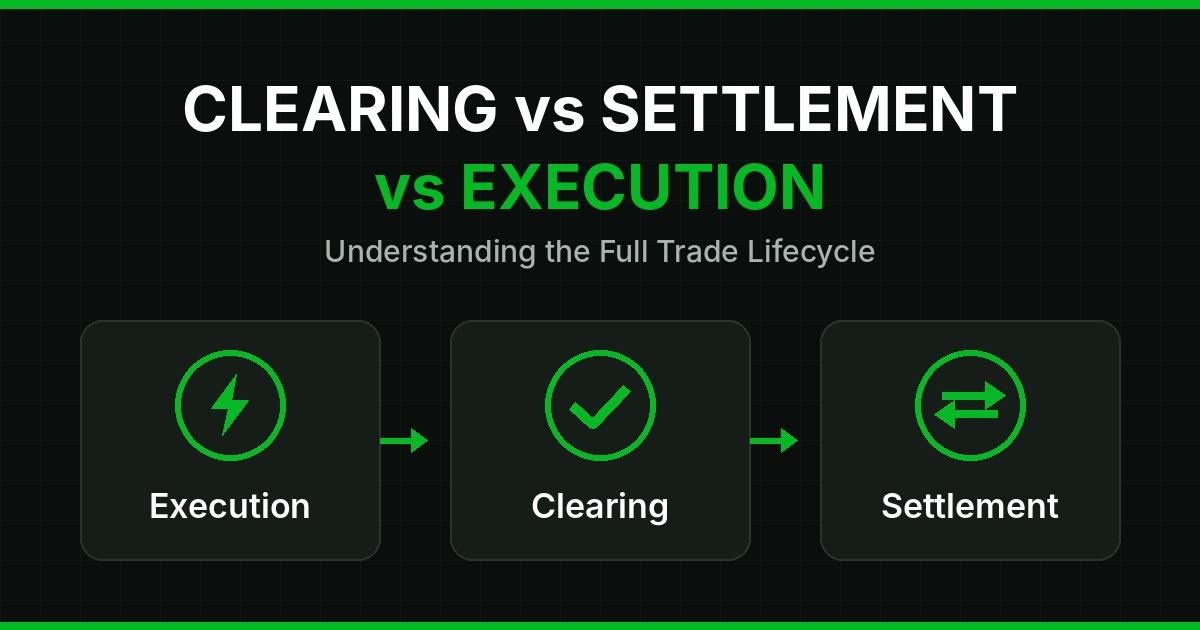
The trade lifecycle is the complete path a transaction follows, from the moment an order is placed to the moment ownership officially changes hands. In simple terms, it has three core stages:
- Execution: the buyer and seller agree on a deal.
- Clearing: the deal is checked, recorded, and guaranteed.
- Settlement: cash and securities are actually exchanged.
Together, the last two stages make up the clearing and settlement process, which runs quietly after every trade. Think of it like buying a house. Agreeing on the price is execution. Next, the lawyers verify documents and the bank confirms funding, which is clearing. Finally, the keys and money change hands, which is settlement. Each step depends on the one before it.
Stage 1: Trade Execution
Execution is the part most traders see and feel. It happens when your order is matched with an opposite order in the market.
How Execution Works
When you place an order, your broker routes it to a trading venue. This could be a stock exchange, an electronic communication network, or a market maker. There, a matching engine pairs your buy order with a sell order at an acceptable price.
Once a match is found, the trade is considered executed. At this point, the price, quantity, and time are locked in. Neither side can back out simply because the market moves a moment later.
What Can Affect Execution Quality
Not every execution is equal. Several factors influence the price you actually receive:
- Order type: A market order fills fast but may suffer slippage. A limit order controls price but may not fill at all.
- Liquidity: Thinly traded assets often have wider spreads, so fills can be worse.
- Volatility: During news events, prices can jump between the moment you click and the moment your order arrives.
- Order routing: Brokers are generally required to seek “best execution” for clients, although methods vary.
Importantly, execution only creates an agreement. No money or shares have moved yet. That’s where the next two stages come in.
Stage 2: Clearing
Clearing is the behind-the-scenes verification stage. It begins right after execution and ensures both parties can actually deliver what they promised.
What Happens During Clearing
First, trade details from both sides are compared and confirmed. If the buyer’s records and the seller’s records don’t match, the mismatch is flagged and corrected.
Next, a central counterparty (CCP), often called a clearing house, steps into the middle of the trade. Through a legal process known as novation, the original contract is replaced by two new ones. The clearing house becomes the buyer to every seller and the seller to every buyer.
This step matters enormously. If one party defaults, the clearing house still honors the trade. As a result, counterparty risk is greatly reduced across the whole market.
Netting: The Hidden Efficiency
Clearing also involves netting. Instead of settling every single trade separately, the clearing house offsets buys and sells for each member firm. For example, if a broker buys 10,000 shares of a stock and sells 9,000 shares of the same stock in one day, only the net 1,000 shares need to move.
In the United States, the National Securities Clearing Corporation (NSCC) handles this for most equity trades. According to its parent company, the Depository Trust & Clearing Corporation (DTCC), netting typically reduces the value of payments that must be exchanged by roughly 98% on a given day. That’s a massive reduction in cash and risk moving through the system. It’s also the first big clue in the clearing vs settlement puzzle: clearing shrinks obligations before anything is paid.
Margin and Risk Management
To protect itself, the clearing house requires members to post collateral, known as margin. Margin requirements are recalculated regularly based on market conditions. When volatility spikes, margin calls can rise sharply. This is one reason some brokers have temporarily restricted trading in extremely volatile stocks in the past.
Stage 3: Trade Settlement
Settlement is the final stage. This is when the buyer’s cash actually reaches the seller, and the seller’s securities are delivered to the buyer. Only then is the transaction legally complete. This is the point where the clearing vs settlement line is drawn, since clearing promised the transfer and settlement now performs it.
How Trade Settlement Works
Most modern markets use a principle called delivery versus payment (DVP). Under DVP, securities move only if payment moves at the same time. Consequently, neither side ends up delivering without receiving.
In the US, the Depository Trust Company (DTC) acts as the central securities depository. It records ownership changes electronically, so physical share certificates are rarely involved today.
Settlement Cycles: T+1, T+2, and Beyond
Settlement timing is expressed as “T plus” a number of business days, where T is the trade date. Over the years, these cycles have steadily shortened:
- US equities moved from T+3 to T+2 in 2017.
- On May 28, 2024, the US, Canada, and Mexico shifted most stock trades to T+1.
- India completed its move to T+1 in early 2023 and has since introduced an optional same-day settlement option for selected stocks.
- The UK and European Union have announced plans to move to T+1, scheduled for October 2027.
Shorter cycles reduce the time during which something can go wrong, and they compress the entire clearing and settlement process into fewer hours. On the other hand, they put more pressure on firms to confirm and fund trades quickly, especially for international investors working across time zones.
What Happens When Settlement Fails
Occasionally, a trade fails to settle on time. This can happen when a seller doesn’t have the shares, or when paperwork or funding is delayed. Failed trades may lead to penalties, forced buy-ins, or interest charges. For individual traders, these failures are rare, but they do occur, particularly around short selling.
Clearing vs Settlement: The Key Differences
Since clearing and settlement happen close together, they’re easy to confuse. Still, the clearing vs settlement distinction is clear once you see their roles side by side.
Purpose: Clearing prepares a trade for completion. Settlement actually completes it. In other words, clearing answers “can this trade be finished safely?” while settlement answers “has it been finished?”
Timing: Clearing starts immediately after execution and runs until settlement date. Settlement happens at the end, on the scheduled settlement day.
Main players: Clearing is handled by clearing houses and clearing members. Settlement is handled by central securities depositories, custodian banks, and payment systems.
Risk focus: Clearing manages counterparty risk through novation, netting, and margin. Settlement removes principal risk through delivery versus payment.
Output: Clearing produces net obligations. Settlement produces final, irreversible transfers of ownership and cash.
Put simply, when people debate clearing vs settlement, they are really comparing a verification process with a transfer process. Both are essential, and neither works well without the other.
How Execution Fits Into the Picture
Execution is the trigger for everything else. Without a matched trade, there’s nothing to clear or settle. Yet execution carries the least amount of finality. A trade can be executed perfectly and still face problems downstream if clearing or settlement breaks down.
That’s why professionals view the full clearing and settlement process as just as important as getting a good fill. A great entry price means little if the trade can’t be completed reliably.
A Real-World Example: Following One Trade
Let’s trace a simple stock purchase from start to finish.
On Monday at 10:15 a.m., you buy 50 shares of a large US company at $200 each. Your order is executed on an exchange within milliseconds. Your broker shows the position instantly.
That evening, your broker submits the trade details to the clearing house. The details are matched against the seller’s records. The clearing house then steps in as counterparty and nets your broker’s activity against all its other trades for the day.
On Tuesday, which is T+1, trade settlement takes place. Your broker’s account at the depository receives the shares, and $10,000 moves to the seller’s side. Only now are you the legal owner of those 50 shares.
Notice how much happened after the moment you thought the trade was “done.”
Does This Apply to Other Markets?
The same three stages exist across most asset classes. However, the details differ.
Futures and options: These are cleared through exchange-owned clearing houses. Positions are marked to market daily, meaning gains and losses are settled in cash every day rather than only at the end.
Spot forex: Most currency pairs settle on T+2, although some, such as USD/CAD, settle on T+1. Retail forex accounts usually roll positions over rather than taking physical delivery of currency.
Cryptocurrency: On centralized exchanges, trades are typically recorded on the exchange’s internal ledger almost instantly. Moving coins on the blockchain itself is a separate step. Because there is often no independent clearing house, counterparty risk sits largely with the exchange itself.
Why Traders Should Care About the Clearing and Settlement Process
You might wonder why any of this matters if your broker handles it automatically. In practice, it affects you in several ways.
First, settlement timing determines when sale proceeds become fully available. In a cash account, buying with unsettled funds and selling before they settle can cause a “good faith violation.”
Second, record dates for dividends depend on settlement. You must own shares by the settlement date, not just the trade date, to be on the books.
Third, understanding clearing helps explain sudden margin hikes or temporary trading restrictions during extreme volatility.
Finally, knowing how your broker clears trades, whether in-house or through a third-party clearing firm, helps you assess the safety of your account.
Common Misconceptions
“My order filled, so I own the shares.” Not quite. You have a contractual right to them, but legal ownership transfers at settlement.
“Clearing and settlement are the same thing.” As covered above, the clearing vs settlement difference is real. One verifies and guarantees; the other transfers.
“Faster settlement removes all risk.” Shorter cycles reduce risk, but they don’t eliminate operational errors, funding gaps, or system outages.
Final Thoughts
Execution, clearing, and settlement form a chain, and every link matters. Execution sets the terms. Clearing checks and guarantees them. Trade settlement then delivers the final result. Understanding clearing vs settlement, and where execution fits, gives you a clearer picture of what really happens after you trade and why timing, liquidity, and counterparty safety all matter.
As with any part of trading, sound tools should support your process, not replace your understanding of it. Platforms such as GainzAlgo focus on the signal and analysis side of trading, while brokers and clearing firms handle the post-trade mechanics described above. If you’re asking “is GainzAlgo legit,” the most reliable approach is the same one you’d use for any trading service: review transparent performance information, read independent user feedback, test it carefully before committing real capital, and make sure it fits a well-understood plan that includes how your trades are executed, cleared, and settled.

 English
 Arabic
 French
 Spanish
 Portuguese
 Deutsch
 Turkish
 Dutch
 Italiano
 Russian
 Romaian
 Portuguese (Brazil)
