


Multiple Access Methods. One Contactless Smart Locker in the UAE
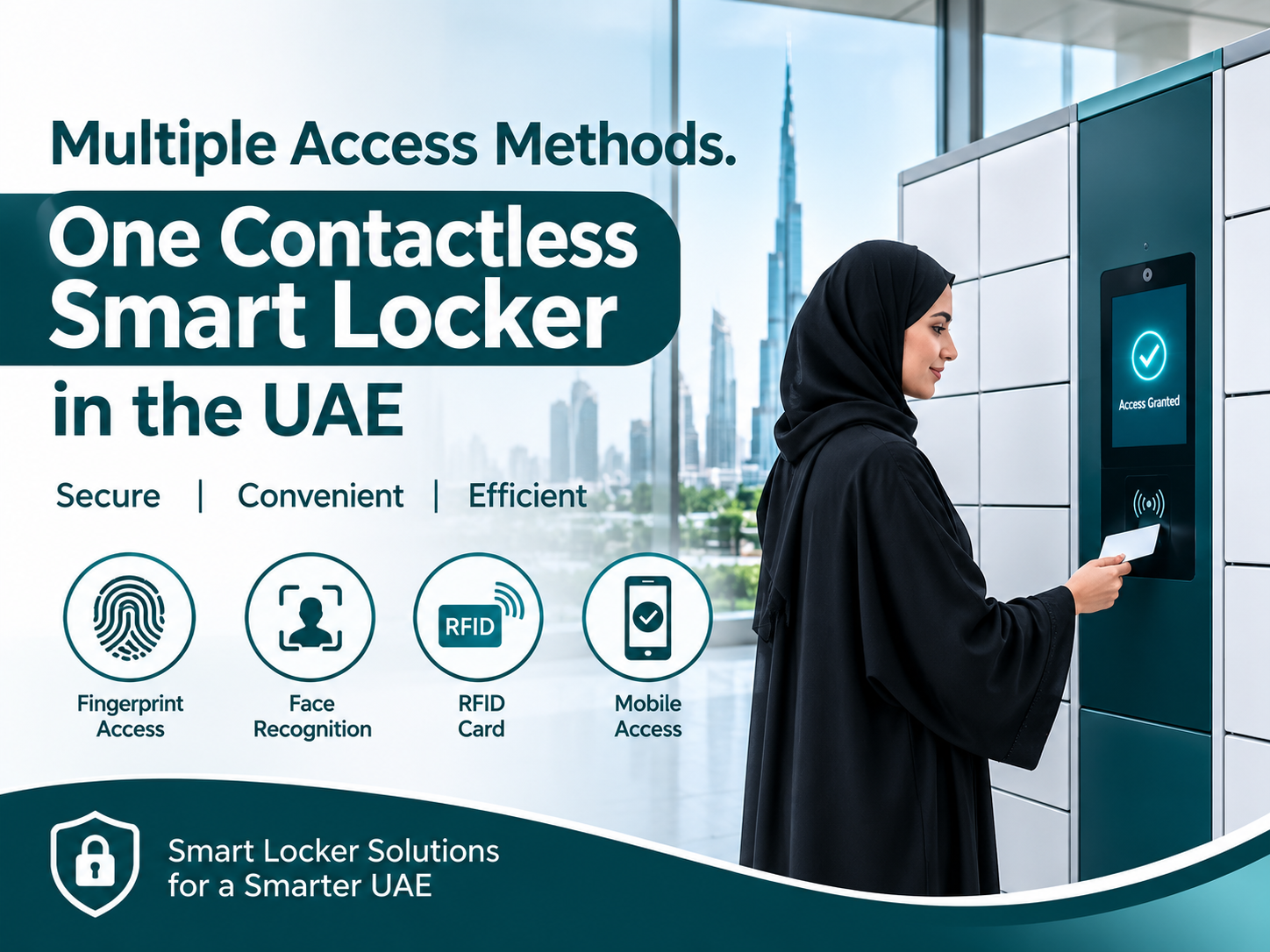
Across the UAE’s airports, government service centres, corporate campuses, hospitals, and retail destinations, the demand for secure, self-service storage has outgrown the limitations of traditional key-and-padlock lockers. The Smart Locker has emerged as the definitive answer — a contactless, software-managed storage unit that authenticates users through their choice of credential, logs every access event in a tamper-proof audit trail, and integrates seamlessly with enterprise identity and facility management platforms.
What makes the UAE’s next generation of intelligent lockers truly transformative is not any single access method, but the convergence of multiple authentication technologies within one unified, field-proven hardware platform.
Why the UAE Demands Contactless, Multi-Modal Locker Access
The UAE’s position as a global hub for tourism, trade, and government-delivered services creates a uniquely diverse user population. A locker bank installed at Dubai International Airport Terminal 3 must accommodate Emirati nationals authenticating with their Emirates ID, international business travellers preferring QR code redemption from a booking confirmation email, and airport staff using biometric credentials registered in the HR system. A single-method locker that serves only one of these groups creates queues, frustration, and operational inefficiency. The TekLocker platform by Tektronix LLC is engineered from the ground up to eliminate this constraint, offering every access modality on a single unit — allowing institutions to deploy one hardware standard across every use case rather than managing multiple incompatible locker ecosystems.
UAE federal and emirate-level government initiatives reinforce this direction. The UAE Digital Government Strategy 2025 mandates contactless, digitally enabled service delivery across all public touchpoints. The Smart Dubai initiative and Abu Dhabi’s Department of Government Enablement (DGE) digital transformation programmes both explicitly prioritise self-service, app-enabled infrastructure that reduces dependence on attended service counters. A multi-modal intelligent locker is not simply a storage convenience — it is a physical node in the UAE’s broader smart city and digital government ecosystem.
Face Recognition Locker Access: Biometric Security Without Contact
Of all available authentication modalities, biometric verification delivers the highest level of identity assurance. Face Recognition Locker Access uses an embedded AI-powered camera with liveness detection to verify a user’s identity in under one second, with false acceptance rates below 0.001% — a security threshold that exceeds card-based and PIN-based systems by orders of magnitude. Liveness detection algorithms distinguish a live face from a photograph, video replay, or 3D mask, preventing spoofing attacks that could compromise high-value storage environments such as evidence lockers in UAE police facilities, pharmaceutical sample storage in hospital research units, or confidential document lockers in DIFC law firms.
For UAE government and critical infrastructure deployments, face recognition locker access aligns with the national biometric identity framework administered by the Federal Authority for Identity, Citizenship, Customs and Ports Security (ICP). Users can be enrolled during onboarding at HR or visitor management touchpoints, with facial templates stored in encrypted form — either on-device for air-gapped security environments or in the cloud for enterprise-wide identity federation. Crucially, TekLocker’s biometric processing is fully compliant with the UAE Personal Data Protection Law (PDPL, Federal Decree-Law No. 45 of 2021), which classifies biometric data as sensitive personal data requiring explicit consent, purpose limitation, and secure processing controls.
QR Code Smart Locker Access: Frictionless Redemption for Every User
Not every use case demands biometric authentication. For retail parcel collection, event cloakrooms, co-working day-pass storage, and visitor locker banks, speed and simplicity of access matter more than the highest-assurance identity verification. QR Code Smart Locker Access delivers exactly this: a unique, time-limited QR code is generated and dispatched to the user’s email or mobile phone at the point of reservation — whether through a mobile app, a web portal, a property management system, or an integrated kiosk — and scanned at the locker unit’s integrated barcode reader to release the assigned compartment instantly.
QR code tokens are cryptographically signed and time-bounded, expiring automatically at the end of the reserved session to prevent reuse. For high-throughput environments such as mall parcel collection points in Dubai Mall or Yas Mall, or baggage storage at Abu Dhabi Cruise Terminal, the QR modality eliminates the need for users to remember PINs, carry physical cards, or interact with any staff member — reducing average collection time to under fifteen seconds and enabling the locker bank to handle peak demand volumes without service degradation.
OTP Secure Locker Access: Dynamic Credentials Over Any Channel
One-time password authentication combines the universality of SMS delivery with the time-bounded security of dynamic credentials. OTP Secure Locker Access is the modality of choice for deployments where users cannot be pre-enrolled biometrically and do not have a smartphone application installed — making it the most inclusive access method for walk-up, unregistered users. When a user requests locker access through a web portal, interactive kiosk, or call centre agent, a six-digit OTP is generated and delivered via SMS to the registered mobile number. The code is valid for a configurable window — typically five to fifteen minutes — after which it expires and cannot be reused, even if intercepted.
In UAE government service centres — Amer centres, Tasheel offices, typing centres, and Federal Authority for Nuclear Regulation (FANR) document submission facilities — OTP locker access provides citizens and residents with a familiar, low-friction mechanism to collect completed documents from a self-service locker without requiring face-to-face handover with a government employee. This directly supports the UAE’s target of delivering 100% of government services digitally and the Ministry of Human Resources and Emiratisation (MOHRE) strategy of reducing counter attendance requirements across labour and immigration services.
National ID Locker Authentication: Trusted Identity for UAE Residents
The Emirates ID — issued by the Federal Authority for Identity, Citizenship, Customs and Ports Security (ICP) and carried by every UAE resident — is one of the most trusted identity documents in the GCC, embedding a chip that stores the cardholder’s verified biographic and biometric data. National ID Locker Authentication leverages this existing trusted credential by integrating a certified smart card reader into the locker kiosk panel, allowing any UAE resident to tap their Emirates ID to authenticate locker access without prior enrolment in a separate system.
For public sector deployments — court complexes, health authority buildings, municipalities, land department offices, and the General Directorate of Residency and Foreigners Affairs (GDRFA) service halls across Dubai, Abu Dhabi, and Sharjah — Emirates ID authentication provides an audit trail that is legally attributable to a specific verified individual, satisfying the evidentiary requirements that government agencies need to maintain chain-of-custody records for documents stored in or retrieved from lockers. The modality also accommodates GCC national ID cards from Saudi Arabia, Qatar, Kuwait, Bahrain, and Oman, making the system natively inclusive for the large GCC expatriate professional community working across UAE free zones and financial districts.
Smart Locker UAE: Deployment Environments and Use Cases
The versatility of TekLocker’s multi-modal authentication platform makes it applicable across virtually every vertical sector driving the UAE’s economic and social development:
• Airports and Transport Hubs: Dubai International (DXB), Abu Dhabi International (AUH), and Al Maktoum International (DWC) deploy intelligent lockers for passenger baggage storage, airside crew equipment lockers, and landside parcel collection — each requiring different authentication modalities for different user populations within the same installation.
• Corporate Campuses and Free Zones: DIFC, ADGM, Dubai Media City, Dubai Internet City, and Abu Dhabi’s Masdar City deploy smart lockers for hot-desking personal item storage, enabling desk-sharing ratios above 1:1 while ensuring every employee has secure, attributable storage access without a dedicated desk.
• Healthcare Facilities: Hospitals affiliated with the Dubai Health Authority (DHA) and Abu Dhabi Health Services Company (SEHA) use intelligent lockers for patient valuables storage, visitor bag deposit, and clinical sample chain-of-custody management — each requiring PDPL-compliant biometric authentication and tamper-evident audit logs.
• Retail and E-Commerce: Last-mile parcel collection lockers operated by logistics providers including Aramex, Fetchr, and Noon in UAE malls and residential communities rely on QR and OTP authentication to deliver 24/7 self-service collection without staffing requirements.
• Education: UAE universities including NYU Abu Dhabi, Khalifa University, and American University of Sharjah deploy smart lockers for student equipment loan programmes, exam material secure storage, and personal item storage — integrated with student ID card systems through the National ID or QR modalities.
Smart Locker Abu Dhabi: Capital City Deployment Context
Abu Dhabi’s government digitalisation agenda under the DGE and Abu Dhabi Government Services Authority (Tamm) is creating significant demand for self-service infrastructure across the capital’s public buildings, cultural destinations, and commercial districts. Smart Locker Abu Dhabi deployments benefit from the capital’s advanced fibre and 5G connectivity infrastructure — which supports cloud-managed locker networks with sub-second authentication latency — and from the high concentration of government employees and ICP-enrolled residents who can use Emirates ID authentication without any additional enrolment step.
High-profile Abu Dhabi deployments include locker banks at the Abu Dhabi National Exhibition Centre (ADNEC) serving international trade show visitors, Louvre Abu Dhabi and Zayed National Museum serving cultural tourism visitors with QR-based day-use cloakroom lockers, and Khalifa Port’s logistics facilities where chain-of-custody document lockers authenticated by National ID serve customs brokers and freight forwarders. The Abu Dhabi Judicial Department (ADJD)’s court complexes across the emirate are also deploying document handover lockers that eliminate the need for litigants and lawyers to interact with court registry staff in person — a direct digitisation of a previously manual service.
Smart Locker Dubai: Scale, Diversity, and Innovation Leadership
As the UAE’s commercial capital and one of the world’s most visited cities, Dubai presents both the largest addressable market and the most demanding performance requirements for intelligent locker infrastructure. Smart Locker Dubai deployments must handle visitor populations spanning 200-plus nationalities, operate continuously across 24-hour retail and hospitality environments, and integrate with Dubai’s award-winning digital government platforms including the Dubai Now super-app and DubaiConnect unified digital services portal.
The Roads and Transport Authority (RTA) has integrated smart locker infrastructure into Dubai Metro stations to serve daily commuters requiring secure parcel collection and personal item storage without detours to dedicated collection points. Dubai Courts has deployed document exchange lockers across its Deira and Business Bay complexes, reducing counter attendance requirements for case filing and document retrieval. Dubai Silicon Oasis Authority and Dubai Science Park have installed TekLocker units for resident company employees, enabling 24/7 access to secure storage without security guard attendance — reducing facility management costs while improving the employee experience across after-hours working patterns.
Conclusion
From the biometric precision of Face Recognition Locker Access to the universal convenience of QR Code Smart Locker Access, OTP Secure Locker Access, and National ID Locker Authentication, the TekLocker platform delivers everything institutions across Smart Locker UAE, Smart Locker Dubai, and Smart Locker Abu Dhabi environments require — one contactless, enterprise-grade Smart Locker solution that meets every user, every credential, and every compliance requirement the UAE demands.
FAQs
1. What is a Smart Locker and how does it differ from a traditional locker?
A Smart Locker is a software-managed storage unit that replaces physical keys and padlocks with electronic authentication, automated compartment assignment, and cloud-connected audit logging. Unlike traditional lockers, which require mechanical key management, spare key storage, and manual lock replacement after lost keys, a smart locker assigns and releases compartments automatically based on verified user identity — generating a tamper-proof record of every access event that can be retrieved instantly for security investigations, compliance audits, or operational analytics. TekLocker units operate continuously without on-site staff attendance, reducing facility management overhead while delivering a higher security standard than any key-based system.
2. How does TekLocker handle users who do not have a smartphone or UAE National ID?
TekLocker’s OTP Secure Locker Access modality is specifically designed for users without smartphones or pre-enrolled biometric credentials. A six-digit one-time password delivered via SMS to any mobile number — including international roaming numbers — is sufficient to authenticate locker access. For users without mobile phones, authorised administrators can generate printed access codes through the management portal. This inclusive design ensures that TekLocker deployments in public-facing UAE government service centres and transport hubs never create access barriers for less digitally connected user segments, including elderly residents, overseas visitors, and first-time users.
3. Is Face Recognition Locker Access compliant with the UAE Personal Data Protection Law?
Yes. TekLocker’s biometric processing architecture is designed for full compliance with Federal Decree-Law No. 45 of 2021 (UAE PDPL). Facial templates are generated from the live image at the point of authentication and are never stored as raw photographs in the access log. Template storage options include on-device encrypted storage (for air-gapped deployments where biometric data must not leave the premises) and cloud storage with AES-256 encryption and role-based access controls (for enterprise-wide identity federation). Explicit consent capture, purpose limitation configuration, and data subject access request workflows are all built into the TekLocker administration portal, enabling Data Protection Officers to maintain a defensible PDPL compliance position.
4. Can a single Smart Locker UAE installation support all four access methods simultaneously?
Yes. A single TekLocker unit can be configured to accept all four authentication modalities — face recognition, QR code, OTP, and National ID smart card — simultaneously on the same hardware panel. Each modality is independently configurable, allowing administrators to restrict specific compartment tiers to higher-assurance methods (biometric-only for high-value storage) while leaving lower-tier compartments open to all methods including QR and OTP. This tiered authentication architecture allows a single locker bank to serve multiple user populations and security requirement levels within one installation, eliminating the cost and management complexity of deploying separate locker systems for different user groups.
5. What integration options does Smart Locker Dubai and Abu Dhabi infrastructure support?
TekLocker integrates with enterprise systems through a REST API architecture that supports connections to Human Resources Information Systems (HRIS) for employee credential synchronisation, Property Management Systems (PMS) for hotel and residential deployments, Visitor Management Systems for pre-registering guest locker assignments, and Physical Access Control Systems (PACS) including HID and Genetec for unified identity management across all access points on a campus. Dubai-specific integrations include the Dubai Now app for resident-facing service booking, RTA’s transport management systems for commuter locker reservations, and Dubai Courts’ case management systems for automated document handover workflows. Abu Dhabi deployments support integration with the Tamm government services portal and ADNOC contractor management systems.

 English
 Arabic
 Spanish
 Portuguese
 Deutsch
 Turkish
 Dutch
 Italiano
 Russian
 Romaian
 Portuguese (Brazil)
 Greek
