


Why Packaging Manufacturers Should Review GST Classification Before Claiming Refunds
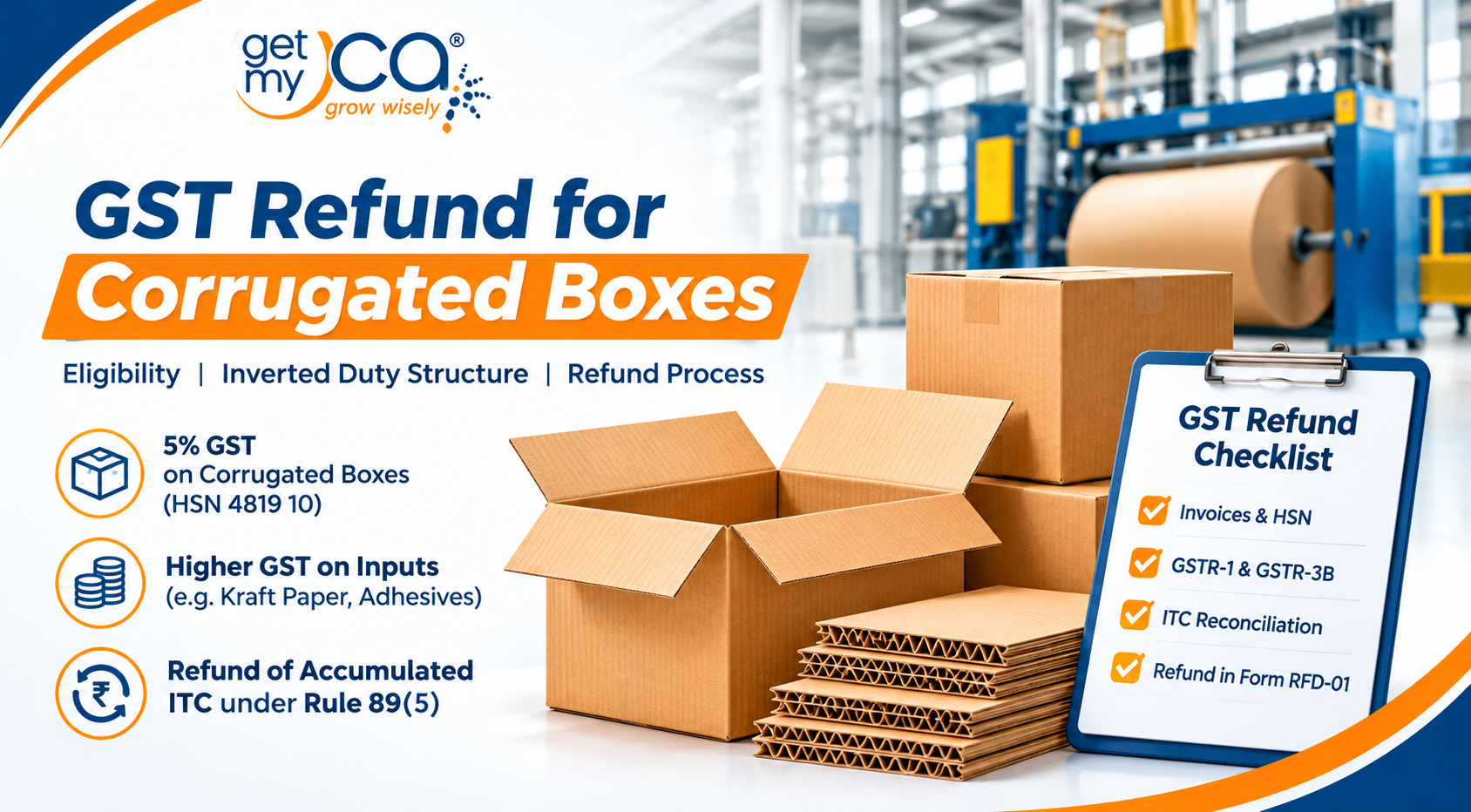
Packaging businesses manufacture a wide range of products, including corrugated cartons, folding boxes, paperboard cases and specialised packaging materials.
Although these products may appear similar, their classification and GST treatment can differ.
Manufacturers should therefore examine the nature of each finished product before calculating tax liabilities or preparing refund applications.
Accurate classification is particularly important where a business claims accumulated Input Tax Credit because of an inverted duty structure.
Why Do Packaging Products Require Separate Classification?
GST rates are determined using the relevant tariff headings, product descriptions and applicable notifications.
A manufacturer producing different packaging products should not automatically use one HSN code for every item.
The composition, construction and characteristics of the finished product may affect its classification.
For example, specified corrugated cartons, boxes and cases falling under heading 4819 10 attract 5% GST under the relevant rate provisions.
However, manufacturers must independently verify the classification of other paper and paperboard packaging products.
Incorrect classification can affect both sales invoicing and the calculation of GST liabilities.
How Does Product Classification Affect ITC Refunds?
An inverted duty structure may arise when eligible input goods attract a higher GST rate than the outward supplies.
Certain paper-based inputs may attract 18%, while specified corrugated boxes attract 5%.
This difference can lead to accumulated eligible ITC.
Manufacturers considering GST refund eligibility for corrugated boxes should first confirm whether their finished goods fall under the appropriate classification.
They should also review whether their particular refund category satisfies Section 54(3) and the applicable CGST Rules.
A rate difference alone does not establish the amount refundable.
The claim must follow the prescribed calculation and statutory restrictions.
What Happens When a Business Manufactures Multiple Products?
Some manufacturers produce corrugated boxes alongside other paper packaging products.
Different outward supplies may attract different GST treatments.
In these situations, the business should maintain product-wise records of taxable values and applicable rates.
The accounts team should avoid combining unrelated product categories merely for convenience.
Useful records include:
-
Product descriptions and specifications.
-
HSN-wise sales registers.
-
Applicable GST rate references.
-
Purchase invoices and input classifications.
-
Production and inventory records.
-
GSTR-1 and GSTR-3B reconciliation.
-
Relevant refund calculation workings.
These records can help identify whether the information reported in GST returns matches actual supplies.
How Can Manufacturers Prevent Classification Errors?
Businesses should review tax classifications when launching new products or changing packaging specifications.
Staff responsible for invoicing should use an approved product classification register.
Where classification questions are complex, businesses may seek GST advisory services for Indian manufacturers to review relevant statutory provisions and supporting records.
Regular internal checks can identify incorrect product codes before they affect several tax periods.
Conclusion
Accurate GST classification is essential for manufacturers producing different types of packaging.
Correct HSN treatment supports reliable tax invoices, GST return preparation and assessment of potential refund eligibility.
Manufacturers should review product classifications and relevant tax rules before submitting inverted duty refund claims.

 English
 Arabic
 French
 Spanish
 Deutsch
 Turkish
 Dutch
 Italiano
 Russian
 Romaian
 Portuguese (Brazil)
 Greek
