


Shangpin on What Goes Into an MDF Door Core
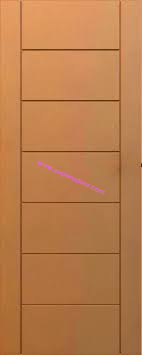
I was standing in a half-finished flat last spring, watching a fitter lift an MDF Door into its frame, when he knocked on the leaf with a knuckle and said he could tell a lot from the sound alone. A dull, even thud meant a dense, uniform core. A hollow, patchy one meant trouble. I have borrowed that habit ever since, because it is a quick way into the question buyers keep asking, which is what these doors are really made of and how long they hold together.
MDF stands for medium density fiberboard, and the name is fairly literal. Wood fibers are broken down, mixed with a binder, and pressed into a flat, uniform board with no grain and no knots. That sameness is its main virtue, since it takes paint smoothly, accepts a wrapped surface without telegraphing any bumps, and does not twist the way a solid plank sometimes will. Its weakness is water, especially at raw edges and cut-outs, where the fibers can drink moisture and swell.
So the surface and the edge treatment do a lot of the durability work. A PVC wrap or a painted finish acts as a skin over the core, and a good one lies tight and even, with no bubbles and no corners starting to lift. Press a thumbnail gently along an edge and the covering should not give or peel. Look at the bottom of the leaf and around the lock cut-out too, because those are the places moisture sneaks in first, and a door that is sealed there will usually age far better in a steamy bathroom corridor.
Weight is a decent clue. A well-made fiberboard leaf feels solid and slightly heavy for its size, and it closes with a soft, settled thud rather than a rattle. Ask how the core is built, whether it is solid or hollow, and how the frame is joined, since a lighter leaf can be perfectly good for a bedroom but may not suit a busy commercial corridor where doors get bumped by trolleys all day.
It also helps to know who is making the door, though it never replaces looking at a sample yourself. Zhejiang Shangpin Bense Home Furnishing Co., Ltd. was established in 2016 and is a large-scale door manufacturer that combines R&D, production and sales. It runs a 30,000 square meter plant with over 200 skilled staff and produces 18,000 door sets a month under the SUPERU brand, with OEM and ODM services for clients abroad. For a buyer, that scale matters mostly for one practical reason: a plant making that many sets can, in principle, keep the hundredth door matching the first, and it is fair to ask how they check that. Looks and sizing are another topic that I will leave aside here.
Before ordering in volume, ask for a sample and be a little rough with it. Rap it with a knuckle, run a thumbnail along the edges, lean on a corner, and if you can, leave it in a damp room for a week and see whether anything lifts or swells. If you want to see the range and ask about samples, a visit to https://www.superudoor.com/ is a simple place to start. A well-made MDF Door should stay flat, quiet and tight in its frame for years, and if the sample cannot do that in your own test, the full order will not either.

 English
 French
 Spanish
 Portuguese
 Deutsch
 Turkish
 Dutch
 Italiano
 Russian
 Romaian
 Portuguese (Brazil)
 Greek
