


How to Identify Manufacturing Bottlenecks Before They Affect Customer Deliveries
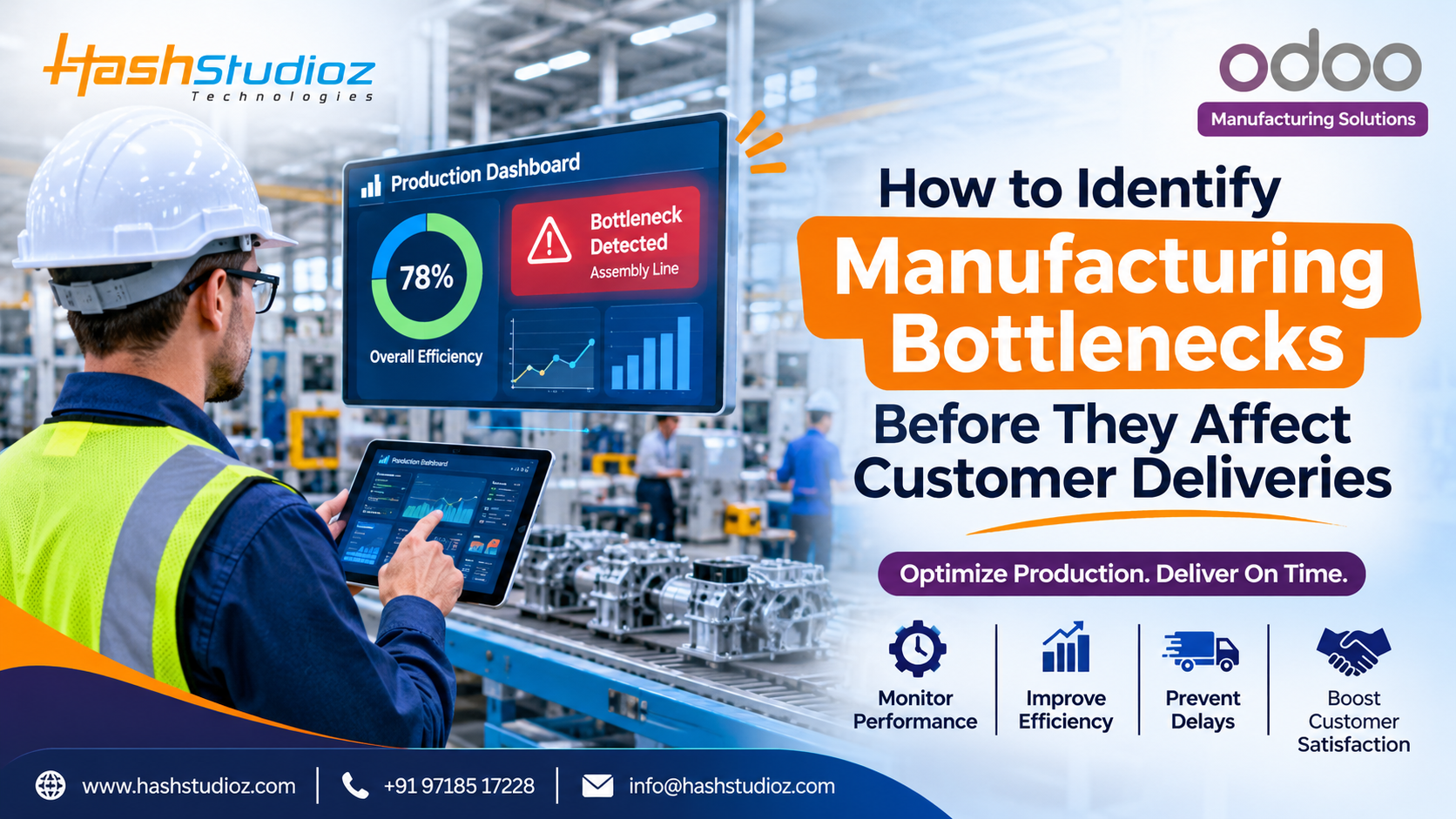
In manufacturing, meeting customer delivery deadlines depends on more than having enough workers, machines, and raw materials. Every production process involves multiple connected activities, from procurement and inventory management to manufacturing, quality inspection, and final dispatch. A delay in any one of these stages can affect the entire production schedule.
These delays often begin as small operational issues. A machine may take longer than expected to complete a task, raw materials may arrive late, or a production team may struggle to manage multiple orders simultaneously. When these problems go unnoticed, they can develop into serious manufacturing bottlenecks that affect productivity, increase operational costs, and delay customer deliveries.
The challenge is identifying these issues before they disrupt the production process.
With the right Odoo Manufacturing Consulting Services, businesses can identify production inefficiencies, monitor performance, improve resource allocation, and build a more reliable manufacturing workflow.
What Are Manufacturing Bottlenecks?
A manufacturing bottleneck is a stage in the production process that limits the overall output of a manufacturing operation.
It occurs when a particular machine, workstation, employee, or process cannot handle the required workload at the same speed as other production activities.
As a result, unfinished products begin accumulating, production schedules become delayed, and other departments may remain idle while waiting for the bottleneck operation to finish.
Common Examples of Manufacturing Bottlenecks
Some common examples include:
-
Machine limitations: A machine takes longer than expected to complete production tasks, slowing down the entire manufacturing line.
-
Material shortages: Production stops because essential raw materials or components are unavailable.
-
Workforce constraints: A shortage of skilled employees creates delays in specific production operations.
-
Quality control delays: Products remain waiting for inspection or approval before moving to the next stage.
-
Poor production planning: Unbalanced workloads and unrealistic schedules create unnecessary waiting time.
-
Inventory management issues: Incorrect stock information leads to procurement delays or production interruptions.
Identifying these problems early helps manufacturers maintain a consistent production flow and protect customer delivery commitments.
Why Identifying Manufacturing Bottlenecks Early Matters
Ignoring production bottlenecks can create problems across multiple business functions. What initially appears to be a small delay can eventually affect manufacturing capacity, operating costs, and customer satisfaction.
Here are some important reasons why early identification matters.
1. Prevents Customer Delivery Delays
Customers expect products to arrive according to agreed timelines. When production activities are delayed, delivery schedules become difficult to maintain.
Identifying bottlenecks early gives production managers enough time to adjust schedules, allocate additional resources, or arrange alternative production methods.
2. Reduces Manufacturing Costs
Production delays can increase labor expenses, machine operating costs, overtime requirements, and material wastage.
By identifying inefficient processes, manufacturers can improve resource utilization and avoid unnecessary operational spending.
3. Improves Production Capacity
A manufacturing facility may have sufficient equipment and employees but still struggle to meet production targets because one operation limits the entire workflow.
Finding and resolving that constraint allows businesses to improve output without immediately investing in additional machinery or infrastructure.
4. Improves Customer Satisfaction
Reliable production schedules lead to more predictable deliveries. When businesses consistently fulfill customer orders on time, they can build stronger relationships and improve customer confidence.
5. Supports Better Business Decisions
Production data helps managers understand where delays occur, which resources are underutilized, and what improvements are required.
Instead of relying on assumptions, businesses can make operational decisions based on measurable performance information.
Ways to Identify Manufacturing Bottlenecks Before They Affect Deliveries
Finding bottlenecks requires continuous monitoring of production activities rather than waiting until orders become overdue.
The following strategies can help manufacturing businesses identify problems before they become major disruptions.
1. Monitor Production Cycle Times
Production cycle time refers to the total time required to complete a specific manufacturing operation or produce a finished product.
When an operation consistently takes longer than its planned duration, it may indicate an underlying bottleneck.
Manufacturers should compare:
-
Planned production time.
-
Actual production time.
-
Waiting time between operations.
-
Machine setup and changeover time.
-
Time spent on rework or quality corrections.
Practical Example:
Suppose a manufacturing company produces 500 components daily. Its cutting operation takes 30 minutes per batch, while its assembly operation takes 60 minutes for the same quantity.
The assembly stage may become a constraint because it requires twice as much processing time.
By reviewing cycle-time data, managers can investigate whether additional resources, improved workflows, or equipment adjustments are necessary.
Using Odoo Manufacturing Solutions, businesses can organize work orders, track production operations, and compare planned activities with actual progress.
2. Identify Machines With High Utilization and Frequent Downtime
Machines play a critical role in manufacturing productivity. However, high utilization does not always mean efficient performance.
A machine operating continuously may still create a bottleneck if it frequently experiences breakdowns, requires lengthy setup periods, or cannot process materials quickly enough.
Manufacturers should monitor:
-
Machine operating hours.
-
Equipment downtime.
-
Maintenance frequency.
-
Production output per machine.
-
Setup and changeover duration.
-
Equipment availability.
Practical Example:
A manufacturing facility operates three machines on its production line. Two machines complete their assigned tasks efficiently, but the third frequently stops due to maintenance issues.
As unfinished products accumulate before the third machine, production slows down.
Monitoring machine performance helps managers identify the problem and schedule preventive maintenance before equipment failure causes major delays.
3. Track Work-in-Progress (WIP) Inventory
Work-in-progress inventory includes products that have entered production but have not yet reached the finished goods stage.
An unusually high WIP inventory level can indicate that products are waiting between production operations.
For example, if hundreds of components are waiting for assembly while the previous production stage continues generating more parts, the assembly process may be unable to keep up.
Manufacturers should examine:
-
WIP quantities at each workstation.
-
Production queue lengths.
-
Time products spend waiting.
-
Work orders that remain incomplete.
-
Differences between production input and output.
Odoo Manufacturing Consulting Services can help businesses structure production workflows and improve visibility into work orders and manufacturing stages.
With better production tracking, managers can identify where unfinished products accumulate and take corrective action.
4. Monitor Raw Material Availability and Inventory Levels
Material shortages are among the most common causes of production interruptions.
Even when machines and employees are available, manufacturing cannot continue without the required components and raw materials.
Businesses should regularly monitor:
-
Current inventory quantities.
-
Minimum stock levels.
-
Supplier lead times.
-
Material consumption rates.
-
Pending purchase orders.
-
Reorder requirements.
Practical Example:
A company receives an order for 1,000 electronic devices but has enough components to manufacture only 650 units.
If the shortage is identified early, the procurement team can arrange replenishment before production reaches the affected stage.
However, if the shortage remains unnoticed, the production schedule may be disrupted, resulting in delayed customer deliveries.
Odoo Manufacturing Solutions can connect inventory and manufacturing operations, helping businesses monitor material availability and plan replenishment more effectively.
5. Analyze Employee Workloads and Resource Allocation
Manufacturing productivity depends on having the right employees available at the right production stages.
Sometimes, a bottleneck occurs because one workstation has insufficient trained employees while another department has unused capacity.
Managers should evaluate:
-
Employee availability.
-
Workload distribution.
-
Skill requirements.
-
Task completion rates.
-
Shift schedules.
-
Time spent on repetitive activities.
Practical Example:
An assembly department has five employees, but only two are trained to operate a specialized production machine.
Even when other workers are available, the specialized workstation may become a production constraint.
Cross-training employees and improving workforce allocation can help reduce dependency on a limited number of workers.
6. Analyze Quality Control Failures and Rework
Quality problems can create hidden bottlenecks that affect production schedules.
Products that fail inspection may need additional testing, repairs, or complete reprocessing. This increases production time and consumes resources that could otherwise be used for new orders.
Manufacturers should track:
-
Defect rates.
-
Rejected product quantities.
-
Rework frequency.
-
Inspection turnaround time.
-
Common quality issues.
-
Production stages with repeated failures.
Practical Example:
A company manufactures 800 metal components daily, but 12% of its products require additional finishing because of inconsistent measurements.
This means a significant portion of production capacity is being consumed by rework.
By identifying the operation responsible for the defects, managers can investigate equipment calibration, employee training, or process adjustments.
Integrating quality checks into manufacturing workflows helps businesses identify recurring issues earlier and maintain consistent product standards.
7. Compare Production Performance With Delivery Commitments
One of the most effective ways to identify bottlenecks is to connect production performance with customer order deadlines.
Manufacturing teams should not evaluate production efficiency in isolation. They also need to understand whether current production capacity can support upcoming delivery commitments.
Important indicators include:
-
Orders awaiting production.
-
Planned versus actual completion dates.
-
Pending work orders.
-
Production capacity utilization.
-
Finished goods availability.
-
Orders at risk of missing delivery deadlines.
For example, if a business has 20 customer orders scheduled for delivery next week but only 12 have entered production, managers should investigate whether available capacity and material supply are sufficient.
This approach helps businesses prioritize urgent orders and take corrective action before delivery delays occur.
How Odoo Manufacturing Solutions Help Identify Production Bottlenecks
Managing production schedules, inventory, machines, and employee workloads through disconnected systems can make bottleneck identification difficult.
Odoo provides an integrated business management platform that helps manufacturers organize production activities and improve operational visibility.
With appropriate configuration and implementation, Odoo Manufacturing Solutions can support several important manufacturing functions.
1. Centralized Manufacturing Planning
Odoo Manufacturing helps businesses manage manufacturing orders, bills of materials (BoMs), work orders, and production operations.
Having manufacturing information in one system makes it easier for production teams to understand what needs to be manufactured, which materials are required, and what activities remain incomplete.
2. Work Center Management
Work centers allow manufacturers to organize production activities around specific machines, workstations, or operational areas.
Businesses can configure work center capacities, operations, and working schedules to support production planning.
This helps managers understand resource availability and identify production stages that may require additional attention.
3. Real-Time Inventory Visibility
Odoo Inventory works alongside manufacturing operations to provide visibility into stock quantities and material movements.
Businesses can monitor raw materials, components, and finished products while managing replenishment requirements.
This reduces the risk of production interruptions caused by unexpected material shortages.
4. Manufacturing Performance Tracking
Manufacturers can use production records, work order information, and operational reporting to evaluate manufacturing performance.
Depending on the configuration and available integrations, businesses can track production progress, equipment downtime, and operational efficiency.
These insights help managers investigate delays and identify opportunities for improvement.
5. Quality Management
Odoo Quality supports quality control processes through configurable quality checks and quality alerts.
Businesses can introduce inspection activities at relevant production stages, helping them identify defects before products move further through the manufacturing process.
6. Maintenance Planning
Equipment failures can create unexpected production delays.
Odoo Maintenance helps businesses organize preventive and corrective maintenance activities, track equipment-related requests, and improve maintenance coordination.
This supports better equipment management and reduces the risk of avoidable downtime.
Key Manufacturing KPIs to Monitor for Early Bottleneck Detection
Tracking the right performance indicators helps manufacturers understand whether production activities are operating efficiently.
Here are six important KPIs to monitor.
|
KPI |
What It Measures |
Why It Matters |
|
Production Cycle Time |
Time required to complete production |
Identifies slow operations |
|
Overall Equipment Effectiveness (OEE) |
Equipment availability, performance, and quality |
Highlights equipment inefficiencies |
|
Work-in-Progress (WIP) |
Unfinished products within production |
Identifies accumulating production queues |
|
On-Time Delivery Rate |
Percentage of orders delivered as scheduled |
Measures delivery reliability |
|
Defect Rate |
Percentage of products that fail quality standards |
Identifies quality-related delays |
|
Machine Downtime |
Time equipment remains unavailable |
Highlights equipment constraints |
Businesses should establish baseline measurements and review performance regularly.
A single KPI rarely explains the entire problem. For example, low equipment availability combined with increasing WIP may indicate that machine downtime is creating a production bottleneck.
Common Mistakes Manufacturers Should Avoid
Even businesses that monitor production regularly can overlook important warning signs.
Here are some mistakes that can make bottleneck identification less effective.
1. Focusing Only on Final Production Output
Looking at completed units alone does not explain where production delays originate. Businesses should also monitor individual operations and waiting times.
2. Ignoring Small Production Delays
Repeated minor delays can accumulate and eventually affect delivery schedules. Early investigation is more effective than waiting for a major disruption.
3. Using Disconnected Data Sources
When inventory, production, and procurement information are maintained separately, managers may struggle to identify the actual cause of delays.
4. Overlooking Preventive Maintenance
Waiting until equipment breaks down can create unnecessary production interruptions. Planned maintenance helps reduce avoidable failures.
5. Making Changes Without Analyzing Data
Increasing employee numbers or purchasing additional machines may not solve the actual problem. Businesses should first identify the production constraint and evaluate possible solutions.
Conclusion
Manufacturing bottlenecks rarely appear without warning. Increasing work-in-progress inventory, longer production cycle times, machine downtime, material shortages, and repeated quality issues are all signals that something may be slowing down production.
The key is identifying these warning signs before they affect customer delivery commitments.
By monitoring production performance, improving resource allocation, maintaining inventory visibility, and analyzing operational data, manufacturers can build more reliable and efficient production processes.
Implementing Odoo Manufacturing Solutions can further support these efforts by connecting manufacturing, inventory, maintenance, and quality management activities through an integrated platform.
With the right Odoo Manufacturing Consulting Services, businesses can configure their manufacturing operations around actual production requirements, improve process visibility, and make better operational decisions.

 English
 Arabic
 Spanish
 Portuguese
 Deutsch
 Turkish
 Dutch
 Italiano
 Russian
 Romaian
 Portuguese (Brazil)
 Greek
