


Spinal Decompression Therapy in Atlanta for Herniated and Bulging Discs: What It Can and Can't Do
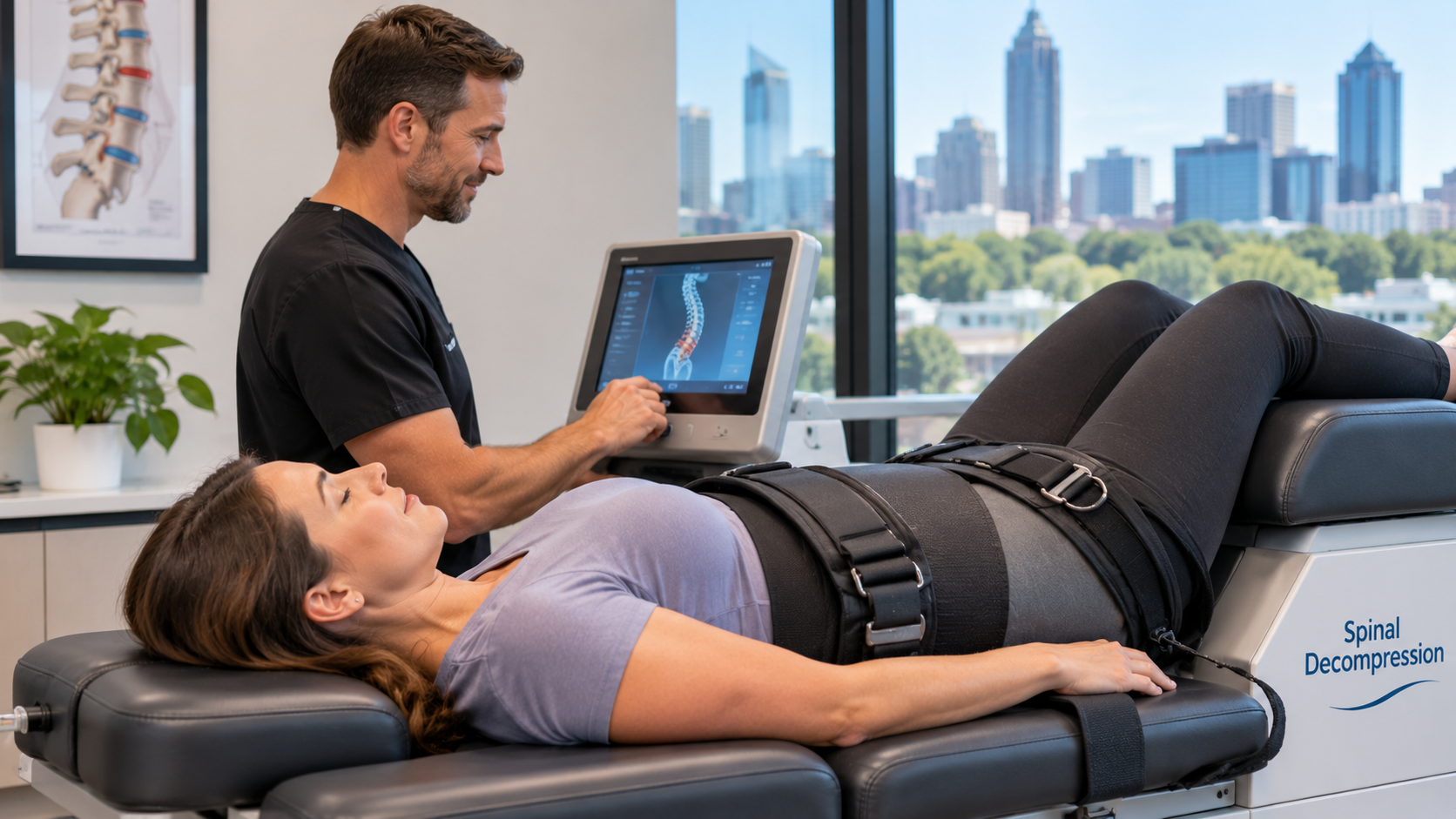
Spinal decompression therapy in Atlanta is a non-surgical treatment that uses a controlled, computer-guided table to gently reduce pressure within the spine, and it is most often considered for herniated discs, bulging discs and degenerative disc changes after a proper evaluation. It is one option in a care plan, not a guaranteed fix, and whether it suits you depends on your exam findings and health history.
The first time I heard the words "herniated disc," I pictured something dramatic, like a bone slipping out of place. The reality is quieter and, honestly, more confusing. You might have a dull ache in your lower back for weeks, then suddenly a sharp pain down one leg. Or a stiff neck that turns into tingling in your fingers. When I started reading about spinal decompression therapy in Atlanta, I wanted plain answers: what it is, who it is for, what it feels like and what the research honestly says.
That is what this post is. I'll explain what is happening inside a herniated or bulging disc, how decompression is meant to help, what a session looks like, who should be cautious, and how to judge whether it is working. I'll also be clear about where the evidence is strong and where it is still thin, because you deserve both sides before you commit to anything.
What is actually going on inside a herniated or bulging disc
A herniated disc happens when part of the soft, jelly-like center of a spinal disc pushes out through a tear in its tougher outer layer, and a bulging disc is when the disc's outer wall pushes outward without the center breaking through. Both can press on or irritate nearby nerves and cause pain, numbness or weakness.
Your spine is a stack of bones called vertebrae with a rubbery disc between each pair. Those discs act as cushions. Each one has a soft center and a firm outer ring. Over time, and sometimes after an awkward lift or twist, that outer ring can weaken.
According to Mayo Clinic, a herniated disk is most common in the lower back, often happens gradually as discs age and lose flexibility, and many people never find out exactly what caused it. Mayo Clinic also notes something I found reassuring: some people with a herniated disc have no symptoms at all, symptoms often improve over time, and most people do not need surgery.
So why does it hurt so much for some people? It comes down to where the disc material goes. If it presses on a nerve root, the pain can travel. A disc problem in the lower back can send pain into the buttock, thigh, calf or foot. A disc problem in the neck can send pain into the shoulder, arm or hand.
Herniated, bulging and degenerative: the differences in plain words
A bulging disc pushes outward evenly like a tire under pressure, a herniated disc has a tear that lets inner material escape, and degenerative disc changes are the gradual drying out and thinning of discs that comes with age and wear. All three can contribute to back or neck pain, but they are not the same problem.
Here is how I keep them straight:
- Bulging disc: the outer wall of the disc pushes out past its normal edge, usually over a wider area. The center stays inside.
- Herniated disc: the outer wall tears and part of the soft center pushes through. You may also hear "slipped disc" or "ruptured disc."
- Degenerative disc changes: discs lose water and height over time, which can narrow the space between vertebrae and make the spine stiffer.
These often overlap. A disc that has degenerated can be more likely to bulge or herniate. That is one reason a good evaluation matters. Two people can both say "I have a disc problem" and need very different plans.
How spinal decompression therapy is meant to work
Spinal decompression therapy is a non-surgical approach in which a patient lies on a specialized, computer-controlled table that applies gentle, varying pulling forces to a targeted area of the spine, with the goal of reducing pressure on discs and nerves and supporting better function. Settings are customized to the person's condition and comfort.
At Corrective Chiropractic, which has offices across metro Atlanta including Buckhead, Sandy Springs, Decatur and Marietta, decompression is described as a non-surgical approach designed to reduce pressure within the spine. Modern systems use controlled protocols that target specific areas and vary the forces applied during a session.
The general idea is easy to picture. When you sit or stand, gravity and body weight compress your spine all day. Decompression gently does the opposite, creating space between vertebrae in a slow, controlled way. Many clinics describe the hoped-for effect as easing pressure on a disc and the nerves around it.
I want to be careful here. The basic concept is simple, but the exact effect on any individual disc is not something anyone can promise. What I can tell you is what the clinic describes and what you can expect from the process. That leads to the most important part.
Who spinal decompression therapy may help
Spinal decompression is most commonly considered for herniated discs, bulging discs, degenerative disc changes, sciatica, radiating arm or leg pain, chronic lower back pain, chronic neck pain and certain types of nerve compression. Suitability always depends on the location and nature of the problem, your symptoms, your health history and your exam findings.
The conditions Corrective Chiropractic lists include:
- Herniated discs, bulging discs and degenerative disc changes
- Sciatica and radiating leg or arm pain
- Chronic lower back pain and chronic neck pain
- Spinal stiffness and limited mobility
- Certain types of nerve compression
- Pain linked to long periods of sitting or standing
- Numbness or tingling linked to nerve irritation
If you already know your problem is disc related, the clinic's page on herniated and bulging disc care is a useful next stop, because it explains how disc injuries are evaluated before any treatment is chosen.
In my experience, the people who seem most drawn to spinal decompression therapy in Atlanta are those who have already tried the usual things. Rest, stretching, pain relievers, maybe physical therapy or an injection. They got some relief, but the pain kept coming back. That pattern is exactly what the clinic says it is designed for.
Signs your back or neck pain may involve a disc
Pain that travels into the hip, leg, shoulder, arm or hand, pain that worsens with certain positions, recurring back or neck pain, and numbness or tingling are the main signs that a disc may be involved. These are worth a proper evaluation instead of guessing.
Here are the patterns I would pay attention to:
- Pain that shoots or burns down one leg or one arm.
- Pain that gets worse when you sit for a long time, cough or sneeze.
- Numbness or pins and needles in a hand, foot or part of a limb.
- Back or neck pain that settles, then returns every few weeks.
- Feeling weaker in one leg or dropping things with one hand.
Mayo Clinic notes that disc pain in the neck often shows up most in the shoulder and arm, and that the pain may feel sharp or burning and get worse with coughing, sneezing or certain movements. Most of the time, a herniated disc affects one side of the body.
Why Atlanta routines can be hard on your discs
Long commutes, desk jobs and weekend bursts of activity put repeated, uneven load on spinal discs, and that pattern is common in metro Atlanta. Sitting for hours compresses lower back discs, and sudden lifting or twisting on the weekend can push an already stressed disc too far.
Think about a normal week for a lot of people here. Forty minutes in traffic on GA-400 in the morning, eight hours at a desk in Midtown or Buckhead, another forty minutes home, then an evening on the couch. Mayo Clinic lists frequent driving as a risk factor for herniated discs, because long periods of sitting combined with vehicle vibration put pressure on the spine.
Then Saturday comes. You help a friend move apartments in Decatur, spend four hours on yard work in Marietta, or pick up a tennis racket for the first time in months. Your discs have spent five days being squeezed in one position, and now they are asked to bend, twist and lift.
None of this means you did anything wrong. It just explains why disc problems are so common, and why so many people start looking into spinal decompression therapy in Atlanta after a flare-up that seemed to come out of nowhere. The flare-up was usually the last step of a long pattern, not the first.
What helps is changing the pattern, not only treating the flare-up. That might mean a standing desk for part of the day, a lumbar cushion in the car, a short walk at lunch along the BeltLine or around the office, and easing into weekend projects instead of going all in. Your chiropractor can tailor these to your findings.
Red flags that need medical care first
Loss of bladder or bowel control, numbness in the inner thighs or groin area, worsening weakness in a leg, or severe pain after a fall or accident are red flags that need prompt medical care before any chiropractic treatment. These can signal serious nerve compression.
This is the part I never want anyone to skip. Mayo Clinic explains that, rarely, a herniated disc can press on the bundle of nerves at the base of the spine, and that this is a medical emergency. Signs include:
- Worsening pain, numbness or weakness that makes everyday activities hard
- Trouble controlling your bladder or bowels
- Numbness in the areas that would touch a saddle, such as the inner thighs and around the rectum
If any of these happen, go to an emergency department or call your doctor right away. Decompression is not a substitute for urgent care, and a responsible clinic will tell you the same thing.
What happens before your first decompression session
Before any spinal decompression session, a responsible clinic starts with a conversation about your symptoms and goals, a physical exam of your spine, posture and movement, and imaging when it is clinically appropriate. Only then is a personalized plan built.
Corrective Chiropractic describes a three-step process:
- Evaluation. A conversation about your symptoms, how they affect daily life, what you have already tried and what you want to achieve.
- Exam. A chiropractor examines your spine, posture, movement and function. Digital X-rays or additional spinal analysis may be recommended.
- Plan. If chiropractic care looks appropriate, a personalized care plan is developed.
I like this order because it puts safety and clarity first. A disc problem can look a lot like other problems, including muscle strain, joint irritation or nerve issues coming from somewhere else. The exam is where those get sorted out.
It is also fair to ask questions at this stage. What did the exam show? Why is decompression being recommended for me? What else will be part of the plan? Clear answers are a good sign.
What a spinal decompression session feels like
A typical spinal decompression session is gentle and controlled: you lie comfortably on a padded table, a harness or support is positioned for the targeted area, and the table slowly applies and releases a pulling force at settings matched to your condition and tolerance. Many people find sessions relaxing.
This is the part people worry about most, so here is what to expect based on how the clinic describes it:
- You lie on your back or stomach, depending on the area being treated.
- Straps or supports are positioned around your hips, torso or neck.
- The table applies a slow, gentle pull, then eases off, in cycles.
- You should feel a stretch, not sharp pain.
- Settings are customized, and you can tell the staff if anything feels off.
Session length varies by equipment and plan, and the staff should explain it beforehand. Some people scroll their phone or close their eyes. Others find it so relaxing they nearly fall asleep, which I think says a lot about how gentle it is meant to be.
How decompression fits into a bigger care plan
Spinal decompression therapy works best as one part of a plan that may also include chiropractic adjustments, posture and movement work, home exercises and habit changes, all reviewed against your starting point. It is rarely meant to be the whole answer on its own.
This is something I wish more people understood before they start. A disc problem usually has a story behind it: long hours of sitting, a job with lots of lifting, weak core muscles, poor posture or simply age-related wear. Decompression may ease pressure, but if the habits behind the problem stay the same, the problem can come back.
A good plan for spinal decompression therapy in Atlanta should answer:
- What other treatments will be combined with decompression?
- What exercises should I do at home?
- What daily habits should I change, at work, in the car or when lifting?
- When will we check progress, and how?
Mayo Clinic lists staying active, keeping a healthy weight, not smoking and using good lifting form as ways to lower the risk of a herniated disc. Those same habits help protect the progress you make during care.
What the evidence honestly says
Research shows that most herniated disc symptoms improve over time with conservative, non-surgical care, but large, high-quality studies on motorized decompression tables specifically are more limited than research on other conservative treatments. Results vary from person to person.
I think this needs saying plainly. Mayo Clinic notes that most people with a herniated disc do not need surgery and that symptoms often improve over time. Their page on herniated disk symptoms and causes is one of the clearest plain-language summaries I have found, and I would read it before any first appointment.
At the same time, I would be wary of anyone promising that decompression will "fix" a disc. The honest picture is that decompression is a reasonable, low-risk option some people choose as part of conservative care, and how well it works depends on the person, the problem and the rest of the plan. That is exactly why progress reviews matter.
My personal rule is simple: give a plan a fair trial, track your symptoms, and expect your provider to change course if nothing is improving.
Who should be cautious about spinal decompression
Anyone who is pregnant, has had spinal surgery or implants, has a fracture, tumor, infection, severe osteoporosis or another serious spinal condition, or has progressive weakness or red flag symptoms should be fully evaluated and speak with their doctor before decompression. Suitability is decided case by case.
The clinic's own page says suitability depends on your problem, symptoms, health history and exam findings. That is the right approach. These are the situations where I would make sure your doctor is part of the conversation:
- Pregnancy
- Previous spine surgery, rods, screws or fusion
- A recent fracture or injury from a fall or car accident
- Known or suspected tumor or infection
- Severe osteoporosis or other bone-weakening conditions
- Progressive weakness, bowel or bladder changes, or saddle numbness
Be honest during your history. The more your chiropractor knows, the safer and more useful your plan will be.
Questions to ask before starting decompression in Atlanta
Before starting spinal decompression therapy in Atlanta, ask what your exam showed, why decompression suits your case, how many sessions are expected, what else the plan includes, how progress will be measured and what happens if you do not improve. The answers show whether the plan is built around you.
My list:
- What did my exam and any imaging show?
- Why do you think decompression fits my problem?
- How long is each session, and how often will I come in?
- What else is part of my plan besides decompression?
- What should I avoid doing between sessions?
- When is my first progress review?
- What happens if my symptoms do not improve?
- Are there any reasons decompression is not safe for me?
You are not being difficult by asking. You are doing exactly what a careful patient should do.
Habits that help protect your discs between sessions
The habits that best protect your discs are breaking up long periods of sitting, lifting with your legs instead of your back, keeping your core strong, staying at a healthy weight and avoiding smoking. Small daily changes support whatever happens on the treatment table.
Here is what I would focus on:
- Move every 30 minutes. Sitting puts steady pressure on lower back discs. Stand, walk or stretch briefly.
- Lift smart. Bend your knees, keep the load close and avoid twisting while lifting.
- Build core strength. Ask your chiropractor for gentle exercises that suit your findings.
- Drive kindly. Mayo Clinic lists frequent driving as a risk factor, so use lumbar support and take breaks on long trips around I-285 or out of town.
- Sleep well. A supportive mattress and pillow matter more than people think.
None of this is glamorous, but it adds up.
How to tell if decompression is helping
You can tell spinal decompression is helping when radiating pain moves less far down the arm or leg, flare-ups become less frequent or shorter, numbness eases, and sitting, standing or sleeping becomes more comfortable. Compare these against your starting point at each progress review.
I like keeping a quick weekly note:
- Average pain on a 0 to 10 scale
- How far the pain travels (back only, buttock, thigh, below the knee)
- Any numbness or tingling, and where
- One daily task that felt easier or harder
- How long you can sit comfortably
Pain that moves back toward the spine and away from the limb is often described as a good sign. Pain that spreads further, or new weakness, should be reported right away. Either way, real notes make every progress review more accurate.
My honest take
Spinal decompression therapy in Atlanta is worth considering if you have a disc-related problem, you have tried the basics without lasting relief, and you want a non-surgical option inside a clear, evaluation-based plan. It works best when it is paired with good habits, honest progress reviews and a provider who screens carefully.
What I keep coming back to is this: disc problems often improve, and you have more options than surgery or living with it. Get properly evaluated, know the red flags, ask good questions and track how you feel. That puts you in control of the decision, whatever you end up choosing.
Frequently Asked Questions
1. What is spinal decompression therapy in Atlanta used for?
Spinal decompression therapy in Atlanta is most often considered for herniated discs, bulging discs, degenerative disc changes, sciatica, radiating arm or leg pain, chronic lower back pain, chronic neck pain and certain types of nerve compression, after a full evaluation.
2. Is spinal decompression therapy painful?
It is designed to be gentle. Most people feel a slow, controlled stretch rather than pain, and settings are adjusted to your condition and comfort. Tell the staff right away if anything feels sharp or wrong.
3. Can spinal decompression help a herniated disc?
It is commonly considered for certain disc conditions as part of a non-surgical plan. Results vary, and whether it suits you depends on where the disc problem is, your symptoms, your health history and your exam findings.
4. What is the difference between a bulging and herniated disc?
A bulging disc pushes outward while its outer wall stays intact. A herniated disc has a tear that lets part of the soft inner material escape, which may press on or irritate a nearby nerve.
5. How long does a decompression session take?
Session length depends on the equipment and your care plan. Your clinic should explain the length and how often you will come in before you start.
6. How many sessions will I need?
There is no fixed number. It depends on your condition, how long you have had it, your exam findings and how your body responds. A good plan includes regular progress reviews.
7. Who should not have spinal decompression?
People who are pregnant, have had spinal surgery or implants, or have fractures, tumors, infections, severe osteoporosis or red flag symptoms should be fully evaluated and speak with their doctor before decompression.
8. When should I go to the emergency room instead?
Seek urgent care for loss of bladder or bowel control, numbness in the inner thighs or groin area, or quickly worsening leg weakness. These can be signs of serious nerve compression.
9. Do I need X-rays before decompression?
Not always. Your chiropractor decides based on your history, exam and symptoms. Imaging is recommended when it would change the plan, such as ruling out other causes of your pain.
10. Do herniated discs get better without surgery?
Many do. Symptoms often improve over time with conservative, non-surgical care, and most people with a herniated disc never need surgery. Your provider can help you decide which options fit your situation.

 English
 Arabic
 French
 Spanish
 Portuguese
 Deutsch
 Turkish
 Italiano
 Russian
 Romaian
 Portuguese (Brazil)
 Greek
