


The Growing Importance of Data Center Security in the UAE
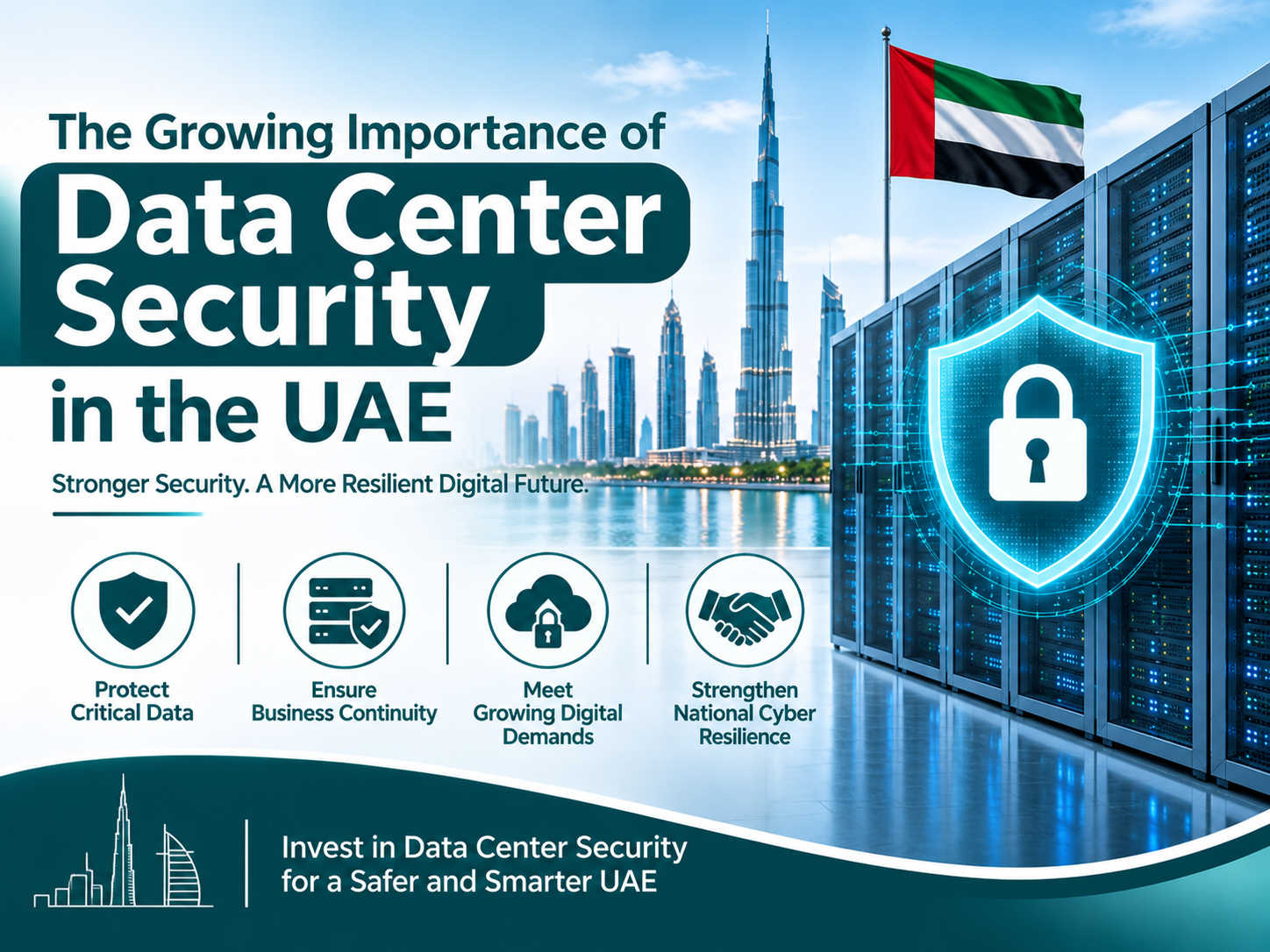
Strong Data Center Security has become a national priority as the UAE builds one of the most connected digital economies in the world. Every banking transaction, government service, cloud application and artificial intelligence workload depends on facilities that must stay secure, available and trusted. This guide explains why protection is growing in importance, which layers matter most, and how to choose the right partner.
A modern data center faces two kinds of attack at once. Intruders may try to cross the fence, tailgate through a door or tamper with equipment, while remote attackers probe networks, steal credentials and deploy ransomware. Effective protection treats physical and digital defence as one connected strategy.
Why Demand for Protection Is Rising Across the UAE
Several forces are pushing data center protection higher on every board agenda. Hyperscale and sovereign cloud investment is expanding capacity across the Emirates, artificial intelligence is driving denser and more valuable computing environments, and government digital transformation is moving critical services online. At the same time, cyber threats are growing in scale and sophistication.
• Digital growth: banking, healthcare, retail and government workloads are moving to local facilities.
• Data sovereignty: organisations increasingly want sensitive data stored and processed inside the country.
• Rising threats: ransomware, credential theft, insider misuse and supply chain attacks target high value sites.
• Availability expectations: customers expect continuous service, so even short outages carry heavy financial and reputational cost.
• Regulation: national and emirate level rules demand documented, auditable controls.
Threats Facing Data Centers Today
• Unauthorised entry: trespassers, tailgaters or impersonators trying to reach data halls or utility rooms.
• Insider misuse: staff or contractors with excessive access copying data or disrupting services.
• Ransomware and malware: attacks that encrypt systems and demand payment, often entering through stolen credentials.
• Denial of service: floods of traffic that overwhelm applications and network links.
• Supply chain compromise: tampered hardware, software updates or third-party access.
• Environmental and utility failure: power, cooling and fire events that expose weak monitoring and response.
A Layered Defence: Securing the Physical Environment
The strongest facilities follow a defence in depth approach, where each layer slows an intruder and gives staff time to respond. Layers typically run from the site boundary to the cage around a single rack: fencing and vehicle barriers, guarded gates, secure building entry, controlled corridors, protected data halls and locked cabinets. The following controls form the physical core.
Data Center Access Control
Data Center Access Control decides who may enter each zone and when. Leading sites combine cards or mobile credentials with biometrics such as face or fingerprint, mantraps that admit one person at a time, anti-tailgating sensors and visitor escorts. Every event is logged, so investigators can see exactly who entered a hall and at what time.
Data Center Surveillance
Data Center Surveillance provides the eyes of the security team. High resolution cameras cover the perimeter, car parks, entrances, corridors and data halls, while video analytics detect loitering, line crossing, abandoned objects and unusual activity at night. Recordings are retained according to policy and linked to door events so alarms can be verified in seconds.
Data Center Intrusion Detection
Data Center Intrusion Detection works at two levels. On the physical side, fence sensors, radar, thermal cameras, door contacts and motion detectors warn of attempted entry before a person reaches the building. On the network side, intrusion detection and prevention systems watch traffic for known attack signatures and suspicious behaviour. Combining both gives operators an early, accurate picture of what is happening.
Cybersecurity for Data Center Environments
Strong locks cannot stop a remote attacker, so Cybersecurity for Data Center operations must run alongside physical measures. Core practices include network segmentation, least privilege access, multi factor authentication for administrators, rapid patching, secure backups and tested incident response plans. Two technologies deserve particular attention.
Data Center Firewalls
Data Center Firewalls control which traffic may move between zones, applications and the internet. Next generation firewalls add deep packet inspection, application awareness, user identity and threat intelligence. Used with micro segmentation, they limit how far an attacker can move if one system is compromised, which is the heart of a zero-trust design.
Data Center Encryption
Data Center Encryption protects information even when other defences fail. Data should be encrypted at rest on storage and backup media, and in transit between servers, sites and users. Strong key management matters as much as the algorithm, so keys should be held in hardware security modules with clear rotation, separation of duties and recovery procedures.
Data Center Threat Detection and Response
Data Center Threat Detection turns raw logs and alarms into action. Security information and event management platforms collect data from firewalls, servers, access systems and cameras, then correlate it to spot patterns that individual tools would miss. Behaviour analytics and threat intelligence feeds highlight unusual logins, data movement or door activity, while a staffed security operations centre investigates alerts around the clock. Playbooks and regular drills ensure that teams respond quickly and consistently.
Data Center Security UAE: Regulatory and Regional Context
Operators in the country must meet a growing set of expectations. The UAE Personal Data Protection Law (Federal Decree Law No. 45 of 2021) governs personal data, while national cybersecurity strategy and information assurance guidance from the UAE Cybersecurity Council and the Telecommunications and Digital Government Regulatory Authority shape controls for critical infrastructure. Sector regulators, free zones and emirate programmes add further requirements. Many facilities also follow international references such as ISO/IEC 27001, SOC 2, PCI DSS, TIA 942 and Uptime Institute Tier standards to prove maturity to customers.
Data Center Security Dubai
A Data Center Security Dubai project must consider the standards of the Dubai Electronic Security Center and the needs of finance, logistics, aviation and free zone tenants. Dense commercial districts, high temperatures and strong dust loads also affect equipment choice, camera placement and perimeter sensor performance.
Data Center Security Abu Dhabi
A Data Center Security Abu Dhabi project often supports government, energy and institutional clients, with strong emphasis on data residency, resilience and integration with national platforms. Large campus sites need long perimeters, so reliable detection with few false alarms is a major design goal.
Operating Security Day to Day
Technology alone does not keep a facility safe. Success depends on disciplined operations: written procedures for visitors and deliveries, regular access reviews that remove unused credentials, scheduled testing of alarms, cameras and sensors, firmware and patch management, and routine drills for fire, intrusion and cyber incidents. Independent audits and penetration tests reveal weak points before attackers do, and clear reporting lets management see risk, performance and improvement over time. Staff training is equally important, because social engineering and careless behaviour remain common entry points for both physical and digital attacks.
Resilience planning completes the picture. Backup power, redundant cooling, diverse network routes and tested recovery plans ensure that a security incident or equipment fault does not turn into a prolonged outage. Security teams, facility managers and IT staff should rehearse these plans together so roles are clear when pressure is highest.
Experience, Expertise, Authority and Trust: What to Verify
A facility is only as dependable as the people who design and run its protection. Four proof points help buyers separate strong partners from risky ones:
• Experience: verifiable projects in mission critical sites, with references available on request.
• Expertise: engineers who understand perimeter technology, electronic security, networks and integration, not only equipment supplies.
• Authority: practices aligned with ISO/IEC 27001, Uptime Institute and TIA 942 guidance and the relevant UAE regulatory frameworks.
• Trust: transparent documentation, tested maintenance plans, clear service levels and secure handling of site information.
Choosing the Right Security Partner
• A risk assessment and site survey that covers the perimeter, buildings, halls and network zones.
• Detection technologies chosen for desert conditions, with low false alarm rates.
• Open integration between access control, video, alarms, network tools and the monitoring centre.
• Redundancy, backup power and fail-safe behaviour so protection continues during faults.
• Local support, spare parts, preventive maintenance and fast response commitments.
How Tektronix LLC Supports Mission Critical Sites
Tektronix LLC designs, supplies and supports electronic security for organisations across the UAE. Data center owners can explore our perimeter security solutions to see how detection, barriers, cameras and control rooms fit together, or speak with the Tektronix LLC team to plan a site survey and a phased deployment that protects critical infrastructure without disrupting operations.
Conclusion
Data Center Security and Cybersecurity for Data Center protect critical digital assets. Data Center Encryption and Data Center Firewalls defend every data path. Data Center Access Control and Data Center Surveillance guard every perimeter and room. Data Center Intrusion Detection and Data Center Threat Detection stop attacks early. Choose Data Center Security UAE, Data Center Security Dubai or Data Center Security Abu Dhabi.
FAQs
Q1. Why is Cybersecurity for Data Center as important as physical protection?
Physical barriers cannot stop remote attacks. Network controls, patching, authentication and monitoring protect the data and services that physical measures only house.
Q2. What should Data Center Encryption cover?
It should protect data at rest on storage and backups, and data in transit between servers, sites and users, with keys managed securely in hardware security modules.
Q3. How do Data Center Firewalls reduce the impact of a breach?
By segmenting the network and inspecting traffic between zones, they stop an attacker from moving freely from one compromised system to the rest of the environment.
Q4. What is the role of Data Center Intrusion Detection on the perimeter?
Fence sensors, radar, thermal cameras and door contacts provide early warning of attempted entry, giving security staff time to verify and respond before reaching the building.
Q5. What drives a Data Center Security Abu Dhabi project?
Data residency, resilience, integration with government and institutional systems and reliable detection across large campus perimeters are the usual priorities.

 English
 Arabic
 French
 Portuguese
 Deutsch
 Turkish
 Dutch
 Italiano
 Russian
 Romaian
 Portuguese (Brazil)
 Greek
