


What Does Current Mean And Why It Matters To Your Power Adapter?
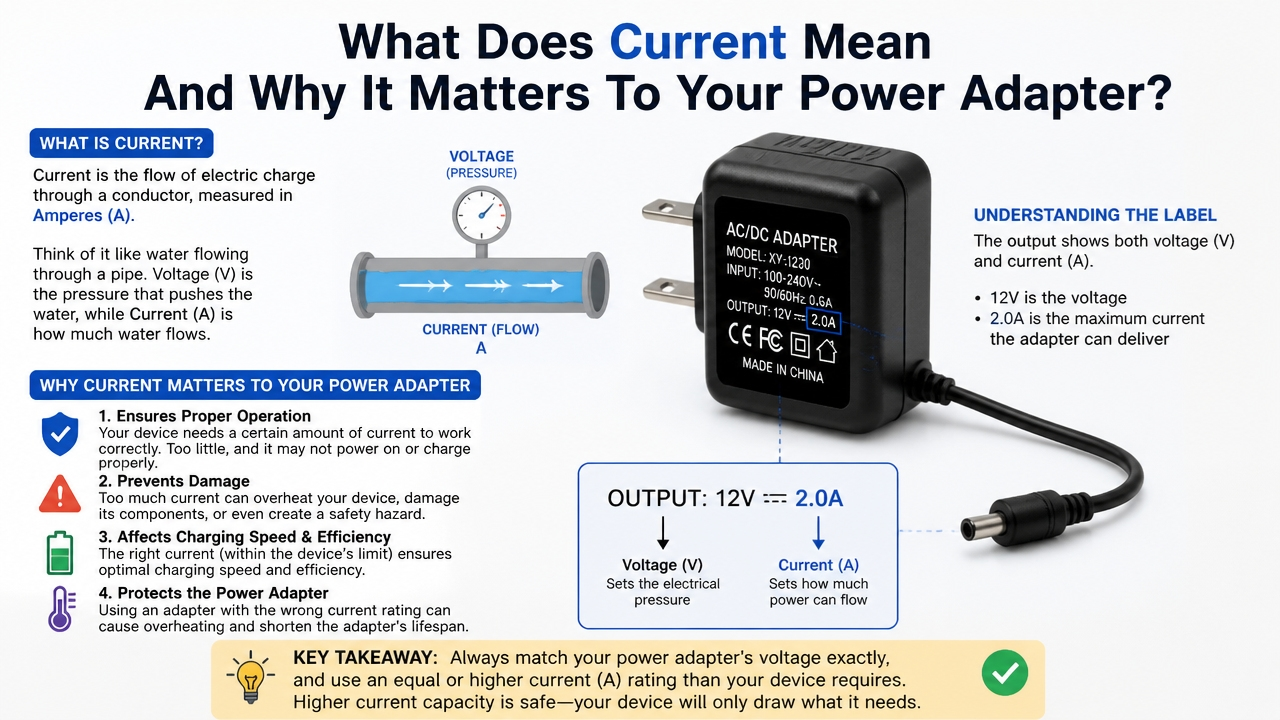
When selecting a power adapter or DC power supply, most people focus on voltage. It is easy to understand why: voltage is the number printed on the label and it seems to match what the device expects. However, current, measured in amps, is just as important and it is frequently misunderstood.
Current is the rate at which electrical charge flows through a circuit. In practical terms, for power adapters, current ratings tell you how much electricity the supply can safely deliver, not how much it forces into a device. Understanding this distinction is critical for choosing the right adapter and avoiding damage to your equipment.
What Is Current in Simple Terms?
Electric current is the flow of electrons through a conductor. It is measured in amperes, usually shortened to “amps” or represented by the letter “A.” One amp means one coulomb of charge passes a point in one second.
In a power supply circuit, current moves from the adapter, through the cable and into the device. The amount of current that flows depends on two things: the voltage supplied and the resistance or load of the device. This relationship is described by Ohm’s law: current equals voltage divided by resistance.
For a fixed voltage, a device with lower resistance will draw more current. A device with higher resistance will draw less. The adapter does not decide how much current flows; the device does.
The Volt-Amp Relationship
Voltage and current work together. Voltage is the electrical pressure that pushes charge around a circuit. Current is the amount of charge that actually moves. Think of a water system: voltage is the water pressure and current is the flow rate through the pipe.
A power adapter must supply both the correct voltage and enough current capacity for the device to operate. If voltage is too low, the device may not turn on. If voltage is too high, it can damage the device. If current capacity is too low, the adapter will overheat or shut down. If current capacity is too high, nothing bad happens, provided the voltage is correct.
Clearing Up the “Pushing Power” Misconception
A common misconception is that a higher amp rating will “push” more current into a device, causing it to run hotter or faster or even blow up. This is incorrect.
Current is drawn, not pushed. A device will only draw the current it needs based on its internal circuitry and the voltage applied. If an adapter is rated at 5 amps and the device only needs 1 amp, the device will draw 1 amp. The extra capacity in the adapter is simply unused headroom.
The confusion often comes from thinking about current like water pressure. A high-pressure pump can burst a pipe. But current is more like the diameter of a pipe: a wider pipe can carry more water, but it only carries as much as the tap opens. The device is the tap. The adapter is the pipe.
This is why using a 12-volt 5-amp adapter on a device that requires 12 volts and 1 amp is perfectly safe. The device draws 1 amp. The adapter is simply capable of supplying more if needed, which it will not be.
How Devices Draw Only What They Need
Electronic devices are designed to draw a specific amount of current at a given voltage. This is determined by the resistance and the active components inside the device. When you plug in a device, it presents a load to the power supply and current flows according to that load.
Consider a simple example. A laptop charger might be rated at 19 volts and 3.16 amps. The laptop does not always draw 3.16 amps. When the battery is full and the laptop is idle, it might draw less than 0.5 amps. When the battery is charging and the processor is under load, it might draw close to the full 3.16 amps. The charger supplies whatever the laptop draws, up to its maximum rating.
If the laptop requires more current than the charger can supply, the charger will overheat, the voltage may droop and the device may malfunction. If the charger supplies more current than the device needs, the excess capacity is simply unused.
Current and Power: Watts and the Bottom Line
Power, measured in watts, is the product of voltage and current. A 12-volt, 2-amp adapter supplies 24 watts. A 12-volt, 5-amp adapter supplies 60 watts. This matters because power is what actually does work in a device.
When a device has a power rating, such as 36 watts, you can check whether a supply is suitable by multiplying its voltage and current ratings. For example, a 12-volt supply must provide at least 3 amps to deliver 36 watts. Anything less will struggle or fail.
It is important to remember that the wattage rating of a power supply is a maximum, not a constant output. The supply will only deliver as much power as the device draws. But if the device tries to draw more than the supply’s maximum wattage, the supply will overheat.
Practical Examples of Choosing a Power Adapter
Example 1: Replacing a Plug Pack A device originally came with a 9-volt, 1-amp plug pack. The original supply has failed. The user finds a 9-volt, 2.5-amp plug pack. This is a safe replacement. The voltage matches and the higher current capacity is unused headroom. The device will still draw only what it needs.
Example 2: Upgrading a Power Supply A 5 volt device currently runs on a 1-amp supply. The device occasionally resets when drawing peak current. Upgrading to a 5-volt, 2-amp supply is appropriate. The higher current capacity stops the supply from hitting its limit. The voltage remains correct.
Example 3: The Dangerous Mismatch A user has a 24-volt device but picks up a 12-volt, 3-amp supply. The voltage is wrong. The device will likely not operate correctly and in some cases, it may attempt to draw excessive current, overheating the supply. Voltage mismatches are dangerous. Current mismatches, within reason, are not.
Common Mistakes to Avoid
Several mistakes are common when choosing power adapters:
-
Matching only the plug size. The physical connector is irrelevant if the electrical ratings are wrong.
-
Assuming higher amps mean more power output. The device controls the draw. A higher-rated adapter simply has more capacity in reserve.
-
Ignoring polarity. Many plug packs are centre-positive or centre-negative. Incorrect polarity can damage equipment or cause a short circuit.
-
Using an adapter with the same voltage but a lower amp rating. This can cause overheating and premature failure of the adapter.
-
Assuming all devices with the same voltage can share an adapter. Devices may have different internal protection, filtering requirements or load behaviours.
Why Current Ratings Matter for Safety
Current ratings are not just about performance; they are also about safety. A power supply that is overloaded will run hot. Over time, heat degrades components and can lead to failure, which may create a fire risk in poorly designed equipment.
Australian electrical standards require that power supplies be constructed to handle their rated load continuously, with margins for safety. Reputable suppliers, such as Campad Electronics who are offering DC power supplies for electronic equipment, ensure their products meet relevant safety requirements. Still, the user must select a supply with current capacity equal to or greater than the device’s demand.
How to Determine the Current Your Device Needs
The easiest way is to check the original adapter. It should list the output voltage and current. If the original adapter is missing, check the device itself. Many devices have a label near the power input stating the required voltage and current.
If the information is not available, look at the device’s power rating in watts. Divide the wattage by the voltage to get the required current. For example, a device rated at 18 watts requiring 12 volts will draw approximately 1.5 amps. Choose a supply rated at 2 amps or higher to leave some margin.
It is generally recommended to choose a power supply with a current rating that is at least 10 to 20 percent higher than the device’s maximum draw. This provides margin for inrush current, which can briefly be higher than steady-state draw and keeps the supply running cooler. See How Many Amps Do I Need in a Power Supply more further information.
When Higher Current Is Necessary
Some devices have brief periods where they draw much more current than their average. Motors, solenoids and radios with transmitters are examples. A motor might draw 2 amps when running but 6 amps for a fraction of a second when starting. If the power supply is only rated at 2 amps, it may struggle or shut down.
In these cases, a power supply with a higher current rating is essential. It is not “pushing” current into the motor. It is simply able to supply the moment of high demand without its output voltage collapsing.
The Role of Voltage Regulation
A well-designed switchmode power supply regulates its output voltage so that it remains stable even as the load current changes. If a device draws a sudden burst of current, a poorly regulated supply may experience a voltage drop. This can cause the device to reset or malfunction.
Higher-current supplies often have better regulation because they are designed for heavier loads. This is another reason why choosing a supply with a current rating above the minimum can improve reliability.
Summary
Current is the flow of electrical charge, measured in amps. In the context of power adapters, it represents the maximum amount of current the supply can safely deliver. It is not a force that pushes electricity into a device. Devices draw current according to their design and a higher-rated supply simply offers more headroom.
When choosing a power adapter, match the voltage exactly and ensure the current rating is equal to or greater than the device’s requirement. Do not be afraid of a higher amp rating, it is safe and often more reliable. Be mindful of polarity, connector type and the quality of the supply itself. Understanding these fundamentals will help you choose the right adapter the first time and avoid the common mistakes that lead to damaged equipment.
What does current mean in a power adapter?
Current, measured in amps, is the rate at which electrical charge flows through a circuit. For a power adapter, the current rating tells you the maximum amount of electricity the supply can safely deliver to a device. It is not the amount the adapter forces into the device.
Is a higher amp adapter dangerous for my device?
No. A device only draws the current it needs based on its internal circuitry and the supplied voltage. If the adapter is rated higher than the device’s requirement, the extra capacity is unused headroom. The device will draw the same current as it would with a lower-rated adapter, as long as the voltage matches.
What happens if I use an adapter with a lower amp rating than my device needs?
If the device tries to draw more current than the adapter can supply, the adapter will overheat, the output voltage may drop and the device may malfunction, reset or shut down. Continuous overloading can permanently damage the adapter and create a fire risk.
How do I know how many amps my device needs?
Check the original adapter label for output voltage and current. If it is missing, check the device’s label near the power input. If only the wattage is listed, divide the wattage by the voltage to get the required current. For example, 18 watts divided by 12 volts equals 1.5 amps.
Can I use a power adapter with the same voltage but a different plug size?
No. The physical connector must match the device’s input jack. Matching only the voltage and ignoring the plug size can result in a poor connection, short circuit or no power at all. Always ensure the connector fits securely and the polarity matches. See Selecting the Right Plug Size for Your DC Power Supply for tips on selecting the correct plug size.
What is the difference between current and voltage?
Voltage is the electrical pressure that pushes charge through a circuit, while current is the amount of charge that actually flows. Using a water analogy, voltage is water pressure and current is the flow rate through the pipe. A power adapter must supply both correctly. See What Is Voltage In A Power Supply for more information.
What is polarity and why does it matter?
Polarity refers to which part of the connector is positive and which is negative. Most adapters are either centre-positive or centre-negative. If the polarity is reversed, the device may be damaged, fail to operate or even short-circuit. Check the label on the device and adapter for the polarity symbol.
Should I choose an adapter with a current rating much higher than my device needs?
It is safe to choose an adapter with a higher current rating and it often improves reliability. A supply rated at least 10 to 20 percent above the device’s maximum draw runs cooler and handles brief inrush currents, such as those from motors or radios, without voltage drops.
What is the relationship between current, voltage and power?
Power in watts is calculated by multiplying voltage by current. For example, a 12-volt, 2-amp adapter supplies 24 watts. A device with a certain wattage requirement needs a supply whose voltage and current product meets or exceeds that number. The wattage rating is a maximum, not a constant output.
Why does my device draw less current at some times than at others?
Devices draw current based on their operating state. For example, a laptop draws less when idle or with a full battery and draws more when charging or under heavy processing load. The adapter supplies whatever the device draws, up to its maximum rated current.

 English
 Arabic
 French
 Spanish
 Portuguese
 Deutsch
 Turkish
 Dutch
 Italiano
 Russian
 Portuguese (Brazil)
 Greek
