


How to Calculate Concrete for Deck Footings
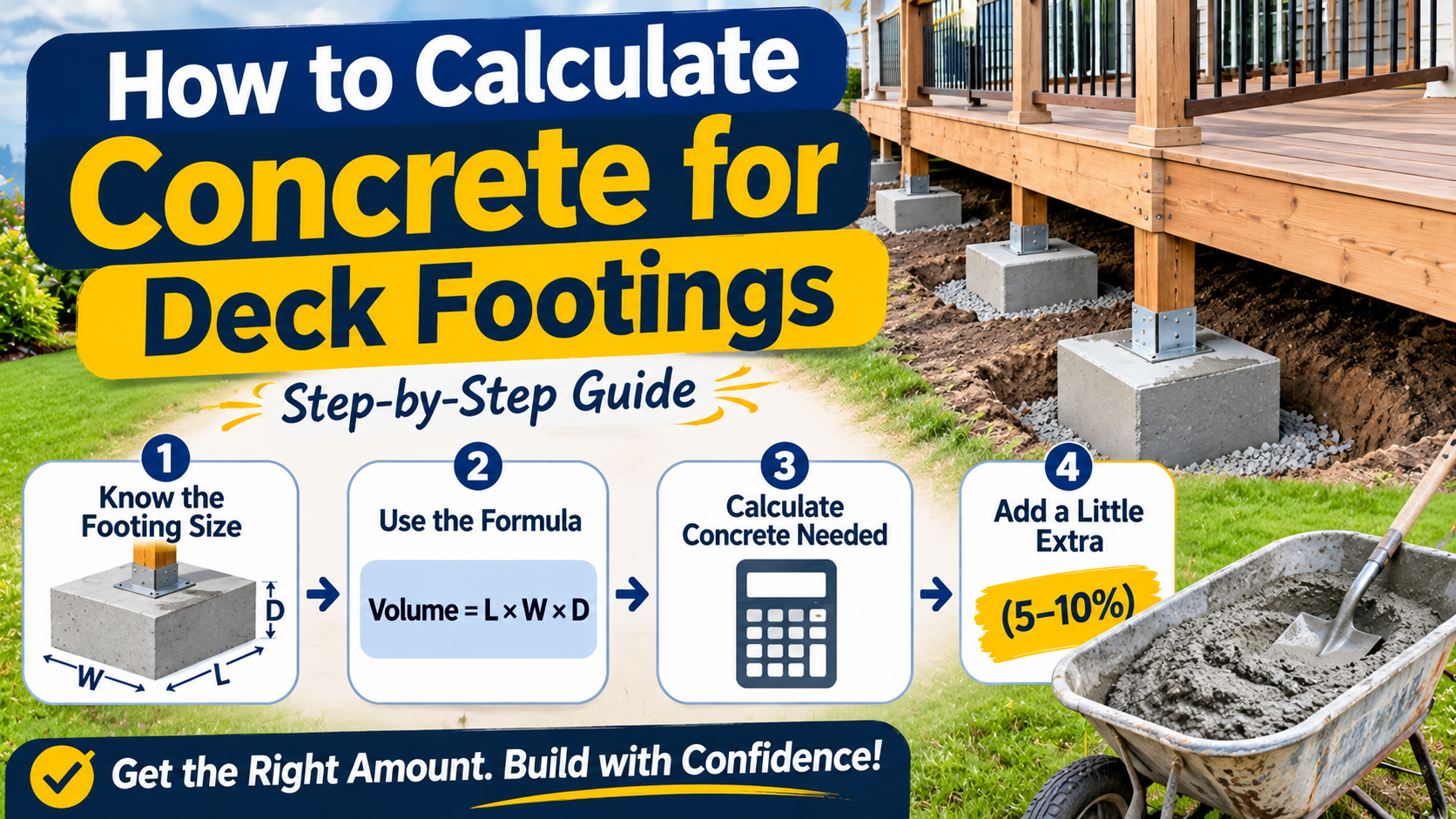
Ordering concrete for deck footings looks simple until you stand in the supply aisle. How many bags is that? Do you need a truck? What if the footings are different sizes? A short calculation answers all of it, and it only takes a few minutes.
If you want to check your numbers as you go, a concrete volume calculator can work out the volume for round forms of any diameter and depth. The steps below show what happens behind that number, so you can spot a mistake before you buy.
Step 1: Get the Footing Details First
You can’t calculate until you know three things for each footing: the shape, the size, and the depth. These come from your deck plans and your local building department, not from guesswork. Depth usually depends on the local frost line, and size depends on the load each post carries and the soil.
Write down the number of footings, too. Many decks use the same size throughout, but some mix sizes, for example larger footings under the beam ends. Keep a separate line for each size so the math stays clean.
Step 2: Round Footings (Tubes)
Most deck footings are round, poured into cardboard forming tubes. A round footing is a cylinder, so use the cylinder volume formula. Work in feet, which means converting inches by dividing by 12.
Volume = 3.14 x radius x radius x depth (all in feet)
The radius is half the diameter. For a 12 inch tube, the diameter is 1 foot, so the radius is 0.5 feet. At 4 feet deep, the volume is 3.14 x 0.5 x 0.5 x 4, which is about 3.14 cubic feet.
Step 3: Square or Rectangular Footings
Some footings are poured into square wooden forms or a dug square hole. For these, multiply length by width by depth, again in feet.
Volume = Length x Width x Depth
A square footing that is 2 feet by 2 feet and 1 foot deep holds 4 cubic feet. If your footing has a post pedestal on top of a wider pad, calculate the pad and the pedestal separately, then add them together.
Step 4: Wider Bases and Odd Shapes
Some footings flare out at the bottom to spread the load, often called a bell or belled base. The simplest way to handle this is to split the footing into parts. Treat the straight section as one cylinder and the flared bottom as a second, wider shape. Calculate each, and add them.
If the shape is awkward, round up. A slightly generous estimate is safer than running short in the middle of a pour.
Step 5: Multiply by the Number of Footings
Take the volume of one footing and multiply by how many you have. If you have different sizes, calculate each size, then add the totals.
Here’s a quick reference for round footings at 4 feet deep. Your depth may differ, so adjust the numbers for your plan.
| Tube Diameter | Volume per Footing | 60 lb Bags per Footing |
|---|---|---|
| 8 inches | About 1.4 cubic feet | About 4 |
| 10 inches | About 2.2 cubic feet | About 5 |
| 12 inches | About 3.1 cubic feet | About 7 |
| 16 inches | About 5.6 cubic feet | About 13 |
The bag counts assume a 60 pound bag yields about 0.45 cubic feet. Check the yield printed on your bags, since it varies by brand.
Step 6: Add a Waste Allowance
Holes are never perfectly round, soil crumbles, and some concrete stays in the wheelbarrow. Add about 10 percent to your total. For a deck with ten 12 inch footings at 4 feet deep, the total is about 31.4 cubic feet. Adding 10 percent brings it to roughly 34.5 cubic feet.
Round up to whole bags. A few extra bags cost very little compared with a footing that comes up short.
Step 7: Bags or Ready Mix?
For a handful of footings, bagged concrete is usually the practical choice. Divide your total volume by the yield per bag. For 34.5 cubic feet at 0.45 cubic feet per bag, you need about 77 bags. That’s a lot of lifting and mixing, so think about whether you can handle it.
For larger jobs, ready mix can be easier. A cubic yard is 27 cubic feet, so 34.5 cubic feet is about 1.3 cubic yards. Many suppliers charge extra for small loads, so ask about minimums and delivery fees. Compare the total cost of bags, tool rental, and your time against a delivered load before you decide.
Step 8: Check the Result
A good habit is to estimate the answer a second way. Take the average volume per footing, multiply by the count, and see if it matches your total. Also check your units, since mixing inches and feet is the most common reason an estimate comes out far too high or low.
Keep a small buffer in your plan for surprises, such as a hole that turns out deeper than expected because the soil was soft.
Common Mistakes to Avoid
The first is using the tube diameter as the radius, which makes the volume four times too big. The second is forgetting to convert inches to feet. A third is skipping the waste allowance and then running out partway through a pour.
Other frequent slips are leaving out the belled base, using the wrong bag yield, and ordering exactly what the math says with no cushion. Also remember that tubes sit in holes that may be wider than the tube, which can use more concrete if the form isn’t tight against the soil.
Final Thoughts
Calculating concrete for deck footings comes down to a short chain: get the footing size and depth from your plans, work out the volume of one footing, multiply by the count, and add a waste allowance. Then turn the total into bags or cubic yards.
Take a few minutes to double check the math and the units, and confirm the footing requirements with your building department. A careful estimate keeps the pour smooth and the budget on track.

 English
 Arabic
 French
 Spanish
 Portuguese
 Deutsch
 Turkish
 Dutch
 Russian
 Romaian
 Portuguese (Brazil)
 Greek
