


Global Green Methanol Fuel Market to Reach USD 36.90 Billion by 2034 at 35.0% CAGR
Global Green Methanol Fuel Market is gaining attention across the energy, maritime, chemical and transportation industries as companies seek lower-carbon alternatives to conventional fossil fuels. Green methanol is a low-carbon liquid fuel produced from renewable feedstocks such as municipal solid waste, agricultural residues, or through electro-synthesis using renewable hydrogen and captured carbon dioxide. Its ability to support decarbonization across marine transport, industrial processes and power generation is positioning it as an important component of emerging low-carbon fuel supply chains.
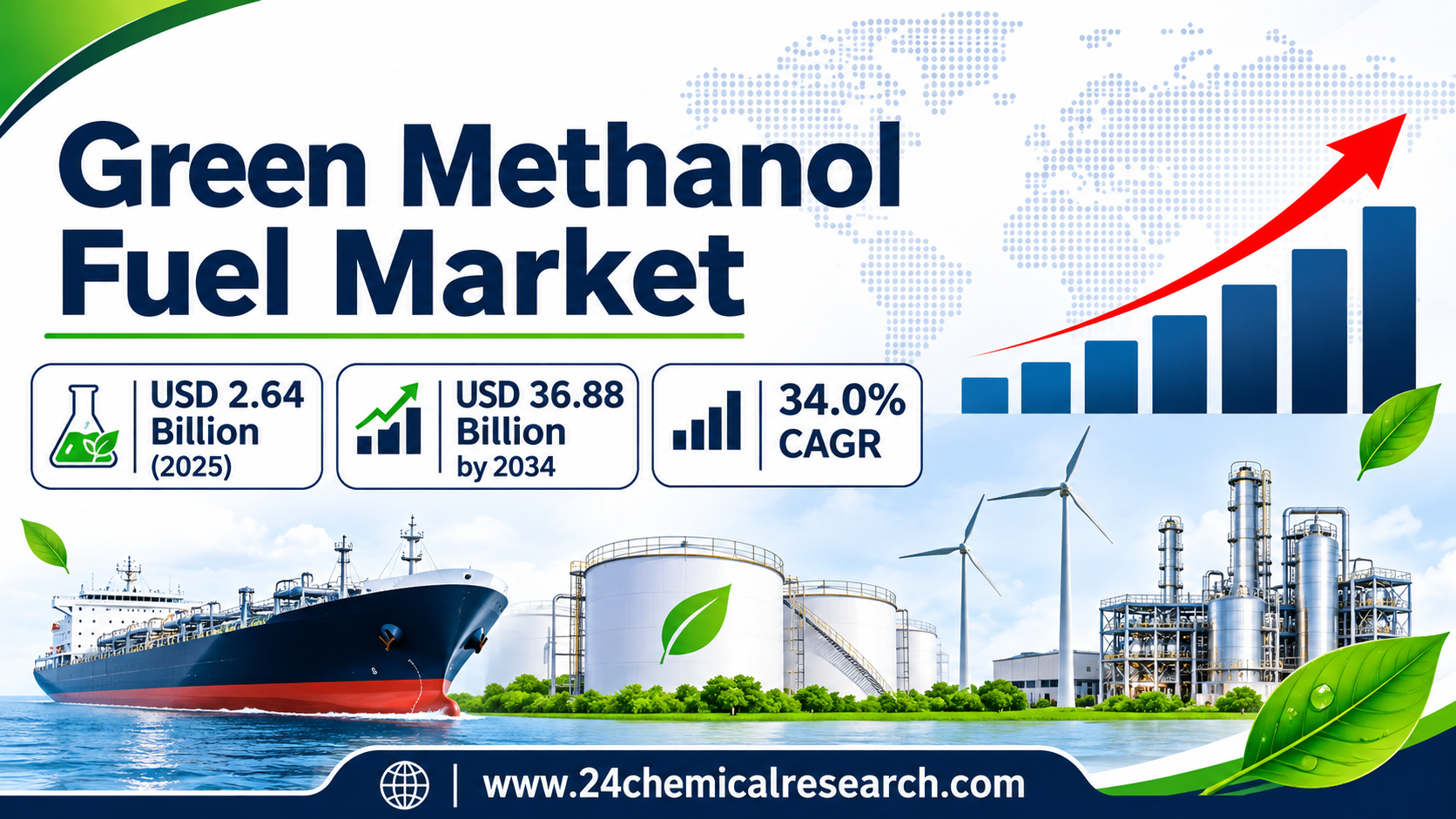
According to 24ChemicalResearch, the global green methanol fuel market was valued at USD 2.64 billion in 2025 and is projected to increase from USD 3.30 billion in 2026 to USD 36.90 billion by 2034, registering a CAGR of 35.0% during the forecast period. The market is being shaped by maritime decarbonization targets, expanding renewable hydrogen capacity, carbon-capture investments, technological advancements in electrolyzers and increasing demand for alternative fuels across industrial and energy applications.
Read the complete Global Green Methanol Fuel Market report:
https://www.24chemicalresearch.com/reports/289016/global-green-methanol-fuel-forecast-market
Green Methanol Fuel Market: A Low-Carbon Energy Industry in Transition
From a chemical-industry perspective, green methanol occupies an important position between renewable energy production and established chemical and fuel supply chains. It is produced through several pathways, including waste-sourced methanol, by-product-sourced methanol, biomass-derived methanol and e-methanol manufactured using renewable hydrogen and captured carbon dioxide.
The report identifies e-methanol as an important product category because it combines green hydrogen with captured carbon dioxide, supporting policy-driven decarbonization objectives. Waste-sourced and by-product-sourced production provide alternative feedstock routes, while biomass-derived methanol offers another pathway based on renewable biological materials.
Green methanol can deliver up to 80% lower greenhouse-gas emissions than conventional methanol. Its compatibility with existing fuel infrastructure and methanol-capable engines also supports its potential adoption across maritime, industrial and power-generation applications.
Marine fuel represents the leading application segment, supported by maritime emissions targets and the compatibility of methanol with existing dual-fuel engines. Shipping and logistics companies represent the leading end-user category.
What Is Driving Green Methanol Fuel Market Growth?
One of the strongest demand drivers is the accelerating shift toward low-carbon mobility. Governments worldwide are strengthening emissions-reduction requirements, encouraging transportation operators and industrial users to explore alternative fuels.
The maritime sector is particularly important because shipping companies are increasingly evaluating methanol as an alternative to conventional marine fuels. Methanol's compatibility with dual-fuel engines and its zero-sulphur characteristics make it relevant to operators seeking to meet stricter environmental requirements.
Another important growth driver is the expansion of green methanol production technology. Improvements in electrolyzer efficiency and biogas fermentation technologies are helping reduce input energy requirements and production costs.
Integrated carbon-capture systems combined with renewable electricity can provide the feedstock required for green methanol synthesis. Modular production plant designs also offer greater flexibility, allowing facilities to scale according to regional resource availability.
Tightening emissions-trading frameworks and increasing attention to lifecycle emissions assessments are further encouraging fuel purchasers and industrial companies to consider low-carbon alternatives.
Production Chemistry and Technology Remain Important
The manufacturing economics of green methanol are closely connected to renewable hydrogen availability, carbon dioxide capture, feedstock sourcing and production technology.
E-methanol production combines renewable hydrogen with captured carbon dioxide to produce methanol through a synthetic pathway. This approach is particularly relevant to regions with renewable electricity resources and established carbon-capture infrastructure.
Biomass-derived methanol and waste-sourced production provide alternative routes that support circular-economy objectives by utilizing renewable biological materials and waste streams.
The report highlights improvements in electrolyzer efficiency, biogas fermentation technologies and integrated carbon-capture systems as important developments in the industry.
Modular plant designs can reduce initial capital requirements and support flexible deployment across different geographical markets. These technological improvements are helping producers develop more efficient supply chains and address the growing demand for low-carbon fuels.
High Production Costs and Feedstock Availability
Like many emerging renewable fuel markets, green methanol production economics are influenced by the availability and cost of key inputs.
Green hydrogen production requires substantial investment in electrolyzers and renewable electricity infrastructure. These requirements can increase manufacturing costs compared with conventional fossil-based methanol.
The report also identifies limited availability of high-grade renewable electricity in certain production regions as an important cost consideration.
Access to captured carbon dioxide is another important factor. Carbon-capture facilities and associated infrastructure require significant investment, while feedstock availability can influence production capacity and geographical expansion.
For producers, renewable energy procurement, carbon-capture partnerships and efficient plant utilization remain important considerations in improving production economics.
Where Are the Chemical and Energy Industry Opportunities?
North America and Asia-Pacific represent important emerging opportunities for green methanol producers and suppliers.
In North America, the growing fleet of LNG-converted vessels and automotive hybrid programs creates opportunities for green methanol as an alternative or complementary fuel. Renewable energy incentives and investments in maritime infrastructure can further support regional development.
In Asia-Pacific, China's expanding polymer and chemical industries are creating opportunities for green methanol as a lower-carbon industrial feedstock. Its potential use in plastics, fertilizers and other chemical manufacturing processes supports demand beyond fuel applications.
Both regions are increasingly aligning policy frameworks with carbon-neutrality objectives. Incentives, preferential tariffs and renewable energy investments are creating opportunities for manufacturers to expand production and establish regional supply chains.
The maritime industry also provides opportunities through the development of methanol bunkering facilities, dedicated storage infrastructure and methanol-compatible vessels.
Green Methanol Fuel Market Segmentation
The report evaluates the global green methanol fuel market across type, application and end user, providing an overview of demand patterns and production pathways.
By type, the market includes:
-
Waste-Sourced
-
By-Product Sourced
-
Biomass-Derived
-
E-Methanol (Renewable Hydrogen & Captured CO2)
E-methanol represents an important segment because it combines renewable hydrogen with captured carbon dioxide, supporting comprehensive carbon-reduction objectives. Waste-sourced and by-product-sourced production offer circular-economy advantages and diversify feedstock availability.
Biomass-derived methanol provides another renewable production pathway, utilizing biological feedstocks to support lower-carbon fuel production.
By application, the market covers:
-
Marine Fuel
-
Aviation Fuel Blending
-
Road Transportation
-
Power Generation
Marine fuel represents the leading application segment because of maritime emissions targets and the compatibility of methanol with dual-fuel engines.
Aviation fuel blending offers an additional opportunity as airlines and fuel producers explore alternative pathways toward lower-carbon aviation fuels.
Road transportation utilizes methanol's fuel characteristics, while power generation applications benefit from its potential integration into hybrid energy systems.
By end user, the market includes:
-
Shipping & Logistics Companies
-
Chemical & Petrochemical Industry
-
Automotive Manufacturers
-
Energy Utilities
Shipping and logistics companies represent the leading end-user category, supported by maritime decarbonization requirements and fleet modernization strategies.
The chemical and petrochemical industries utilize methanol as a feedstock for olefins, formaldehyde and polymer precursors. Automotive manufacturers are exploring methanol-based fuel cells and modified internal combustion technologies.
Energy utilities also represent an important end-user segment through the potential integration of methanol into hybrid energy portfolios.
Review the report's complete segmentation, methodology and selected market analysis:
https://www.24chemicalresearch.com/reports/289016/global-green-methanol-fuel-forecast-market
Regional Green Methanol Fuel Market Outlook
Europe
Europe holds the leading position in the global green methanol fuel market. The region benefits from comprehensive policy frameworks, renewable hydrogen investments, carbon-capture facilities and developing methanol bunkering infrastructure.
The European Union's Fit for 55 package, hydrogen strategy and low-carbon certification framework support the development of renewable fuel production and adoption.
Countries including Denmark, Germany, the Netherlands and Sweden are important participants in the development of green methanol production facilities and related supply chains.
The availability of renewable electricity, particularly offshore wind, also supports green hydrogen production and the expansion of e-methanol manufacturing.
North America
North America represents an important emerging market, supported by federal and state-level incentives for renewable hydrogen, electrolyzer deployment and carbon-capture projects.
The United States is attracting investments in green methanol production, particularly in Texas, California and the Midwest, where renewable energy resources and industrial infrastructure support project development.
Canadian provinces are also exploring renewable energy resources, including wind, solar and hydropower, for dedicated e-methanol production facilities.
Public-private partnerships and renewable energy incentives are helping strengthen the regional production ecosystem.
Asia-Pacific
Asia-Pacific is an emerging region for green methanol production and consumption. Increasing investment in renewable energy generation and industrial decarbonization is creating opportunities for new production facilities.
China's polymer and chemical industries provide potential demand for green methanol as a sustainable industrial feedstock.
Major ports in Singapore, Shanghai and Mumbai are also evaluating methanol bunkering infrastructure to support the adoption of alternative marine fuels.
Japan and South Korea are developing certification and regulatory frameworks to support the adoption of methanol-compatible technologies across shipping and industrial applications.
Other Emerging Markets
South Africa and Gulf countries are also exploring opportunities in the green methanol value chain.
Renewable hydrogen investments, port infrastructure development and public-private partnerships are supporting the evaluation of green methanol production and distribution projects.
Gulf states are particularly interested in developing renewable hydrogen infrastructure and utilizing their strategic maritime positions to participate in low-carbon fuel supply chains.
These developments create opportunities for regional producers and international suppliers seeking to expand into emerging markets.
Competitive Landscape: Global Chemical Producers and Green Fuel Suppliers
The global green methanol fuel market is characterized by established chemical and energy companies alongside specialized renewable fuel producers.
The report identifies OCI Global, Methanex Corporation, Enerkem, Carbon Recycling International, BASF, Mitsubishi Gas Chemical, Södra, European Energy and Nordic Green among the key industry participants.
OCI Global's BioMCN facility in the Netherlands represents an important production platform for biomass-derived methanol, with developments in e-methanol supporting its low-carbon portfolio.
Methanex Corporation benefits from its established methanol production and distribution infrastructure and is expanding its involvement in lower-carbon methanol supply.
Enerkem focuses on converting non-recyclable municipal waste into bio-methanol through gasification technology, connecting renewable fuel production with waste-management initiatives.
Carbon Recycling International demonstrates the potential of e-methanol production through carbon capture and renewable hydrogen integration.
European Energy is developing e-methanol production capacity by combining captured industrial carbon dioxide with renewable hydrogen.
Södra, Nordic Green and Mitsubishi Gas Chemical are also participating in the development of green methanol production and related commercial initiatives.
The competitive environment is increasingly influenced by production scale, renewable feedstock access, carbon-capture technology, long-term supply agreements and the availability of maritime distribution infrastructure.
Emerging Market Trends in Green Methanol Fuel
Growing Adoption in the Maritime Sector
The shipping industry has emerged as a primary driver of green methanol adoption. The report identifies more than 200 IMO-approved vessels equipped for methanol-blend operation and projected shipping-fuel volumes exceeding 350,000 metric tonnes by the end of 2025.
The ability to integrate methanol into compatible dual-fuel engines and the development of bunkering facilities are supporting wider commercial interest.
Ports including Rotterdam, Singapore and Hamburg are important locations for developing methanol bunkering infrastructure.
Rising Policy Incentives in Europe and the United States
Government incentives are helping reduce the financial burden associated with green methanol production projects.
The European Union's Renewable Energy Directive and the United States Inflation Reduction Act provide support for renewable hydrogen production, electrolyzer capacity and carbon-capture installations.
These policy developments are encouraging investment in production capacity and supporting the development of regional low-carbon fuel supply chains.
Widespread Electrolyzer Deployment
Improvements in electrolyzer technology are supporting the development of more efficient green hydrogen production systems.
Modular electrolyzer units can be integrated with variable renewable electricity sources, improving production flexibility.
When combined with carbon-capture technologies, these systems provide the essential inputs for e-methanol manufacturing.
Investment in next-generation production facilities across Denmark, Germany and the United States is supporting the development of larger-scale green methanol supply.
Challenges Facing Green Methanol Manufacturers
High production costs remain one of the principal barriers to wider green methanol adoption. Electrolyzers, renewable electricity systems and carbon-capture facilities require significant capital investment.
Infrastructure development is another important challenge. Existing fuel distribution networks are primarily designed for conventional fuels, meaning methanol adoption requires investment in dedicated storage, transportation and bunkering facilities.
Regulatory uncertainty also affects the market. Different definitions and certification requirements for green methanol across geographical markets can create difficulties for producers and fuel purchasers.
Limited feedstock availability and the need for reliable renewable electricity supplies further influence production economics.
These factors make technological improvements, infrastructure investment, supportive policies and long-term commercial partnerships important to the industry's future development.
What Does the Green Methanol Fuel Market Report Cover?
The 112+ page Green Methanol Fuel Market study provides an analysis of the global and regional market from 2025 through 2034, including market size, sales volume, revenue forecasts, competitive positioning, production pathways, product segmentation, application analysis and regional performance.
The study examines key manufacturers, company profiles, product specifications, production capacity, sales, revenue, pricing, gross margins, market developments and competitive positioning.
It also covers historical market data from 2020 to 2025, production methods, cost structure, key end users, planned projects, industry news, mergers and acquisitions, regional consumption, exports and imports.
For chemical manufacturers, fuel producers, shipping and logistics companies, energy utilities, investors and business-development professionals, the study provides a framework for assessing demand, production opportunities, supply-chain development and the evolving low-carbon fuel market.
Key Questions Answered by the Study
The Green Methanol Fuel Market report addresses questions such as:
-
What is the current global green methanol fuel market size?
-
How rapidly is the market expected to grow through 2034?
-
What is the projected market value by 2034?
-
Which green methanol production pathways are covered?
-
What role does e-methanol play in the market?
-
Which applications generate the strongest demand?
-
Why does marine fuel represent the leading application?
-
Which end-user industries are driving market demand?
-
What are the major opportunities in North America and Asia-Pacific?
-
Which companies are competing in the global market?
-
How are renewable hydrogen and carbon-capture technologies influencing production?
-
What role do electrolyzers play in green methanol manufacturing?
-
What are the major infrastructure and regulatory challenges?
-
Which regions are leading green methanol production and adoption?
Explore the complete Green Methanol Fuel Market analysis, forecast and competitive landscape:
Read the Full Green Methanol Fuel Market Report:
https://www.24chemicalresearch.com/reports/289016/global-green-methanol-fuel-forecast-market
Discover key trends and download the report now:
https://www.24chemicalresearch.com/download-sample/289016/global-green-methanol-fuel-forecast-market
About 24 Chemical Research
24 Chemical Research specializes in chemical and materials market intelligence, covering specialty chemicals, polymers, surfactants, advanced materials and related industrial markets. Its research combines market sizing and forecasting with analysis of production, capacity, pricing, trade flows, applications, suppliers, regional demand and competitive positioning.
Contact 24 Chemical Research
Phone: +91 9169162030
Email: help@24chemicalresearch.com
Website: www.24chemicalresearch.com

 English
 Arabic
 Spanish
 Portuguese
 Deutsch
 Turkish
 Dutch
 Italiano
 Russian
 Romaian
 Portuguese (Brazil)
 Greek
