


Why Thales Key Management Is Important for Businesses Managing Sensitive Digital Assets
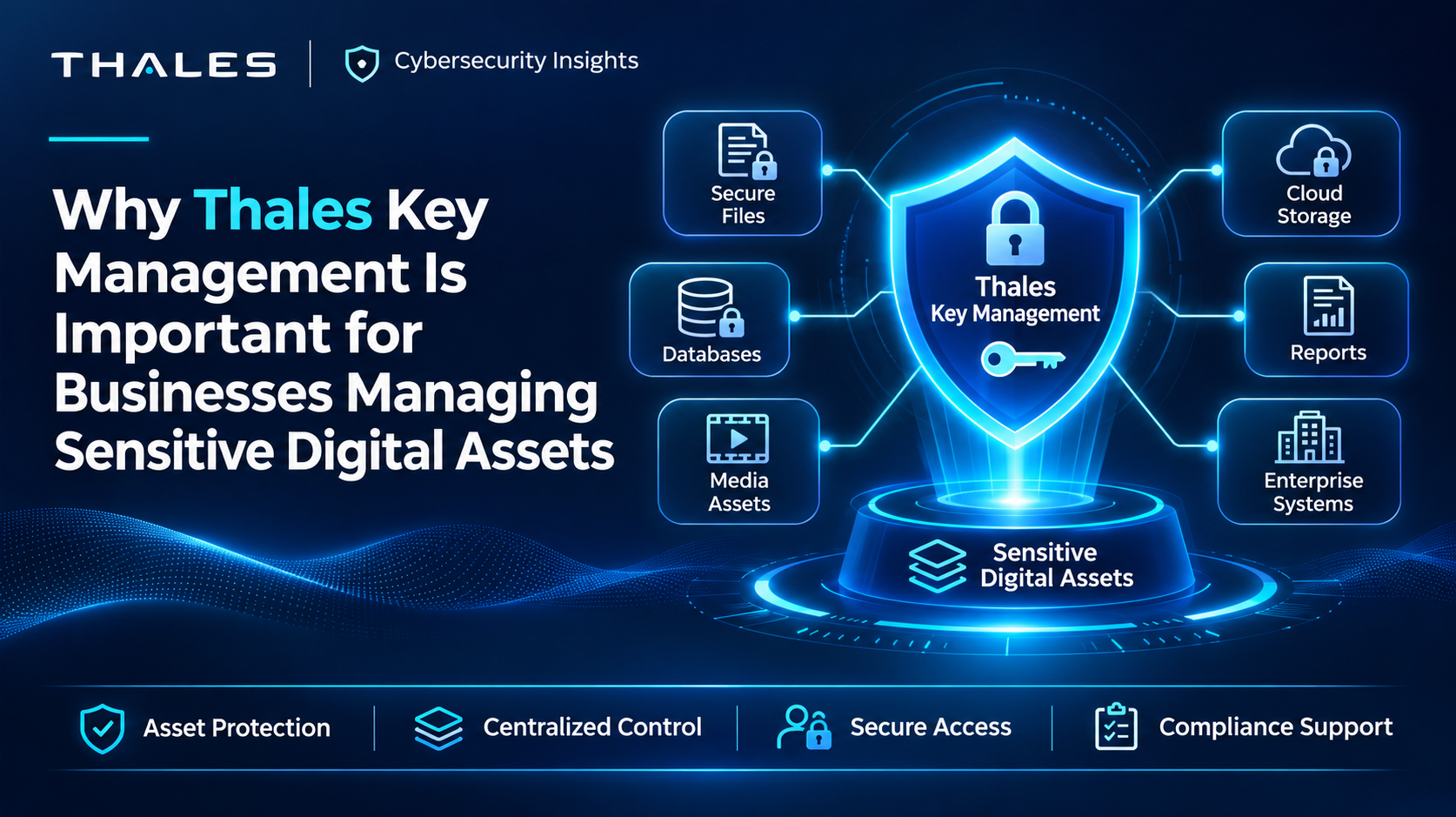
Excerpt:
Businesses increasingly depend on digital assets such as customer records, intellectual property, financial information, databases, and cloud workloads.
Thales key management can help organizations establish centralized control over the cryptographic keys protecting these assets.
Effective Key management improves visibility, access control, lifecycle management, and governance across sensitive digital environments.
Introduction
Digital assets have become essential to modern business operations.
Organizations store customer information, financial records, intellectual property, business documents, application data, databases, and other valuable information across digital environments.
Protecting these assets requires multiple security controls.
Encryption provides an important layer of protection by transforming readable information into an encrypted format. However, cryptographic keys control access to encrypted information.
If businesses do not manage these keys properly, they may create security gaps even when they use strong encryption technologies.
This makes Key management an important component of enterprise data security.
Thales key management can support organizations that need centralized capabilities for managing cryptographic keys across complex IT environments.
What Are Sensitive Digital Assets?
Sensitive digital assets include information that could create significant business, financial, operational, or reputational impact if unauthorized users access it.
Examples include:
-
Customer information
-
Financial records
-
Employee data
-
Intellectual property
-
Business strategies
-
Transaction information
-
Database records
-
Cloud workloads
-
Application data
Organizations should identify and classify these assets before defining encryption and Key management requirements.
Why Encryption Alone Is Not Enough
Encryption protects information by making it unreadable without the appropriate cryptographic process.
However, the cryptographic key remains critical.
An attacker who gains unauthorized access to a key may potentially weaken the protection provided by encrypted data.
Organizations should therefore protect keys independently from the data they secure.
Understanding Key Management in Cryptography
Key management in cryptography covers the lifecycle of cryptographic keys.
A typical lifecycle includes:
-
Generation
-
Storage
-
Distribution
-
Access
-
Usage
-
Rotation
-
Backup
-
Recovery
-
Revocation
-
Retirement
-
Destruction
Businesses should establish clear policies for each stage.
Thales Key Management
Thales key management can help organizations establish centralized control over cryptographic keys across enterprise environments.
Centralized management can support:
-
Key lifecycle management
-
Access control
-
Key rotation
-
Key ownership
-
Monitoring
-
Recovery
-
Governance
The specific architecture should match the organization's infrastructure, applications, and security requirements.
Protecting Digital Assets Across Cloud Platforms
Businesses increasingly distribute workloads across cloud platforms.
A company may store customer information in one cloud environment, operate applications in another, and maintain critical databases on-premises.
This creates complex cryptographic requirements.
A centralized Key management strategy can help organizations maintain consistent policies across these environments.
Managing Key Access
Not every employee or application should have access to every cryptographic key.
Organizations should apply least privilege.
For example, a customer service application may need access to customer-related encryption operations but should not receive access to keys protecting financial systems.
Restricting permissions reduces unnecessary exposure.
Protecting Application Data
Applications process sensitive information every day.
Organizations may encrypt:
-
Customer records
-
Application databases
-
Cloud storage
-
Backup data
-
Internal files
The associated encryption keys should remain under controlled management.
Developers should avoid placing keys directly in application code.
Protecting Database Information
Enterprise databases often contain highly sensitive information.
Organizations may use encryption to protect records at rest.
Key management should control the keys associated with database encryption.
Security teams should track:
-
Key ownership
-
Database dependencies
-
Access permissions
-
Rotation schedules
-
Recovery procedures
Managing Cloud and Hybrid Environments
Hybrid environments combine cloud and on-premises infrastructure.
A business may operate an on-premises ERP system while running customer applications in the cloud.
Both environments may rely on cryptographic keys.
Centralized management can help security teams maintain consistent policies.
Key Rotation
Cryptographic keys should follow defined lifecycle requirements.
Businesses may rotate keys based on:
-
Key age
-
Risk
-
Data sensitivity
-
Internal policy
-
Security requirements
-
Suspected compromise
Rotation should be carefully planned to avoid disrupting applications.
Key Revocation
Organizations may need to revoke keys when they become compromised or no longer serve a valid purpose.
Revocation procedures should define:
-
Who can revoke a key
-
How dependent applications are identified
-
How replacement keys are generated
-
How affected systems are updated
-
How the event is documented
Protecting Key Backups
Key backups require strong security controls.
If a backup contains sensitive cryptographic keys, unauthorized access to the backup may create additional exposure.
Organizations should restrict backup access and test recovery procedures.
Monitoring Cryptographic Activity
Security teams should monitor important events, including:
-
Key creation
-
Key access
-
Key rotation
-
Key revocation
-
Administrative changes
-
Failed access attempts
-
Key retirement
Monitoring can help organizations detect unusual activity.
Managing Digital Certificates
Digital certificates establish trusted identities for applications, websites, APIs, devices, and services.
The private keys associated with certificates require strong protection.
Organizations should monitor certificate expiration, renewal, replacement, and retirement.
Supporting Governance
Centralized Key management can help organizations establish clearer governance.
Security teams can maintain records related to:
-
Key ownership
-
Access permissions
-
Lifecycle status
-
Rotation history
-
Administrative activity
This information can support internal security reviews.
Common Challenges
Key Sprawl
Businesses may accumulate large numbers of cryptographic keys.
Fragmented Management
Different teams may use different Key management processes.
Excessive Access
Applications may receive unnecessary key permissions.
Poor Inventory
Organizations may not know which keys protect specific assets.
Manual Administration
Manual processes can create operational errors.
Best Practices
Businesses should:
-
Identify sensitive digital assets
-
Maintain a complete key inventory
-
Assign key ownership
-
Apply least privilege
-
Separate keys from protected data
-
Establish rotation policies
-
Define revocation procedures
-
Monitor cryptographic activity
-
Protect backups
-
Test recovery
-
Retire obsolete keys
-
Review access regularly
Conclusion
Digital assets represent valuable resources for modern businesses and require strong protection.
Encryption provides an important security layer, but cryptographic keys require dedicated lifecycle management.
Thales key management can support centralized control over cryptographic keys across cloud, on-premises, and hybrid environments.
Key management in cryptography provides the framework for managing keys from generation through destruction.
By implementing effective Key management, organizations can improve visibility, access control, rotation, revocation, recovery, and governance while strengthening the protection of sensitive digital assets.

 English
 Arabic
 French
 Spanish
 Portuguese
 Deutsch
 Turkish
 Dutch
 Italiano
 Russian
 Romaian
 Portuguese (Brazil)
