


CEP Exam Breakdown: How I Moved From “Just a Trainer” to Clinical Confidence
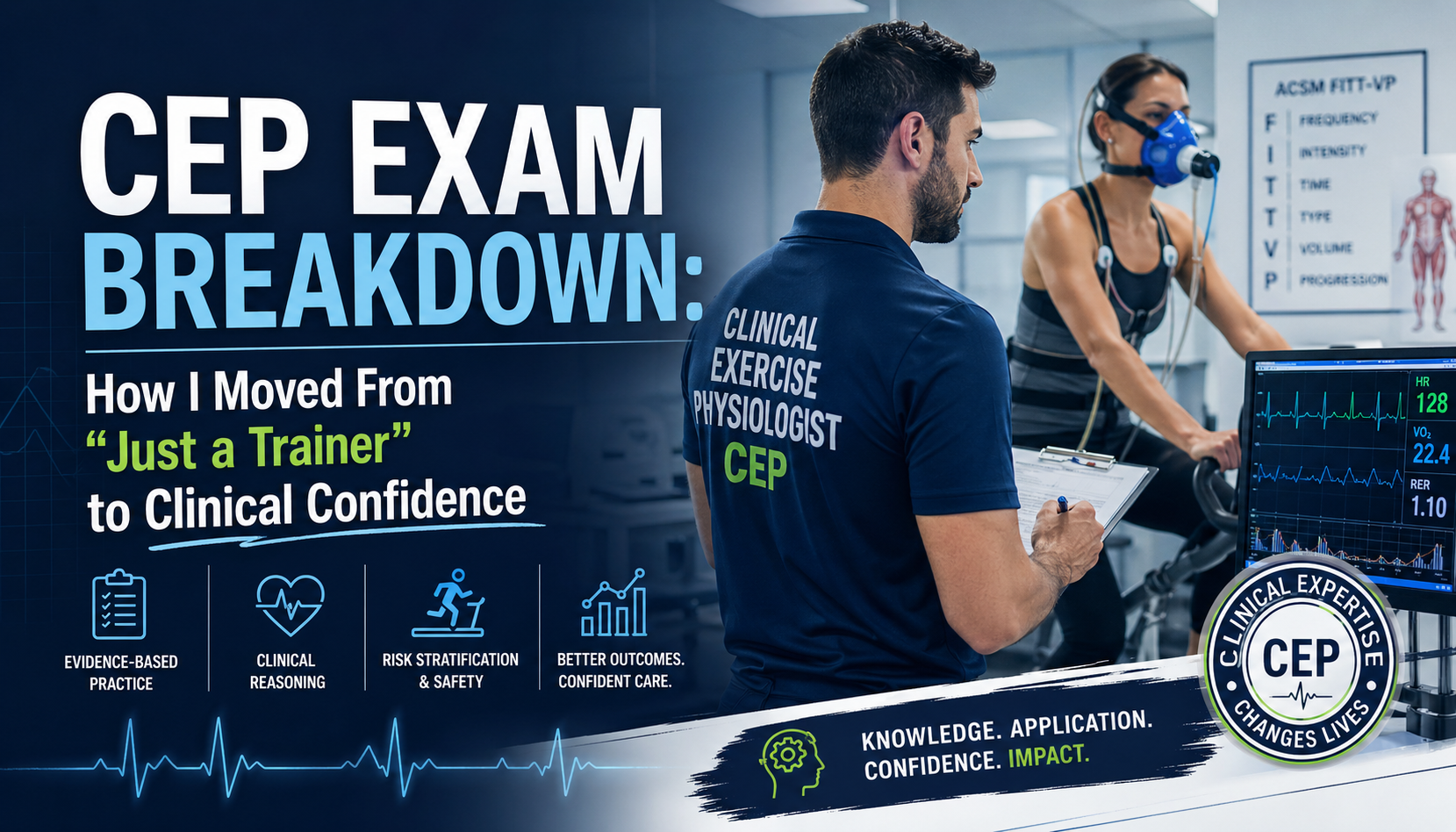
The CEP Exam (Clinical Exercise Physiologist certification assessment) is often misunderstood as a simple credentialing step for exercise professionals. In practice, it functions more as a competency filter that distinguishes general fitness practitioners from clinicians capable of working in cardiac, pulmonary, and metabolic rehabilitation settings. This article examines how the exam reshapes professional identity, particularly the transition from “trainer thinking” to clinically grounded decision-making, and why that shift matters for long-term practice quality.
The CEP Exam as a Clinical Competency Threshold
At its core, the CEP Exam evaluates applied physiological knowledge, risk stratification, exercise testing interpretation, and clinical judgment under constraint. Unlike fitness certifications that emphasize programming and performance optimization, this exam prioritizes patient safety, pathology-informed reasoning, and evidence-based intervention design.
The most underestimated aspect is not content complexity but cognitive reframing. Candidates must move from asking “What improves performance?” to “What is safe, indicated, and therapeutically appropriate given comorbid conditions?” This reframing is what creates the first real separation between fitness instruction and clinical exercise physiology.
From Trainer Logic to Clinical Reasoning
The transition is less about memorization and more about replacing instinctive programming habits with structured clinical reasoning. For example, intensity prescription is no longer based on general fitness heuristics but on diagnostic data such as VO₂ response, ECG interpretation context, and medication effects on heart rate.
This shift often exposes a gap: trainers are accustomed to variability and adaptation, while clinical environments demand justification and risk awareness. Developing clinical confidence requires learning to defend every exercise decision using physiological evidence rather than experience alone.
Preparation Strategy and the Role of Practice-Based Learning
Effective preparation for the exam rarely comes from passive study alone. High-performing candidates rely heavily on CEP practice test questions to simulate decision pressure and identify gaps in clinical logic application. These questions are particularly valuable when they mirror case-based reasoning rather than isolated fact recall.
Many candidates also use a Clinical Exercise Physiologist (CEP) free practice test as an initial diagnostic tool. While limited in depth, it helps establish baseline familiarity with exam structure and identifies weak domains such as ECG interpretation or pharmacological interactions. The most effective strategy is iterative: test, analyze errors, and reframe understanding through applied clinical scenarios.
Clinical Confidence Beyond Certification
Passing the exam does not automatically produce clinical confidence; rather, it validates a mindset already beginning to form during preparation. True confidence emerges when practitioners consistently apply structured reasoning under real patient variability. Over time, decision-making becomes less about recalling guidelines and more about integrating physiological principles into adaptive care planning.
Conclusion
The CEP pathway is less a knowledge test and more a professional transformation. It reshapes how exercise professionals interpret risk, structure interventions, and justify decisions in clinical environments. The most meaningful outcome is not certification itself but the development of disciplined clinical thinking that extends far beyond the exam setting.

 English
 Arabic
 French
 Spanish
 Portuguese
 Deutsch
 Turkish
 Dutch
Dutch
 Italiano
 Russian
 Romaian
 Greek
Greek
