


Domus Washing Machine for Business: Which Capacity Makes Sense for Your First 100 kg of Daily Laundry?
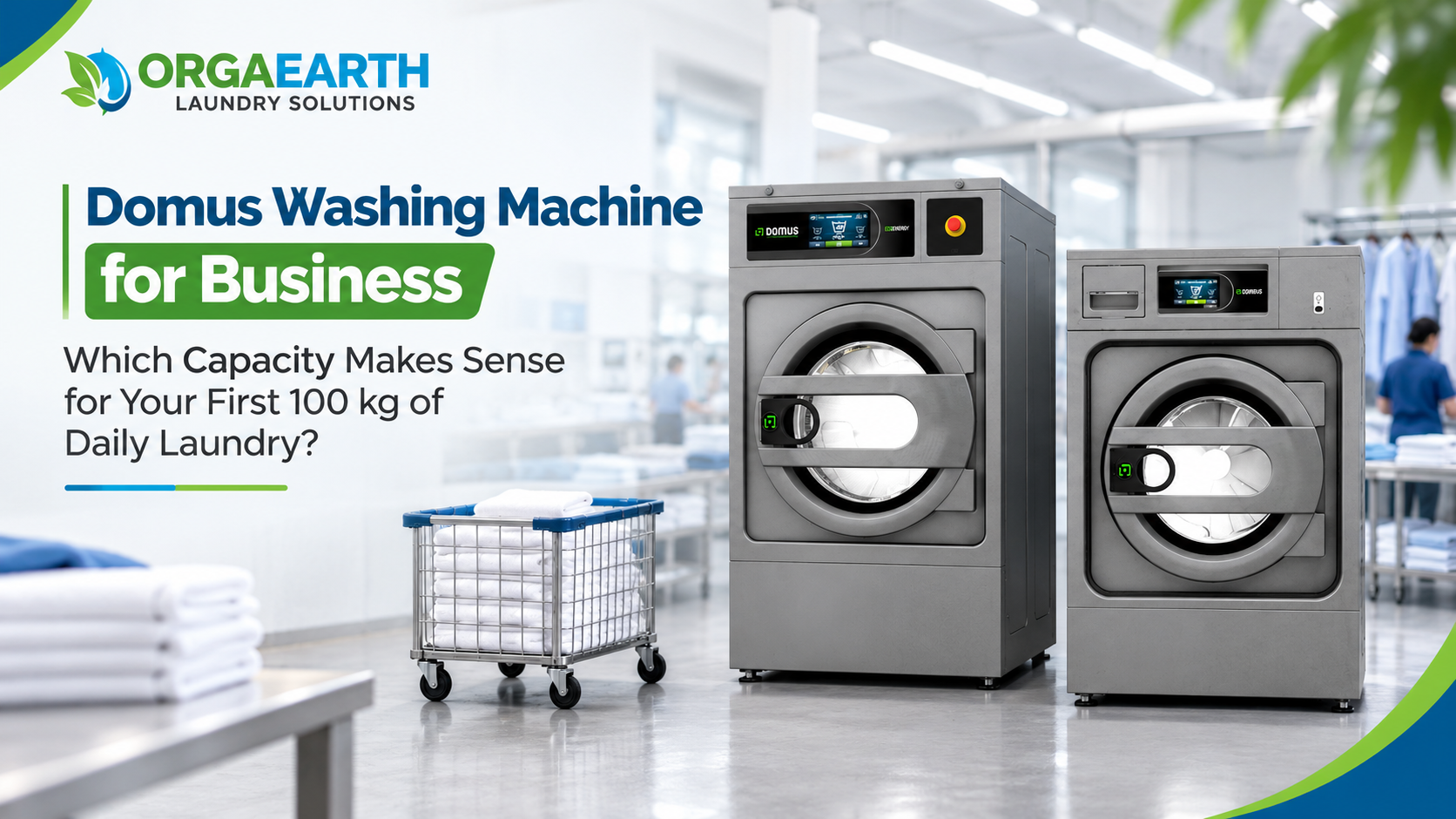
Planning to start a laundry business that processes 100 kg of clothes every day?
Your first major decision is choosing the right washing machine capacity. Buy a machine that is too small, and you may struggle to complete daily orders. Invest in an oversized machine, and you could spend more than necessary before building a stable customer base.
For entrepreneurs considering a Domus washing machine, understanding the relationship between machine capacity, wash cycles, operating hours, and processing costs is essential.
But should you choose a 10 kg, 13 kg, 18 kg, or larger commercial washing machine for your first 100 kg of daily laundry?
Let's understand how to make that decision before investing.
Is 100 kg of Daily Laundry Enough to Start a Business?
Processing 100 kg of laundry daily can be a starting target for a small commercial laundry business.
Potential customers may include residential households, serviced apartments, salons, guesthouses, restaurants, and smaller commercial establishments.
However, 100 kg of daily laundry does not necessarily mean 100 kg of identical clothes.
Your daily workload could include bedsheets, towels, uniforms, shirts, trousers, and other garments requiring different washing programmes.
For example, a startup might expect the following:
|
Laundry Category |
Daily Volume |
|
Everyday garments |
35 kg |
|
Bedsheets and pillowcases |
30 kg |
|
Towels |
20 kg |
|
Uniforms |
15 kg |
|
Total |
100 kg |
This is an illustrative workload, not an industry average.
Different fabrics and soil levels may require separate wash cycles. Therefore, machine capacity should be selected according to practical batch sizes rather than total daily weight alone.
Which Domus Washing Machine Capacities Are Available?
Domus manufactures professional and industrial washing machines for commercial laundry applications.
Its range includes compact professional models and higher-capacity industrial washer extractors.
Common capacity options include:
-
10 kg professional and industrial models
-
13–14 kg industrial models
-
18–20 kg industrial models
-
22–25 kg industrial models
-
Larger machines for higher-volume operations
Rated loading depends on the manufacturer's capacity standard and the selected model.
The right equipment depends on the expected workload, wash programme duration, available space, and utility infrastructure.
How Many Wash Cycles Do You Need for 100 kg Daily?
This is one of the most important calculations when selecting a commercial washing machine.
Suppose you plan to process 100 kg of laundry each day.
For illustration, assume your average load is 80% of the machine's nominal 1:10 capacity. This is a planning assumption, not a universal operating recommendation.
|
Rated Machine Capacity |
Assumed Average Load |
Cycles Needed for 100 kg |
|
10 kg |
8 kg |
13 |
|
13 kg |
10.4 kg |
10 |
|
18 kg |
14.4 kg |
7 |
|
22 kg |
17.6 kg |
6 |
The number of cycles is rounded upward to complete the full daily workload.
Consider the difference between a 10 kg and an 18 kg machine.
A 10 kg washer processing an average of 8 kg per load would require approximately 13 wash cycles.
An 18 kg washer processing 14.4 kg per load would require approximately seven cycles.
This difference can influence labour scheduling, production time, and the number of customer orders completed during a working shift.
However, an 18 kg machine is not automatically the best choice. If customers bring small, incompatible batches that cannot be combined, larger capacity may remain unused.
How Do Working Hours Affect Machine Selection?
A laundry business must complete its washing workload within the available operating hours.
Suppose one complete wash cycle, including loading and unloading, takes approximately 60 minutes.
Under this simplified assumption:
-
A 10 kg machine would require about 13 machine-hours.
-
A 13 kg machine would require about 10 machine-hours.
-
An 18 kg machine would require about seven machine-hours.
-
A 22 kg machine would require about six machine-hours.
For a business operating one eight-hour shift, the 18 kg or 22 kg configuration could be worth evaluating.
However, actual wash cycle durations vary by machine programme, temperature, extraction time, fabric category, and handling requirements.
Some loads may also require additional treatment or separate processing.
Entrepreneurs should calculate machine availability using realistic programme durations rather than assuming every load takes exactly one hour.
Should You Buy One Large Machine or Two Smaller Machines?
This is another important decision when planning a laundry business.
Option 1: One Larger Domus Washing Machine
A larger machine may help process suitable bulk loads in fewer cycles.
It may also simplify installation compared with buying multiple machines.
However, one machine provides limited flexibility when different fabric categories require separate programmes.
If it breaks down, the entire washing operation may stop.
Option 2: Two Smaller Washing Machines
Two smaller machines may offer greater flexibility.
For example, one machine could process white linen while another handles coloured garments.
They may also allow different washing programmes to operate simultaneously.
However, purchasing two machines can increase initial investment, utility connection requirements, and maintenance responsibilities.
The right choice depends on whether your business processes large compatible batches or many smaller customer orders.
What About Drying Capacity?
Buying a suitable washing machine is only one part of planning a commercial laundry.
After washing, garments must be dried or transferred to the appropriate finishing process.
If your washing equipment can process 100 kg daily but your dryer handles only 60 kg during the available shift, drying becomes a production bottleneck.
This can delay ironing, folding, packaging, and customer deliveries.
Before purchasing a Domus washing machine, evaluate the required tumble dryer capacity and drying cycle duration.
High-speed washer extraction may reduce moisture remaining in garments, potentially shortening subsequent drying time and energy consumption.
A balanced washing and drying setup is more useful than simply purchasing the largest washer within your budget.
How Much Does Processing 100 kg of Laundry Cost?
Understanding cost per kilogram is important before setting customer prices.
A laundry business must account for electricity, water, chemicals, labour, drying, finishing, packaging, rent, and machine maintenance.
Consider an illustrative business operating 26 days per month.
Monthly laundry volume = 100 kg × 26 days = 2,600 kg
Suppose its total monthly operating expenses are ₹65,000.
Operating cost per kg = ₹65,000 ÷ 2,600 kg = ₹25 per kg
If the business charges an average of ₹40 per kg:
Monthly revenue = 2,600 × ₹40 = ₹1,04,000
The illustrative monthly operating surplus would be ₹39,000.
These figures are hypothetical, not verified laundry market rates or guaranteed earnings. The surplus excludes any financing, taxes, depreciation, or other expenses not included in the estimate.
Actual profitability depends on customer demand, equipment utilisation, energy consumption, labour, and service pricing.
A suitably sized washing machine can support more predictable operating costs, but it cannot guarantee profitability.
What Features Should You Compare Before Buying a Domus Washing Machine?
High-Speed Extraction
High-spin washer extractors remove more moisture during the extraction stage than otherwise comparable lower-spin configurations.
This can reduce the drying requirement for suitable textiles.
Programmable Washing Controls
Programmable controls allow operators to select or configure washing programmes according to different fabric and soil requirements.
Consistent programmes can support repeatable cleaning results.
Water and Energy Management
Evaluate water consumption, heating requirements, and electrical demand according to the manufacturer's technical specifications.
The most economical equipment depends on the operating conditions, not simply its rated capacity.
Installation Requirements
Consider floor loading, water pressure, drainage, electricity, service clearance, and available working space.
The facility must accommodate both equipment and daily laundry handling.
Maintenance and Service Support
A commercial washing machine is a long-term business investment.
Spare-part availability, qualified maintenance support, and preventive servicing are important considerations when comparing suppliers.
Common Mistakes New Laundry Entrepreneurs Should Avoid
One common mistake is buying a machine based only on its maximum rated capacity.
Another is assuming that a 20 kg machine will always process twice as much laundry as a 10 kg machine in the same time.
Real output depends on wash cycles, loading practices, fabric separation, and operating conditions.
Entrepreneurs should also avoid underestimating drying and finishing requirements.
Purchasing oversized equipment before confirming customer demand can increase capital investment without improving revenue.
Before investing, prepare a practical daily production schedule and calculate the number of batches required for each laundry category.
How OrgaEarth Can Help You Choose a Domus Washing Machine
Choosing suitable commercial laundry equipment requires an understanding of expected washing volume, machine capacity, utilities, and operating requirements.
OrgaEarth Laundry Solutions supplies Domus professional and industrial laundry equipment in India, including washer extractors available in different capacities.
Its equipment portfolio also includes commercial tumble dryers, flatwork ironers, finishing systems, and supporting laundry solutions.
OrgaEarth assists entrepreneurs and existing laundry operators with equipment selection, laundry layout planning, installation requirements, and technical support.
Whether you are starting with 100 kg of daily laundry or planning a larger commercial facility, evaluating the correct machine configuration can help you manage processing time and long-term operating expenses.
Conclusion
Choosing a Domus washing machine for your first 100 kg of daily laundry requires more than comparing equipment sizes.
A 10 kg machine may suit smaller batches or extended operating hours, while an 18 kg or 22 kg model may be more practical when larger compatible loads must be completed during a single shift.
However, no single capacity is automatically suitable for every business.
The ideal configuration depends on your customer mix, washing programmes, practical load sizes, working hours, drying capacity, and budget.
Before investing, calculate the number of daily wash cycles, estimate cost per kilogram, and compare suitable machine models.
A well-planned equipment investment can help your laundry business handle customer demand efficiently and prepare for future growth.
Frequently Asked Questions
1. Which Domus washing machine is suitable for 100 kg of laundry daily?
An 18 kg or 22 kg machine may be worth evaluating for a single-shift operation, depending on programme duration, practical loading, and textile categories. Smaller machines may also be suitable when longer operating hours or multiple units are available.
2. Can a 10 kg Domus washing machine process 100 kg daily?
Yes, provided there are sufficient operating hours and the workload can be divided into compatible loads. At an illustrative average of 8 kg per cycle, approximately 13 cycles would be required.
3. Is one 20 kg washing machine better than two 10 kg machines?
Not necessarily. One larger washer may suit bulk loads, while two smaller machines can provide flexibility for separate garment categories and simultaneous washing.
4. What is the advantage of a high-spin Domus washing machine?
High-speed extraction helps remove moisture after washing, potentially reducing subsequent drying time and energy consumption compared with lower extraction performance.
5. How do I calculate washing machine capacity for my laundry business?
Estimate daily kilograms, divide the workload into compatible wash categories, calculate realistic batch loads, and evaluate how many cycles can be completed during available operating hours.
6. Should I purchase a dryer with my Domus washing machine?
A dryer is generally important for businesses offering in-house washing and machine-drying services. Its capacity should match expected drying volume and practical cycle times.
7. Where can I buy a Domus washing machine in India?
Professional laundry equipment suppliers such as OrgaEarth offer Domus washing machines in different capacities. Buyers should compare technical specifications, infrastructure requirements, warranty conditions, and after-sales support before purchasing.
Contact Us:
Orgaearth Laundry Solutions
Plot no. 774, Udyog Vihar, Phase 5, Gurugram, Haryana, India-122016
Email: marketing@orgaearth.com
Contact No. +91 7042912777

 English
 Arabic
 French
 Spanish
 Portuguese
 Deutsch
 Dutch
 Italiano
 Russian
 Romaian
 Portuguese (Brazil)
 Greek
