


What is VSWR? Formula, Safe Values & Antenna Testing
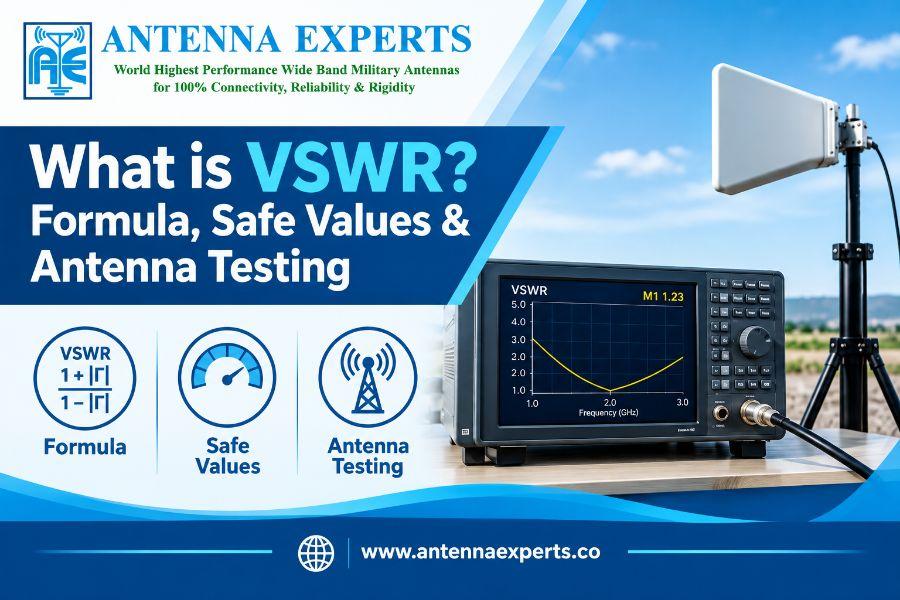
Voltage Standing Wave Ratio (VSWR) measures how well an antenna matches its feed line. A lower VSWR generally indicates a better impedance match and less reflected power. A high VSWR means more signal power is reflected towards the transmitter because of an impedance mismatch.
That's why technicians check it early on. A bad match wastes power and can strain the radio. It could also be a loose connector or damaged cable.
This guide explains the full form of VSWR, its formula, acceptable values, and how to measure antenna VSWR. It also covers practical VSWR limits, field measurement methods, and common causes of high readings.
What Is VSWR?
VSWR full form is Voltage Standing Wave Ratio. For example, a transmitter can connect to an antenna through a 50-ohm feed line. When the antenna and feed line are 50 ohms impedance they are matched and there is no reflected power due to impedance mismatch.
If the antenna impedance is different from the feed line impedance, then part of the transmitted signal is reflected back toward the transmitter. The forward and reflected waves combine to form a standing wave. VSWR is the ratio of the maximum voltage to the minimum voltage of the standing wave on a line.
So the lower the VSWR the better the impedance match. 1:1 is a perfect match, meaning that there is no reflected power due to impedance mismatch.
VSWR Formula What is the VSWR Formula?
The VSWR formula is derived from the reflection coefficient:
VSWR = (1 + |Γ|) / (1 − |Γ|)
Γ (gamma) is the voltage reflection coefficient, which represents the portion of the incident voltage wave reflected due to an impedance mismatch.
Γ can be obtained from impedances:
Γ = (ZL - Z0) / (ZL + Z0)
ZL represents the antenna's input impedance, while Z0 represents the characteristic impedance of the feed line.
A Quick Worked Example
Use a 75 ohm antenna and a 50 ohm cable.
Gamma = (75-50)/(75+50) = 0.2
VSWR = 1.2 / 0.8 = 1.5 : 1
Reflected power = 0.2*0.2 = 4 percent
Return Loss and Mismatch Loss
These three are connected, but not the same.
Return loss is a measure of the level of the reflected signal relative to the forward signal. For Γ = 0.2 it is about 14 dB. The bigger, the better.
Mismatch loss describes the reduction in power delivered to the antenna because of impedance mismatch. For Γ = 0.2 it is about 0.18 dB.
VSWR is expressed as a ratio, while return loss and mismatch loss are measured in decibels (dB).
What is a good antenna VSWR?
Here are the usual points to refer to:
- The perfect match is 1 to 1.
- 1.5:1 is generally regarded as good
- A VSWR of 2:1 is often used as a practical reference limit, although the acceptable value depends on the equipment manufacturer's specifications.
- Above 2:1 is worth a good look
At 2:1 some 11 percent of the power is reflected. The mismatch loss is ~0.5 dB.
There is no one size that fits every number. A good antenna VSWR depends on the transmitter, the frequency and the job. Check what the equipment manufacturer allows.
How do you figure out VSWR?
A technician uses a VSWR meter or antenna analyser. Here's what you need to do:
- Choose a meter appropriate for your frequency and power level.
- Set it up as the maker describes it.
- Insert it between the transmitter and the antenna.
- Measure at the actual operating frequency.
- Before you blame the antenna, check the cable and connectors.
An analyser at low power can sweep a whole band.
A long or lossy cable attenuates the reflected signal, which can make the VSWR reading near the transmitter appear lower than the actual antenna input VSWR.
Reading a VSWR vs Frequency Plot
VSWR is a function of frequency. Antenna might be a good match in the mid-band but not as good at the edges. It’s not enough to just read at one frequency.
The plot of VSWR versus frequency is used to determine how well the antenna maintains the impedance match over the range of operating frequency. This graph helps to know in which frequencies the antenna has a good matching impedance and in which the VSWR increases.
This is most important for wide systems. An electronic warfare antenna often needs to remain matched over a wide spectrum. A weak patch may be missed in a spot check.
In our datasheets we have a Frequency vs VSWR graph as shown in our UHF military SATCOM antenna page. Use the graph of the model you choose.
High VSWR Common Causes
A high reading doesn't mean the antenna is bad. First, read through this list:
- Antenna mounted too close to metal or installed improperly
- Coax cable is damaged or not suitable
- Loose or Broken Connectors
- Water in cable or connector
- Impedance mismatch somewhere in the signal chain
Cable damage, loose connections, and faulty connectors are common causes of high VSWR readings. That’s why RF coaxial cables and RF connectors matter. Our guide to coaxial cable pros and cons helps you choose a type.
Check the cable first, then the connectors, then the mounting, and finally the antenna.
Is a high VSWR damaging to a transmitter?
It can do. Reflected power returns to the output stage and adds to the stress. Some transmitters reduce output when the VSWR rises. Some do not.
A high VSWR reading does not automatically mean the transmitter will be damaged, but it should be investigated before continued operation. Avoid prolonged operation with high VSWR because reflected power can place additional stress on the transmitter's output stage.
Why Antenna Experts?
Antenna Experts is the best antenna manufacturer in India. We advise customers to verify frequency coverage and specifications when selecting any antenna. That includes the match across the band. Our datasheets have a Frequency vs VSWR graph. Request the data sheet for the model you are considering and determine if it is suitable for your frequency and application. We help you narrow your choice. VSWR values are not quoted unless they appear in the data sheet. We help customers compare antenna VSWR specifications with their operating frequency and application requirements before purchase.
FAQ
1. What is the meaning of VSWR?
VSWR is Voltage Standing Wave Ratio. It compares the maximum and minimum voltage levels of a standing wave on a transmission line
2. What is a good VSWR antenna ?
1.5:1 is usually okay. A common practical limit is up to 2:1. The correct value is dependent on your equipment and frequency so read the specification on the transmitter.
3. How do you measure VSWR in the field?
Place a VSWR meter or antenna analyser between your transmitter and the antenna. First set the proper frequency and power range. Before blaming the antenna, check the cable and connectors.
4. Does high VSWR harm transmitters?
It can put stress on the output stage. Some transmitters will cut their power to protect themselves. Limits vary with model, check the maker’s rating.
About the Author
Antenna Experts is an antenna manufacturer in India. The company offers antenna solutions for military, defence, and communication applications. We focus on product specifications, frequency coverage, and technical requirements to help customers select suitable antennas for their needs.

 English
 Arabic
 French
 Portuguese
 Deutsch
 Turkish
 Dutch
 Italiano
 Russian
 Romaian
 Portuguese (Brazil)
 Greek
