


Smart Traffic Survey in UAE - Using Technology to Improve Mobility
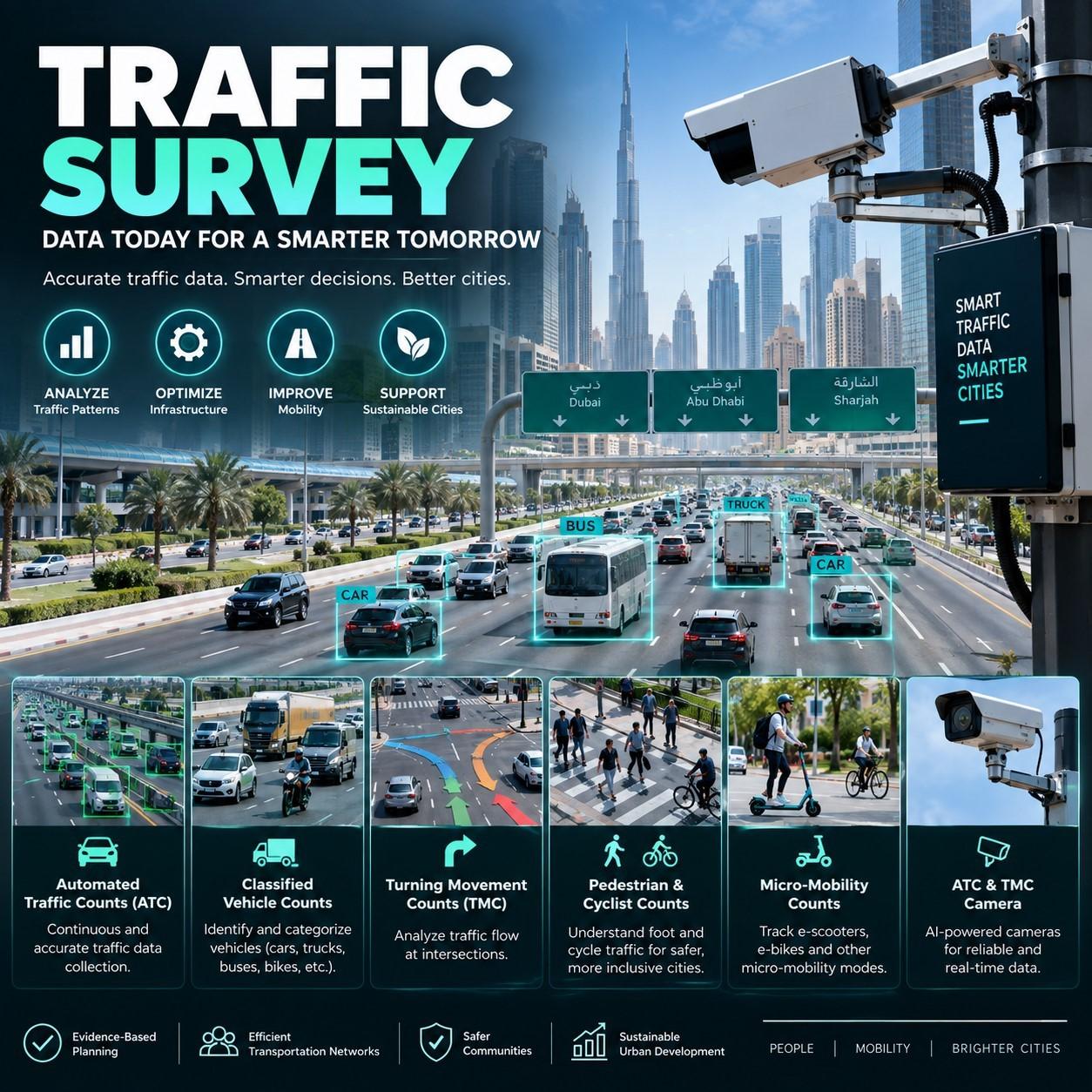
Every road widening, junction redesign, and new transit line across the UAE starts with the same question: how many people and vehicles actually move through this corridor, and when? A rigorous Traffic Survey answers that question with hard numbers, replacing guesswork with the evidence planners need before a single design drawing is finalized.
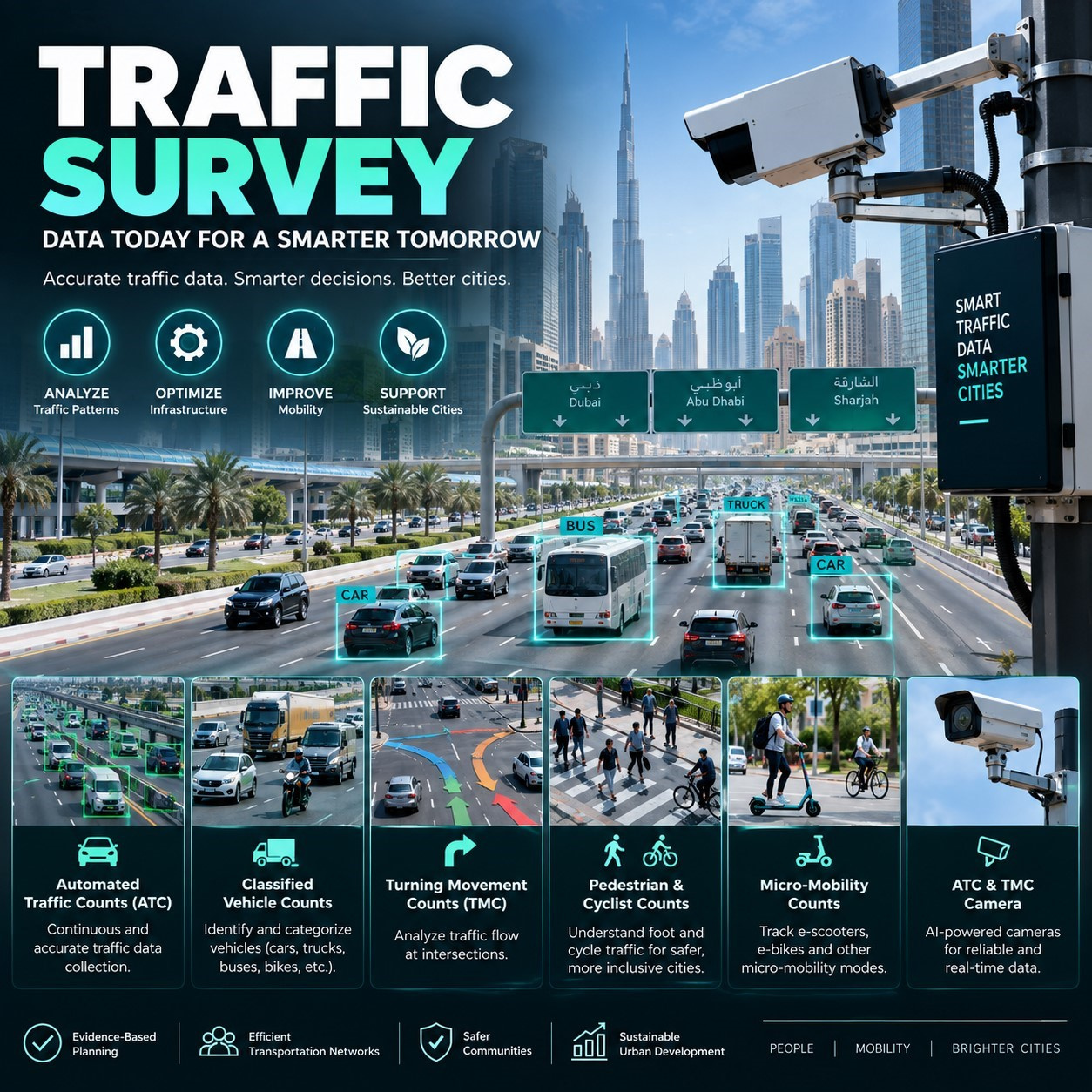
From Dubai's rapidly densifying business districts to Abu Dhabi's expanding residential communities, transport authorities are demanding richer, more granular movement data than a simple vehicle count ever provided. Modern survey technology now captures not just how many vehicles pass a point, but their type, direction, speed, and how they interact with pedestrians and cyclists sharing the same corridor.
That shift matters because a mobility plan built on incomplete data tends to solve the wrong problem — widening a road that was never actually congested, or missing a pedestrian safety issue that never showed up in a basic vehicle-only count.
Developers, government transport authorities, and consulting engineers across the UAE now treat a comprehensive survey as a prerequisite for planning approval, not an optional add-on, making the choice of survey methodology and technology a genuinely consequential project decision.
Why UAE Cities Need Accurate Traffic Data Today
The UAE's population and vehicle ownership have grown considerably faster than many of the road networks originally designed to serve them, creating pressure points at junctions, school zones, and commercial districts that were never modelled for today's actual traffic volumes.
Every new mall, residential tower, or industrial development also triggers a traffic impact assessment requirement from the relevant municipal authority, and the quality of that assessment depends entirely on the accuracy of the underlying count data collected before design work begins.
Federal and emirate-level transport strategies, including Dubai's mobility and self-driving transport initiatives, increasingly reference measured baseline data when setting targets, making accurate current-state surveys a foundation for policy as well as individual project design.
What a Modern Traffic Survey Actually Measures
A comprehensive survey goes well beyond a simple hourly vehicle tally. It typically captures volume by vehicle class, directional split at junctions, peak-hour patterns, pedestrian and cyclist activity, and increasingly, micro-mobility devices such as e-scooters that share road and pavement space with traditional traffic.
This breadth of data lets planners model a corridor's actual behaviour rather than relying on generic regional averages, which is particularly important in a market like the UAE where land use, climate-driven travel patterns, and vehicle mix differ meaningfully from other global benchmarks.
Weather and temperature also shape UAE travel behaviour more than in many other markets, with summer heat measurably shifting pedestrian and cyclist activity toward early morning and evening hours, a pattern that a short daytime-only survey window would entirely miss.
The Power of Automated Traffic Counts (ATC)
Automated Traffic Counts (ATC) use road tubes, radar, or video-based sensors to continuously log vehicle volumes over extended periods, capturing weeks or months of data without the labour cost and human error inherent in manual counting stations.
Because the equipment runs continuously, ATC deployments reveal seasonal and day-of-week variation that a single manual count session would completely miss, giving planners a far more representative picture of how a corridor actually behaves across an entire year.
Battery-powered and solar units also allow ATC deployment in locations without easy access to mains power, extending coverage to peri-urban corridors and new development areas where permanent count infrastructure has not yet been installed.
Understanding Classified Vehicle Counts
Not all traffic is equal from a planning perspective. Classified Vehicle Counts break total volume down by vehicle type — passenger cars, buses, heavy trucks, and motorcycles — data that directly feeds pavement design, signal timing, and freight corridor planning decisions.
A corridor carrying a high proportion of heavy trucks, for example, requires very different pavement specification and turning radius design than one dominated by passenger vehicles, making classification data essential rather than a nice-to-have detail.
Classification data also supports environmental and emissions modeling required for certain development approvals, since vehicle mix directly influences the assumptions used in air quality and noise impact assessments submitted alongside a traffic study.
Capturing Turning Movement Counts (TMC) at Complex Junctions
At intersections, Turning Movement Counts (TMC) record exactly how many vehicles turn left, right, or continue straight through each approach, data that directly determines signal phasing, lane allocation, and whether a junction needs a dedicated turning lane at all.
Multi-leg roundabouts and complex signalized intersections common across UAE road networks benefit especially from detailed turning movement data, since even small directional imbalances can justify a completely different signal timing plan than a symmetric approach would suggest.
Signal timing derived from accurate turning data also reduces unnecessary vehicle idling at junctions, a benefit that ties directly into wider UAE sustainability and emissions-reduction objectives beyond the immediate congestion relief a better-timed signal provides.
Why Pedestrian & Cyclist Counts Matter for Safer Streets
As the UAE invests heavily in walkable districts and dedicated cycling infrastructure, Pedestrian & Cyclist Counts have become essential inputs for crossing design, signal timing at school zones, and justifying new cycle lane investment along commuter corridors.
Without this data, vulnerable road users are often invisible to a purely vehicle-focused planning process, even in areas where pedestrian volume may rival or exceed vehicle traffic during specific hours, such as near schools, mosques, or metro stations.
Counting data also supports before-and-after evaluation of completed cycling and pedestrian infrastructure projects, giving authorities the evidence needed to justify continued investment in walkable and rideable street design across future development phases.
Tracking Micro-Mobility Counts as E-Scooters and E-Bikes Grow
The rapid adoption of shared e-scooters and e-bikes across Dubai and Abu Dhabi has introduced a genuinely new category of road user that legacy count methods were never designed to capture. Micro-Mobility Counts now track these devices separately, informing dedicated lane design and safety interventions at conflict points with both pedestrians and vehicles.
Regulators reviewing micro-mobility operator permits increasingly request documented usage data before approving expanded fleet sizes or new operating zones, making accurate counts a practical business requirement for operators as well as a planning input for authorities.
How ATC & TMC Camera Technology Changes Data Collection
Modern ATC & TMC Camera systems use computer vision to automatically classify vehicles, count turning movements, and log pedestrian activity from a single elevated camera position, replacing the multiple separate manual counters previously needed to capture the same range of movements at a busy junction.
Video-based capture also creates a reviewable record that can be re-analyzed later if a question arises about a specific count period, something a manual tally sheet simply cannot offer once the counting session has ended.
Meeting Traffic Survey UAE Standards and Reporting Requirements
Consultants delivering Traffic Survey UAE projects must align their methodology with the reporting formats expected by the Roads and Transport Authority (RTA) in Dubai, the Department of Municipalities and Transport (DMT) in Abu Dhabi, and relevant Integrated Transport Centre guidance, alongside internationally recognized standards such as those published by the Institute of Transportation Engineers (ITE).
Submitting data in the format each authority expects — including specific peak-hour definitions, classification categories, and confidence-interval reporting — avoids the delays that come from having a technically sound survey rejected on formatting grounds during regulatory review.
Why Dubai Projects Need Specialized Traffic Survey Dubai Expertise
Dubai's dense mix of highways, arterial roads, and rapidly evolving mixed-use developments makes Traffic Survey Dubai projects particularly demanding, requiring survey teams familiar with RTA submission formats, permit requirements for equipment placement on public roads, and the emirate's specific peak-hour traffic patterns.
A team with established Dubai project experience can typically secure the necessary road-use permits and mobilize equipment considerably faster than a provider unfamiliar with the emirate's specific approval process, keeping tight development timelines on track.
Choosing the Right Survey Methodology for Your Project
Not every project needs the same combination of survey methods. A small residential access road may only require a short manual turning movement count, while a major highway interchange redesign typically demands weeks of continuous automated counts combined with camera-based classification and pedestrian data across multiple seasons.
Scoping the right combination upfront — rather than defaulting to a generic package — saves both cost and time, and an experienced survey provider should be able to recommend a methodology matched to the specific planning question the project actually needs answered.
Common Mistakes in Traffic Data Collection Projects
A frequent mistake is collecting data during an atypical week — a public holiday, a major event, or unusual weather — without flagging the anomaly, leading planners to base decisions on a traffic pattern that does not represent normal conditions.
Another common gap is under-specifying the survey duration, capturing only a single weekday when weekend or seasonal variation would have materially changed the resulting design recommendation, particularly around retail and leisure destinations with strongly weekend-skewed visitation patterns.
Finally, some projects treat data collection and analysis as entirely separate exercises, handing raw counts to a design team without the methodological context needed to interpret them correctly, which can lead to design decisions based on a misunderstanding of what the data actually shows.
Why Choose Top Precision for Traffic Survey Services
Top Precision has delivered traffic and mobility survey projects across the UAE, combining automated counting technology with experienced field teams who understand the specific submission requirements of Dubai's RTA and Abu Dhabi's municipal transport authorities, rather than applying a generic international methodology unadapted to local practice.
Every Top Precision deployment is backed by calibrated equipment, documented quality-assurance procedures, and analysts who validate raw counts against site observations before delivery, giving consulting engineers and government clients confidence in the numbers behind every design recommendation.
Clients choose Top Precision specifically for the combination of proven UAE project history, technology-driven data collection that reduces human error, and reporting delivered in the exact format each regulatory authority expects, turning raw traffic counts into decision-ready data rather than a spreadsheet requiring further interpretation.
Working with a Proven Regional Partner
Consultants and developers evaluating a survey partner can review the full range of traffic and mobility survey services offered across the UAE to compare methodology options against their project's specific data requirements and regulatory submission timeline.
Integrating Survey Data into Wider Transport Planning
Traffic count data delivers the most value when it feeds directly into a project's wider transport impact assessment, signal design, and public consultation process rather than sitting as a standalone report. Project teams planning a survey scope often start by requesting a methodology consultation through Top Precision's traffic survey specialists, who can recommend the right count combination before mobilizing equipment on site.
Conclusion
Improving mobility across the UAE starts with a rigorous Traffic Survey built on real, site-specific data. Continuous Automated Traffic Counts (ATC), detailed Classified Vehicle Counts, and precise Turning Movement Counts (TMC) give engineers the junction-level insight design decisions depend on. Comprehensive Pedestrian & Cyclist Counts and emerging Micro-Mobility Counts, captured through modern ATC & TMC Camera technology, complete the picture. For organizations pursuing Traffic Survey UAE compliance, or a Traffic Survey Dubai project specifically, Top Precision delivers accurate, regulator-ready data backed by proven local project experience.
FAQs
1. Why does a project need a professional Traffic Survey instead of an informal estimate?
Regulatory authorities require documented, methodologically sound data before approving a traffic impact assessment, and design decisions based on informal estimates often miss patterns that only show up in properly collected count data.
2. How long do Automated Traffic Counts (ATC) typically run for a project?
Duration depends on the project's needs, ranging from a one-week snapshot for a minor access road to several months of continuous monitoring for a major corridor where seasonal variation materially affects the design outcome.
3. What do Turning Movement Counts (TMC) add that a simple volume count cannot?
They reveal exactly how many vehicles turn in each direction at a junction, data that directly determines signal phasing and lane allocation in a way a single total volume figure never could.
4. Are Pedestrian & Cyclist Counts required for every development project?
Requirements vary by site and authority, but any development near schools, transit stations, or dense pedestrian zones should expect this data to be requested as part of a complete traffic impact assessment.
5. Why do Traffic Survey Dubai projects benefit from local expertise?
A team familiar with RTA submission formats and public-road permit requirements can mobilize equipment and deliver compliant reports considerably faster than a provider unfamiliar with Dubai's specific approval process.

 English
 Arabic
 French
 Spanish
 Portuguese
 Deutsch
 Turkish
 Italiano
 Russian
 Romaian
 Portuguese (Brazil)
 Greek
