


PEB vs RCC Construction: Cost, Time and Benefits
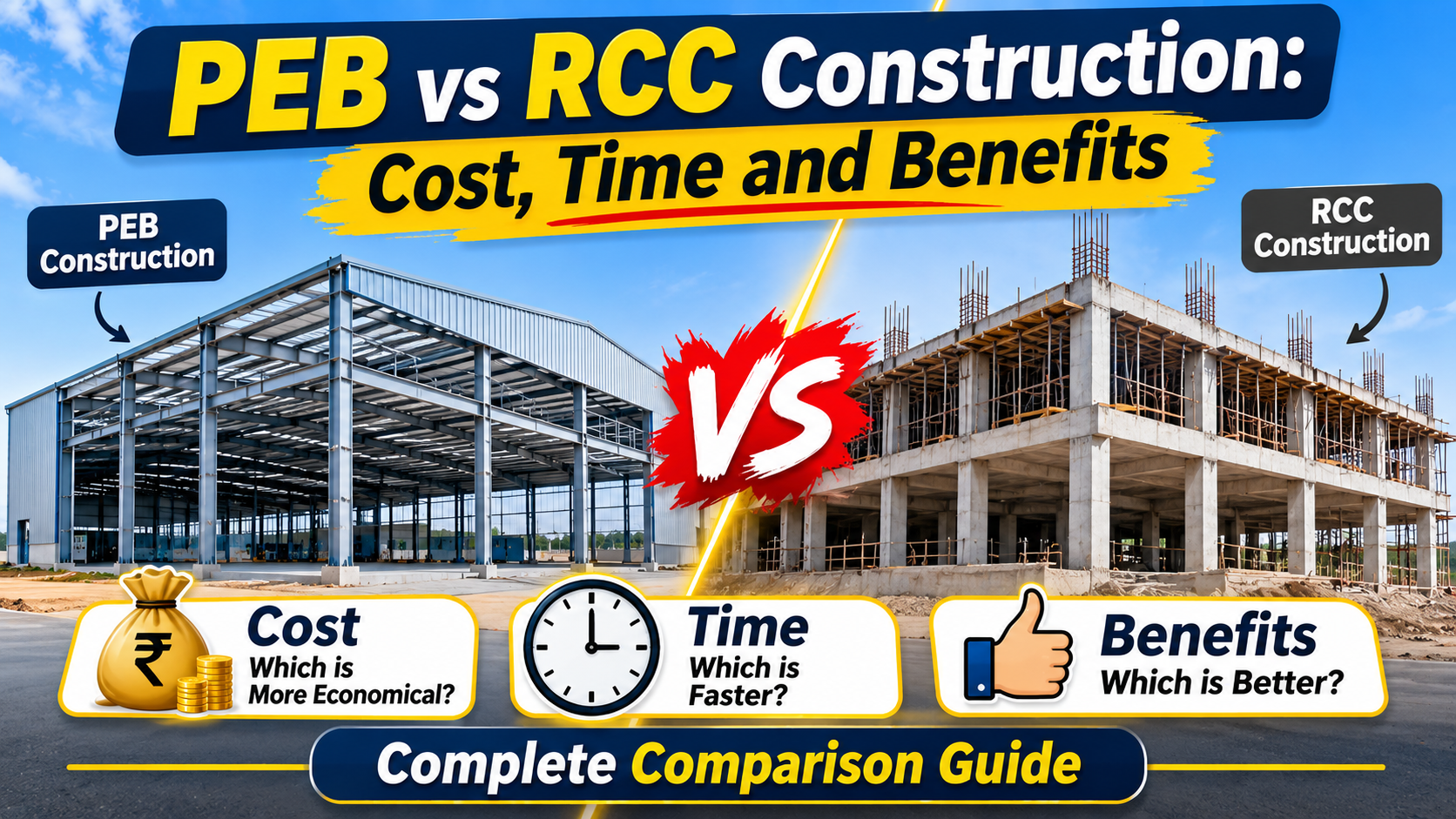
Choosing the right construction method is an important decision for any industrial or commercial project. Businesses planning warehouses, factories, industrial sheds, and commercial buildings often compare Pre-Engineered Buildings (PEB) with Reinforced Cement Concrete (RCC) construction.
Both construction methods have their own advantages, depending on the project requirements, budget, design, and construction timeline.
PEB construction uses engineered steel structures, while RCC construction uses reinforced concrete made from cement, aggregates, steel reinforcement, and water.
In this article, we will compare PEB vs RCC construction based on cost, construction time, benefits, and applications to help you make the right decision.
What Is PEB Construction?
Pre-Engineered Building (PEB) construction is a modern building method in which structural components are designed and manufactured according to specific project requirements.
These steel components are fabricated in a manufacturing facility and transported to the construction site for assembly.
PEB buildings are commonly used for:
-
Factory buildings
-
Manufacturing units
-
Logistics centres
-
Commercial showrooms
-
Industrial sheds
PEB construction is popular for projects requiring large open spaces, flexible layouts, and efficient construction.
What Is RCC Construction?
RCC stands for Reinforced Cement Concrete. It is a traditional construction method that combines concrete with steel reinforcement to create strong structural elements.
RCC buildings are widely used for residential, commercial, industrial, and infrastructure projects.
RCC construction commonly includes:
-
Concrete foundations
-
Reinforced concrete columns
-
Beams and slabs
-
Concrete floors
-
Staircases and structural walls
RCC is suitable for buildings requiring multiple floors, concrete structural systems, and specific architectural designs.
PEB vs RCC Construction: Key Differences
| Factor | PEB Construction | RCC Construction |
|---|---|---|
| Main material | Structural steel | Reinforced concrete |
| Construction time | Generally faster | Generally longer |
| Structural weight | Usually lighter | Usually heavier |
| Large open spaces | Often suitable | May require more columns |
| Design flexibility | High for steel structures | High for concrete structures |
| Site work | More prefabrication | More on-site construction |
| Future expansion | Often easier with planning | May require major structural work |
| Common applications | Warehouses, factories, industrial sheds | Residential, commercial, multi-storey buildings |
The best construction method depends on the building's purpose, structural design, site conditions, and overall project requirements.
PEB vs RCC Construction Cost
Construction cost is one of the most important factors when selecting between PEB and RCC.
PEB Construction Cost
PEB buildings can offer cost advantages for certain industrial projects because their components are engineered and manufactured before arriving at the construction site.
Potential cost benefits include:
-
Efficient steel utilisation
-
Reduced construction time
-
Lower structural weight
-
Reduced on-site labour requirements
-
Faster project completion
However, the final cost depends on steel prices, building dimensions, foundation requirements, roofing, cladding, insulation, and project specifications.
RCC Construction Cost
RCC construction costs depend on several factors, including:
-
Cement and steel prices
-
Concrete quantity
-
Foundation design
-
Labour charges
-
Floor and roof requirements
-
Building height and structural design
RCC may be a suitable choice for buildings requiring multiple floors or concrete structural systems.
Important: PEB is not always cheaper than RCC. A proper cost comparison should include the complete building scope, foundation, flooring, roofing, insulation, transportation, installation, and finishing.
PEB vs RCC: Construction Time
Construction time can significantly affect business operations and project planning.
PEB Construction Time
PEB construction generally takes less time for suitable industrial buildings because steel components are manufactured off-site while foundation and site preparation work can proceed.
Once the components arrive, the steel structure can be assembled according to the approved construction plan.
This can help businesses complete warehouses and factories more efficiently.
RCC Construction Time
RCC construction generally requires more on-site activities, including shuttering, reinforcement, concrete pouring, and curing.
These processes can increase the construction timeline, particularly for large buildings or projects with multiple floors.
The actual construction time depends on the project size, weather conditions, labour availability, design complexity, and site readiness.
Benefits of PEB Construction
1. Faster Construction
PEB components are manufactured before installation, helping reduce on-site construction activities.
2. Efficient Steel Utilisation
Engineered steel structures are designed according to project-specific loads and requirements, allowing efficient use of structural materials.
3. Large Open Spaces
PEB buildings can provide large-span areas with fewer internal columns, depending on the structural design.
This is useful for warehouses, factories, and storage facilities.
4. Flexible Building Design
PEB structures can be customised according to building dimensions, operational requirements, and architectural preferences.
5. Easier Future Expansion
Steel structures can often be extended or modified more conveniently when future expansion is considered during the initial design.
Benefits of RCC Construction
1. Suitable for Multi-Storey Buildings
RCC is widely used for residential apartments, office buildings, and other multi-storey structures.
2. Fire Resistance
Concrete provides inherent fire resistance, although the complete building must meet applicable fire safety requirements.
3. Wide Availability of Materials
Cement, aggregates, reinforcement steel, and labour are commonly available in many regions.
4. Flexible Architectural Applications
RCC can be used for different building shapes, structural layouts, and architectural requirements.
5. Strong and Durable Structures
Properly designed and maintained RCC buildings can provide long-term structural performance.
Which Is Better for Warehouses and Factories?
For many warehouses and industrial sheds, PEB construction can be a practical option because it supports large-span steel structures and faster assembly.
PEB buildings are often preferred for:
-
Storage warehouses
-
Manufacturing facilities
-
Distribution centres
-
Industrial sheds
-
Logistics buildings
RCC construction may be more suitable for projects requiring multiple floors, concrete slabs, or specific structural and architectural features.
In some projects, a combination of PEB and RCC can provide an effective solution. For example, a building may use an RCC foundation and floor with a PEB steel roof and structural system.
Why Choose Mettas Limited for PEB Construction?
Mettas Limited, through its PEB division Mettas Steelcraft, focuses on customised pre-engineered building solutions for industrial, commercial, and infrastructure projects.
The company provides building solutions for applications such as:
-
Industrial warehouses
-
Factory buildings
-
Manufacturing units
-
Commercial showrooms
-
Industrial sheds
-
Infrastructure structures
Mettas Steelcraft focuses on developing practical steel building solutions according to project specifications, structural requirements, and operational needs.
For businesses planning a new warehouse or industrial facility, selecting the right construction method and building partner can help support efficient project planning.
Conclusion
PEB and RCC construction both offer important advantages for modern building projects.
PEB construction is often suitable for warehouses, factories, and industrial sheds where large open spaces and faster construction are important.
RCC construction is widely used for residential, commercial, and multi-storey buildings requiring concrete structural systems.
The right choice depends on the building's purpose, budget, design, construction timeline, and long-term requirements.
Mettas Limited, through Mettas Steelcraft, provides customised PEB building solutions for businesses planning industrial and commercial construction projects.
Choosing the right PEB construction solution can help businesses develop functional, efficient, and well-planned industrial infrastructure.

 English
 Arabic
 French
 Spanish
 Portuguese
 Deutsch
 Dutch
 Italiano
 Russian
 Romaian
 Portuguese (Brazil)
 Greek
