


How an Electronic Buzzer with Flasher Supports Better Fault Indication in Industrial Systems
Industrial equipment operates through several interconnected electrical and mechanical components. Even a small change in operating conditions can sometimes affect the performance of a machine or interrupt a production process. For this reason, industrial facilities use different monitoring and signalling arrangements to communicate faults and unusual conditions.
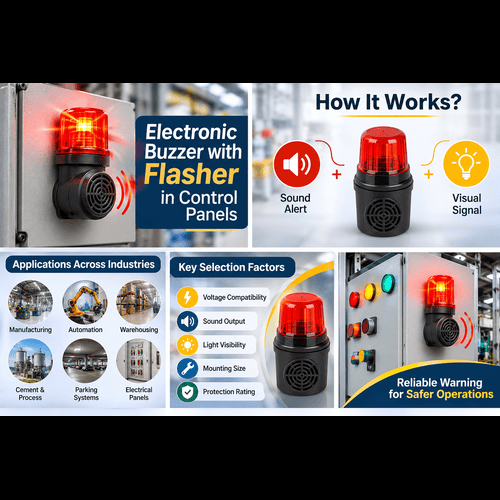
An Electronic buzzer with flasher is one such signalling component. It combines an audible warning with a flashing light, providing operators with two forms of notification. This arrangement can be useful when equipment needs attention and personnel must be informed about a warning condition.
Understanding Fault Indication in Industrial Equipment
Fault indication refers to the process of communicating an abnormal operating condition through a visual, audible, or electronic signal.
For example, a motor protection circuit may detect an overload condition. Similarly, a control system may identify an interruption in a process or a failure in a connected component.
The monitoring system can be designed to activate a warning device when a predefined condition occurs.
An Electronic buzzer with flasher can form part of this arrangement by communicating the warning through sound and light.
Common Conditions That May Require an Alert
Industrial systems may require warning indications for:
-
Motor overload conditions.
-
Equipment malfunction.
-
Electrical supply interruptions.
-
Process deviations.
-
Machine stoppages.
-
Abnormal operating conditions.
-
Maintenance-related notifications.
The actual alarm logic depends on the control panel design and the connected monitoring equipment.
How Does an Electronic Buzzer with Flasher Work?
The working principle is relatively straightforward. The device is connected to a suitable electrical supply and an alarm control circuit.
When the control circuit activates the device, its audible section produces a warning sound while the light section generates a flashing indication.
The two outputs help communicate the same warning through different methods.
The Audible Section
The buzzer produces sound to attract attention. Its output should be appropriate for the environment where it is installed.
For example, a warning device used near heavy machinery may need a different sound output from one installed in a quiet electrical room.
The Visual Section
The flashing light provides a visible indication. Its colour and position should be selected according to the purpose of the alarm.
The Combined Operation
An Electronic buzzer with flasher uses both outputs to make a warning more noticeable. This arrangement can be particularly useful when several activities are taking place around the equipment.
Role in Different Industrial Applications
1. Motor Control Centres
Motor control centres contain electrical equipment used to operate and protect motors. Warning signals can help operators identify conditions that require inspection.
2. Process Control Panels
Manufacturing and processing facilities use control panels to monitor different stages of production. An audible and visual warning can communicate an unexpected change in a monitored process.
3. Conveyor Systems
Conveyor installations are used in warehouses, packaging facilities, and manufacturing plants. Warning devices can be included in control arrangements to notify operators about selected machine conditions.
4. Electrical Distribution Systems
Electrical distribution equipment may include monitoring and protection arrangements that identify abnormal conditions. A suitable alarm can communicate these conditions to nearby personnel.
5. Industrial Alarm Units
Alarm units often combine different types of signalling components to communicate specific warnings. An Electronic buzzer with flasher can be considered where a combined sound and light indication is required.
Choosing the Right Device for Fault Indication
A warning device should match the electrical requirements and physical conditions of its installation.
The following factors deserve attention.
Input voltage: Different control systems operate at different voltage levels. Check the device rating before connecting it.
Sound level: Consider the background noise and the distance between the device and operating personnel.
Flashing colour: Select the colour based on the intended indication and the site's established signalling practices.
Panel arrangement: Check the available mounting cutout, depth, and wiring space.
Protection rating: Ensure that the specified protection level is appropriate for the installation environment.
Maintenance access: The device should be accessible for inspection and testing.
Mimic's published product information describes buzzer-cum-flasher models with different voltage and colour options. The available technical details should be verified for the specific model being considered.
Difference Between a Conventional Buzzer and a Combined Alarm
A conventional buzzer mainly communicates through sound. It can be suitable for applications where an audible notification is sufficient.
A combined device adds a flashing light to the sound output.
|
Feature |
Conventional buzzer |
Combined buzzer and flasher |
|---|---|---|
|
Audible indication |
Yes |
Yes |
|
Visual indication |
Not necessarily |
Yes |
|
Warning methods |
Mainly sound |
Sound and flashing light |
|
Application |
Basic alert systems |
Combined alert arrangements |
An Electronic buzzer with flasher may be a suitable option when the installation requires both forms of notification.
Installation and Testing Considerations
Proper installation helps ensure that a warning device functions as intended.
Before commissioning, technicians should:
-
Verify the electrical supply.
-
Check the terminal connections.
-
Confirm the mounting arrangement.
-
Test the sound output.
-
Observe the flashing indication.
-
Check the response of the alarm circuit.
-
Include the device in the maintenance schedule.
Testing should be performed by qualified personnel following the equipment manufacturer's instructions.
Conclusion
Fault indication helps industrial operators understand when equipment requires attention. Combining sound and light can make warnings easier to notice in different working environments.
An Electronic buzzer with flasher is a practical component to consider for motor control centres, process panels, conveyor installations, and other industrial systems. Its suitability depends on voltage compatibility, sound requirements, installation conditions, and the intended alarm function.

 English
 Arabic
 French
 Spanish
 Portuguese
 Turkish
 Dutch
 Italiano
 Russian
 Romaian
 Portuguese (Brazil)
 Greek
