


How a Precision Air Conditioner Controls Heat in Data Centers
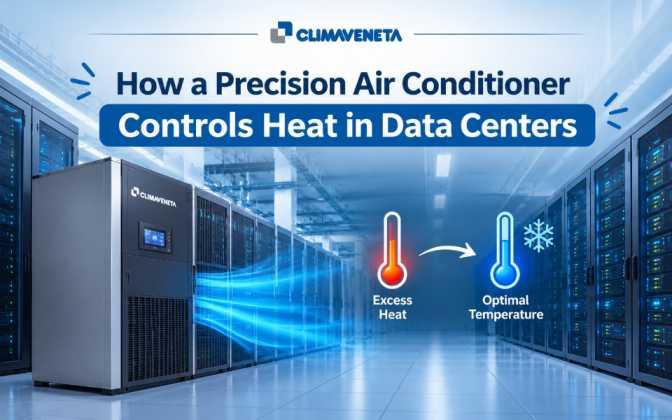
Every AI query, cloud transaction and video stream triggers a physical reaction inside a data hall. Electricity passes through processors, memory and networking hardware, and nearly all of it re-emerges as heat. As AI workloads push rack densities higher, even a short interruption in heat removal can drive equipment toward thermal limits, throttling and shutdown.
At the center of the solution sits the Precision Air Conditioner, a close-control unit built for machines rather than people. Running 24/7/365, it removes dry heat, regulates humidity and filters air to protect uptime in hyperscale, colocation and enterprise facilities. Paired with Air Source Heat Pumps that reuse the recovered heat, it forms a complete thermal strategy.
Here is how a Precision Air Conditioner helps.
Why Data Centers Need Precision, Not Comfort
IT equipment produces almost entirely sensible heat: heat that raises air temperature without adding moisture. Why can’t a comfort system handle it? Because comfort units, typically operating at a Sensible Heat Ratio (SHR) of roughly 0.65–0.70, divert much of their capacity to dehumidification that a server hall never needs.
A Precision Air Conditioner is designed for the opposite load profile. With SHR commonly in the 0.95–0.99 range, nearly all of its capacity removes dry IT heat, reducing wasted energy and hotspot risk.
The Heat Removal Path in Four Stages
Stage 1. Capture
Servers draw cool air from a contained cold aisle or raised-floor plenum, absorb heat across processors, memory and networking components, and exhaust it into the hot aisle. Containment stops that exhaust from recirculating into server intakes, where it would create hotspots, and returns hot air to the Precision Air Conditioner at a higher temperature, which improves coil performance.
Stage 2. Heat transfer
The Precision Air Conditioner draws hot return air across a cooling coil, which rejects the heat through either a direct-expansion refrigerant circuit or a chilled-water circuit, depending on plant architecture. Climaveneta's x-MEXT direct-expansion range covers approximately 30 to 140 kW and pairs inverter scroll compressors with centrifugal EC fans to modulate capacity as load changes. Chilled-water versions, such as the w-MEXT range, connect instead to a central chilled-water plant.
Stage 3. Control
A microprocessor controller monitors inside each Precision Air Conditioner monitors return-air temperature, supply-air conditions, humidity, refrigerant pressures and fan performance, adjusting capacity in real time. The targets come from ASHRAE's Thermal Guidelines for Data Processing Environments: a recommended server-inlet range of 18–27°C and a dew point between −9°C and 15°C. Air that is too dry raises the risk of electrostatic discharge, while excess moisture promotes condensation and corrosion. The dedicated x-MEXT control software provides operating data, diagnostics and trending over the facility network, so operators can confirm that conditions stay inside the envelope.
Stage 4. Delivery and filtration
The Precision Air Conditioner returns conditioned air to the cold aisle at controlled temperature and flow. Because the same air recirculates continuously, filtration removes dust and airborne particles that can foul components and, combined with humidity, accelerate corrosion.
Keeping Heat Control Efficient as Load Varies
Precise control only delivers value if it stays efficient when IT load rises and falls on Precision Air Conditioner. Data halls rarely run at full design load, so partial-load performance largely determines annual energy cost and Power Usage Effectiveness (PUE). Two design features address this directly.
Variable-speed components
Inverter compressors modulate refrigeration capacity, while EC fans adjust airflow to demand. Climaveneta reports that its EC fans cut absorbed power by up to 25% and noise by 4–5 dB(A) compared with traditional solutions.
Free cooling
Free-cooling versions add a coil alongside the direct-expansion coil, so the Precision Air Conditioner can use cold water from the outdoor cooling circuit when ambient conditions allow, reducing compressor work.
Cooling demand in a data center is continuous, so usable free-cooling hours translate directly into energy savings. They depend on the local climate and should be assessed site by site.
Connecting Precision Cooling to the Chilled-Water Plant
In chilled-water designs, each Precision Air Conditioner depends on a central plant for its cooling supply, so the plant's controls affect both resilience and efficiency.
The Data Center Manager, a centralised control system for data center cooling, coordinates the two sides over a dedicated network, connecting up to eight external chillers with up to 20 groups of indoor chilled-water units. Its master unit detects the real heat load in the data hall through an adaptive set-point algorithm and passes it to the chillers, which can adjust set points, enter free-cooling mode or rebalance load across standby units.
Air Source Heat Pumps are an alternative chilled-water source, particularly where cooling and heating demand coexist on one site. Climaveneta's air-source range covers 4 to 2,416 kW and is listed as compatible with IT cooling. In cooling mode, reversible Air Source Heat Pumps supply chilled water to Precision Air Conditioners; in heating mode, they supply hot water for offices and other ancillary spaces. Low-GWP refrigerant options include R513A and R454B.
A Precision Air Conditioner controls heat at room level, but its performance depends on the plant that supplies it. Specifying the units, chillers and Air Source Heat Pumps as one system with shared controls keeps heat removal stable as IT load changes. Climaveneta India manufactures each of these components.

 English
 Arabic
 French
 Spanish
 Portuguese
 Deutsch
 Turkish
 Dutch
 Italiano
 Russian
 Romaian
 Portuguese (Brazil)
