


Automatic Faucets Market Size, Share and Competitive Landscape - 2032
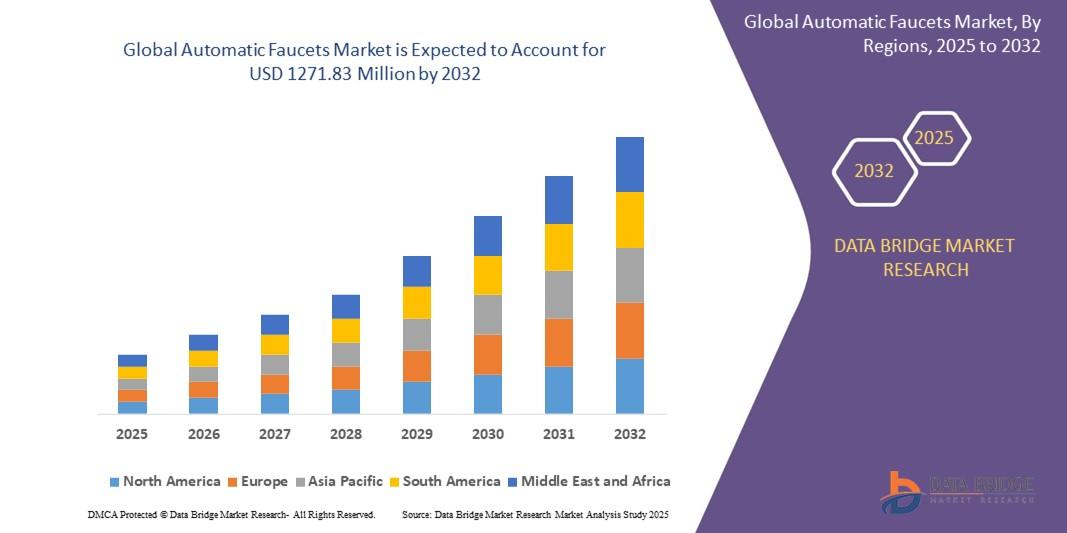
According to the latest report published by Data Bridge Market Research, the Automatic Faucets Market size is projected to reach USD 1,271.83 Million by 2032, exhibiting a CAGR of 7.40% during the forecast period 2025 - 2032.
The market research data included in this Automatic Faucets Market document is analysed and forecasted using market statistical and coherent models. In this era of globalization, many businesses call for Global Market Research to support decision making. To turn complex market insights into simpler version, well established tools and techniques are used for this report. This finest Automatic Faucets Market research report is an entire overview of the market, covering various aspects including product definition, customary vendor landscape, and market segmentation based on various parameters such as type of product, its components, type of management and geography.
Stay informed with our latest keyword market research covering strategies, innovations, and forecasts. Download full report: https://www.databridgemarketresearch.com/reports/global-automatic-faucets-market
Automatic Faucets Market Segmentation and Market Companies
Segments
- On the basis of type, the global automatic faucets market can be segmented into sensor-operated and touch-operated faucets. Sensor-operated faucets are witnessing a surge in demand due to their contactless operation, which helps in maintaining hygiene in public places such as airports, hospitals, and shopping malls. Touch-operated faucets are also gaining popularity in residential settings for their convenience and water-saving features.
- Based on application, the market can be categorized into residential, commercial, and industrial. The commercial segment dominates the market due to the increasing adoption of automatic faucets in hotels, restaurants, offices, and healthcare facilities. These establishments prioritize hygiene standards, which drive the demand for touchless faucets to prevent the spread of germs.
- By distribution channel, the automatic faucets market is divided into online and offline sales channels. The online segment is experiencing rapid growth as consumers prefer the convenience of shopping from home and can access a wide range of products and brands. Offline channels such as specialty stores and home improvement centers also play a significant role in sales, particularly for customers who prefer to see the products physically before purchasing.
Market Players
- LIXIL Group Corporation
- Masco Corporation
- Geberit AG
- Sloan Valve
- TOTO Ltd
- Moen Incorporated
- Oras
- Roca Sanitario
- Presto Group
- TCK
- Zurn Industries, LLC
- GESSI S.p.A
The global automatic faucets market is witnessing a steady growth trajectory driven by the increasing awareness about water conservation, hygiene concerns, and technological advancements in sensor-based devices. The market players mentioned above are leading the charge in innovation and product development to meet the evolving needs of consumers and businesses. The competition in the market is intense, with companies focusing on enhancing the durability, aesthetics, and functionality of automatic faucets to gain a competitive edge.
The Asia-Pacific region is poised to witness significant growth in the automatic faucets market due to rapid urbanization, infrastructure development, and a rising focus on sustainable practices. North America and Europe are also key markets for automatic faucets, driven by stringent regulations on water usage and an increasing shift towards smart homes and buildings.
Overall, the global automatic faucets market is expected to continue its upward trajectory, driven by factors such as increasing awareness about water conservation, hygiene concerns, and the adoption of smart technology in residential and commercial spaces. The market players mentioned above are well-positioned to capitalize on these trends and drive innovation in the automatic faucets industry.
The global automatic faucets market is undergoing a notable transformation with the growing emphasis on sustainability, hygiene, and technological advancements. One key trend that is shaping the market is the integration of IoT technology in automatic faucets, enabling remote monitoring and control of water usage. This trend is driven by the increasing demand for smart solutions that offer efficiency and convenience in residential, commercial, and industrial settings.
Another significant development in the market is the focus on eco-friendly materials and designs in automatic faucets to align with the global push towards sustainability. Market players are investing in research and development to offer products that not only conserve water but also minimize environmental impact throughout the product lifecycle. This heightened focus on sustainability is resonating with environmentally conscious consumers and businesses that prioritize green solutions.
Moreover, customization and personalization are emerging as key strategies for market players to differentiate their offerings and cater to specific consumer preferences. By offering a wide range of design options, finishes, and functionalities, companies can address diverse customer needs and enhance the overall user experience. Customized automatic faucets are gaining traction in luxury residential projects, high-end commercial spaces, and upscale hospitality settings where aesthetics play a crucial role.
In addition, the shift towards touchless technology in automatic faucets is driving market growth, especially in the wake of the COVID-19 pandemic. The heightened awareness of hand hygiene and infection control has propelled the demand for sensor-operated faucets in healthcare facilities, public restrooms, and food service establishments. The touchless feature not only enhances hygiene but also provides a seamless and intuitive user experience, further fueling adoption across various applications.
Furthermore, strategic partnerships and collaborations between automatic faucet manufacturers and technology providers are fostering innovation in the market. By leveraging IoT connectivity, data analytics, and smart algorithms, companies are developing intelligent faucets that can optimize water flow, detect leaks, and provide real-time insights on usage patterns. These smart features not only enhance operational efficiency but also contribute to cost savings and sustainability goals for end-users.
Overall, the global automatic faucets market is undergoing dynamic changes driven by a combination of technological advancements, sustainability objectives, and shifting consumer preferences. As market players continue to innovate and adapt to evolving trends, the landscape is poised for further growth and expansion across regions and segments. The future of automatic faucets lies in their ability to offer seamless integration, sustainable performance, and enhanced user experiences in a rapidly evolving market environment.The global automatic faucets market is experiencing significant growth and transformation driven by various key trends and factors. One of the notable trends shaping the market is the increasing integration of IoT technology in automatic faucets. This integration enables remote monitoring and control of water usage, offering efficiency and convenience in residential, commercial, and industrial applications. The demand for smart solutions is on the rise, especially with the focus on sustainability and water conservation.
Another important development in the market is the emphasis on eco-friendly materials and designs in automatic faucets. Market players are investing in research and development to offer products that not only conserve water but also minimize environmental impact. Sustainable practices are becoming a crucial driving factor for environmentally conscious consumers and businesses, aligning with the global push towards green solutions.
Customization and personalization are emerging as key strategies for market players to differentiate their offerings and cater to specific consumer preferences. By providing a wide range of design options, finishes, and functionalities, companies can address diverse customer needs and enhance the user experience. Customized automatic faucets are gaining traction in luxury residential projects, high-end commercial spaces, and upscale hospitality settings where aesthetics are paramount.
The shift towards touchless technology in automatic faucets is also driving market growth, particularly in response to the heightened awareness of hand hygiene and infection control post-COVID-19. Sensor-operated faucets are in high demand in healthcare facilities, public restrooms, and food service establishments due to their hygiene benefits and intuitive user experience. This trend is expected to continue fueling adoption across various applications.
Furthermore, strategic partnerships and collaborations between automatic faucet manufacturers and technology providers are fostering innovation in the market. Leveraging IoT connectivity, data analytics, and smart algorithms, companies are developing intelligent faucets that optimize water flow, detect leaks, and provide real-time insights on usage patterns. These smart features not only enhance operational efficiency but also drive cost savings and sustainability objectives for end-users.
Overall, the automatic faucets market is evolving rapidly, driven by technological advancements, sustainability considerations, and changing consumer preferences. As market players continue to innovate and adapt to these trends, the landscape is set for further growth and expansion across different regions and market segments. The future of automatic faucets lies in their ability to seamlessly integrate IoT technology, deliver sustainable performance, and enhance user experiences in a dynamic and competitive market environment.
Frequently Asked Questions About This Report
How are companies in the Automatic Faucets Market using Renewable Credits?
What are the upcoming safety regulations for Automatic Faucets Market AI?
What are the upcoming trends in the Automatic Faucets Market?
What is the margin structure across the Automatic Faucets Market value chain?
Which age demographic is the biggest consumer of Automatic Faucets Market products/services?
How will the Automatic Faucets Market value chain change with the rise of 3D printing?
How do Defensive strategies impact overall market valuation?
How is the Automatic Faucets Market performing in the Aerospace industry?
What is the degree of vertical integration in the Automatic Faucets Market?
What is the investment feasibility of the Automatic Faucets Market?
What is the projected growth of the Automatic Faucets Market in North America?
What is the serviceable obtainable market (SOM) for Automatic Faucets Market players?
What are the legal barriers to entry in the Automatic Faucets Market?
Browse More Reports:
Global Marek Disease Market
Global Metalized Bubble Wrap Market
Global Micro-Positron Emission Tomography (PET) Systems Market
Global Military Man Portable Radar System Market
Global Naphthenic Transformer Oil Market
Global Non-Ionizing Breast Imaging Market
Global Ocular Lymphoma Treatment Market
Global Omsk Hemorrhagic Fever (OHF) Treatment Market
Global Overall Equipment Effectiveness Software Market
Global Ozone Generation Market
Global Photonic Neuromorphic Chip Market
Global Pleurisy Disease Market
Global Potash Carbonate Fertilizer Market
Global Pyogenic Granuloma Treatment Market
Global Rapid Diagnostic Tests (RDT) Market
Contact Us:
Data Bridge Market Research
US: +1 315 716 2465
UK: +44 121 387 1739
APAC : +656 2026 606
Email:- corporatesales@databridgemarketresearch.com

 English
 Arabic
 French
 Spanish
 Portuguese
 Deutsch
 Turkish
 Dutch
 Italiano
 Russian
 Portuguese (Brazil)
 Greek
