


Microcrystalline Wax vs Paraffin Wax: Which Is Better for PVC?
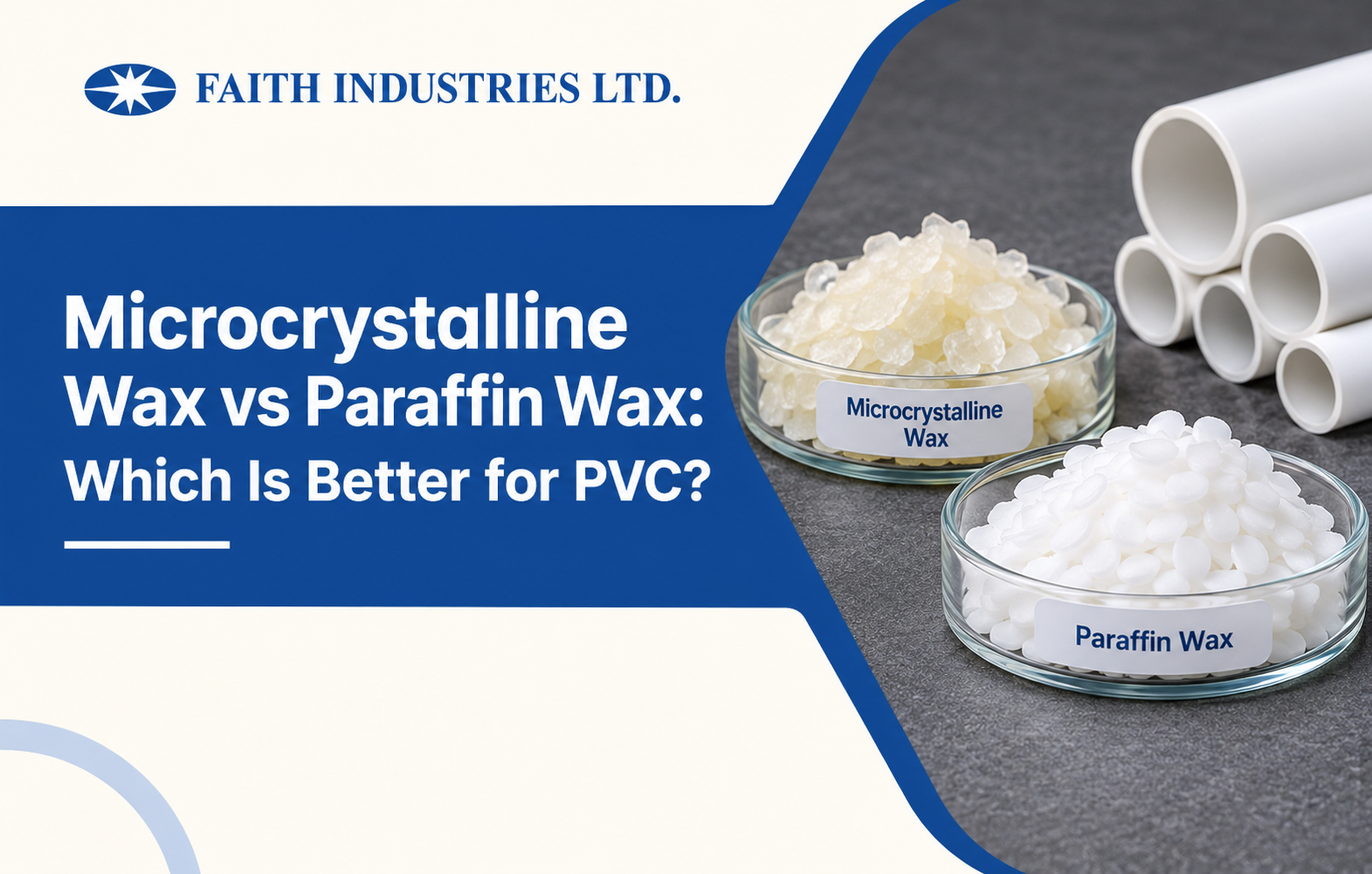
Microcrystalline wax manufacturers are catering to PVC processors that require consistent wax-based lubrication in demanding formulations. Research has shown that hydrocarbon waxes can have a strong influence on fusion behavior in PVC processing, even at low levels of addition. A study of Sn-stabilized PVC pipe formulations found that the melting point and concentration of wax could change the fusion window. Paraffin wax is a common external lubricant. Microcrystalline wax shows thermal and structural behavior.
How do Microcrystalline Wax and Paraffin Wax Behave in PVC Processing?
Paraffin wax primarily serves as a surface lubricant, reducing friction between the PVC melt and the processing surfaces. It may be appropriate for formulations where economical lubrication and release are important but performance is dependent on grade dosage and the rest of the formulation. Microcrystalline wax has a more branched, finer crystal structure, holds oil more strongly in general and has different melting and solidifying behavior.
In PVC these differences can affect the onset of lubrication in heating and cooling. This is important because too much lubrication externally can slow down fusion and too little lubrication can lead to higher friction, torque and surface defects. The choice of wax should therefore be based on the desired fusion window, extrusion behavior and finished surface rather than melting point alone.
Microcrystalline Wax vs Paraffin Wax: Which Is Better for PVC?
Neither microcrystalline wax nor Paraffin Wax is universally better for PVC; the choice depends on lubrication, processing conditions, and formulation balance.
|
PVC need |
Practical choice |
Why |
|
Cost-focused release |
Paraffin Wax |
Efficient external lubrication. |
|
Different solidification |
Microcrystalline wax |
Changes lubrication timing. |
|
Higher oil retention/cohesion |
Microcrystalline wax |
Maintains wax cohesion. |
|
Proven formulation |
Paraffin Wax |
Minimises formulation change. |
Choice depends on performance at the dosage. Changing wax can affect fusion, torque, die release, and surface finish. A grade should be tested in processing. The better choice is the one that delivers the processing window and surface result without upsetting the lubricant balance.
What Should PVC Manufacturers Check Before Selecting the Wax?
Manufacturers need to look beyond melting point when choosing a PVC wax, The melting or congealing behavior of the wax indicates the behavior on heating and cooling. The viscosity of the wax affects the movement and the lubrication of the wax when processed.
Oil content also matters because variations can change consistency and processing results. Most importantly, maintain the right lubrication–fusion balance; adding more wax can reduce friction but may delay fusion or affect surface quality. Finally, evaluate the wax with the complete formulation, including stabilizers, internal lubricants, fillers and other additives.
A wax cannot be selected independently from the rest of the PVC formulation. This formulation-based approach is especially important when working with a pvc stabilizer manufacturer to achieve consistent processing.
How to Choose a Reliable Microcrystalline Wax Supplier or Manufacturer
For PVC production, a reliable wax supplier should be judged by how consistently the material behaves in your process, not simply by its specification sheet. Check whether the supplier maintains the same key properties across batches, because even small variations can change lubrication, fusion time, torque and surface finish. Specifications should clearly define the grade rather than relying on broad descriptions such as “high-quality wax.” A dependable supplier should also help compare the wax against your existing formulation and processing conditions. Most importantly, the supplier should recommend a grade according to the PVC application, whether it is pipe, profile, sheet or another product. This reduces trial-and-error during production.
Why Choose Faith Industries Ltd. for Microcrystalline Wax?
Faith Industries Ltd. has worked with PVC lubricants and waxes for decades, introducing microcrystalline waxes under SurFix™ in 1980 and PVC lubricants and waxes under PolyAid™ in 1982. Its portfolio now covers microcrystalline and paraffin waxes alongside PVC stabilizers and other additives. With in-house R&D and manufacturing capabilities and international supply experience, Faith brings broader formulation knowledge as a pvc additives manufacturer helping customers evaluate wax as part of the complete PVC processing system.

 English
 Arabic
 French
 Spanish
 Portuguese
 Deutsch
 Turkish
 Italiano
 Russian
 Romaian
 Portuguese (Brazil)
 Greek
