


The Difficulties of Die Replacement on Fin Presses
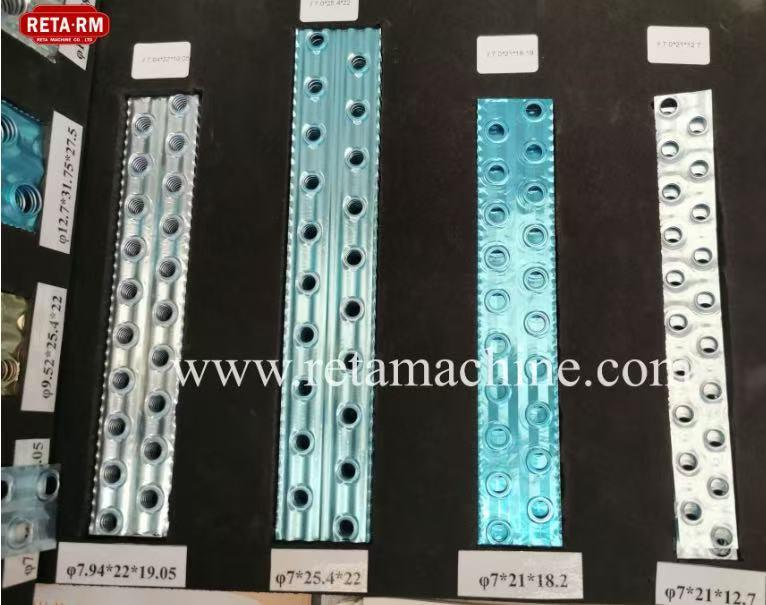
Fin presses are widely used to produce thin heat exchanger fins for HVAC and refrigeration equipment. Their progressive dies integrate punching, collar forming, louver bending and trimming in one compact unit, which brings obvious difficulties during die replacement, directly affecting production efficiency and product quality.
First of all, the requirement for precision alignment is extremely strict. Fin dies work with ultra-thin aluminum or copper foil at high speed, sometimes reaching hundreds of strokes per minute. Even a tiny offset between the upper and lower die will cause burrs, torn collars or inconsistent fin pitch. When replacing the die, technicians must carefully adjust parallelism, feeding timing and clearance of every station. These fine calibrations cannot be finished in a short time, and repeated trial stamping and inspection are necessary before stable production starts.
Secondly, the structure of progressive fin dies is complicated and heavy. A complete fin die contains dozens of punches, die inserts, guide posts and stripping components. Traditional non-modular dies need hoisting to move, and all clamping bolts and positioning blocks must be loosened and fastened in sequence. Any improper lifting or uneven clamping may damage delicate punch tips and guide sleeves. Safety procedures such as lockout and safety block installation also add to the whole changeover cycle.
Another challenge comes from matching auxiliary systems. After a new die is installed, operators need to reset the servo feeder speed, lubrication flow, stroke height and sensor parameters according to the new fin specification. Different fin heights, hole patterns and louver shapes correspond to unique machine settings. Inconsistent feeding or unstable lubrication will lead to continuous waste, especially for customized small-batch orders with frequent die switching.
In addition, the work demands experienced skilled workers. Die replacement is not a simple mechanical swap. Staff must understand stamping mechanics, tool wear rules and defect judgment. Less-experienced operators may take much longer to finish setup or leave hidden risks inside the die set.
Although modular tooling and quick die change systems have eased the pain points, full precision verification remains unavoidable. For many manufacturers, long die-change downtime is still a key bottleneck between high-volume mass production and flexible multi-specification fin manufacturing. Improving die change procedures is therefore an important way to raise the overall equipment efficiency of fin press lines.

 English
 Arabic
 French
 Spanish
 Portuguese
 Deutsch
 Dutch
 Italiano
 Russian
 Romaian
 Portuguese (Brazil)
 Greek
