


Pathology Courses for Doctors: Practical Points Before You Enrol
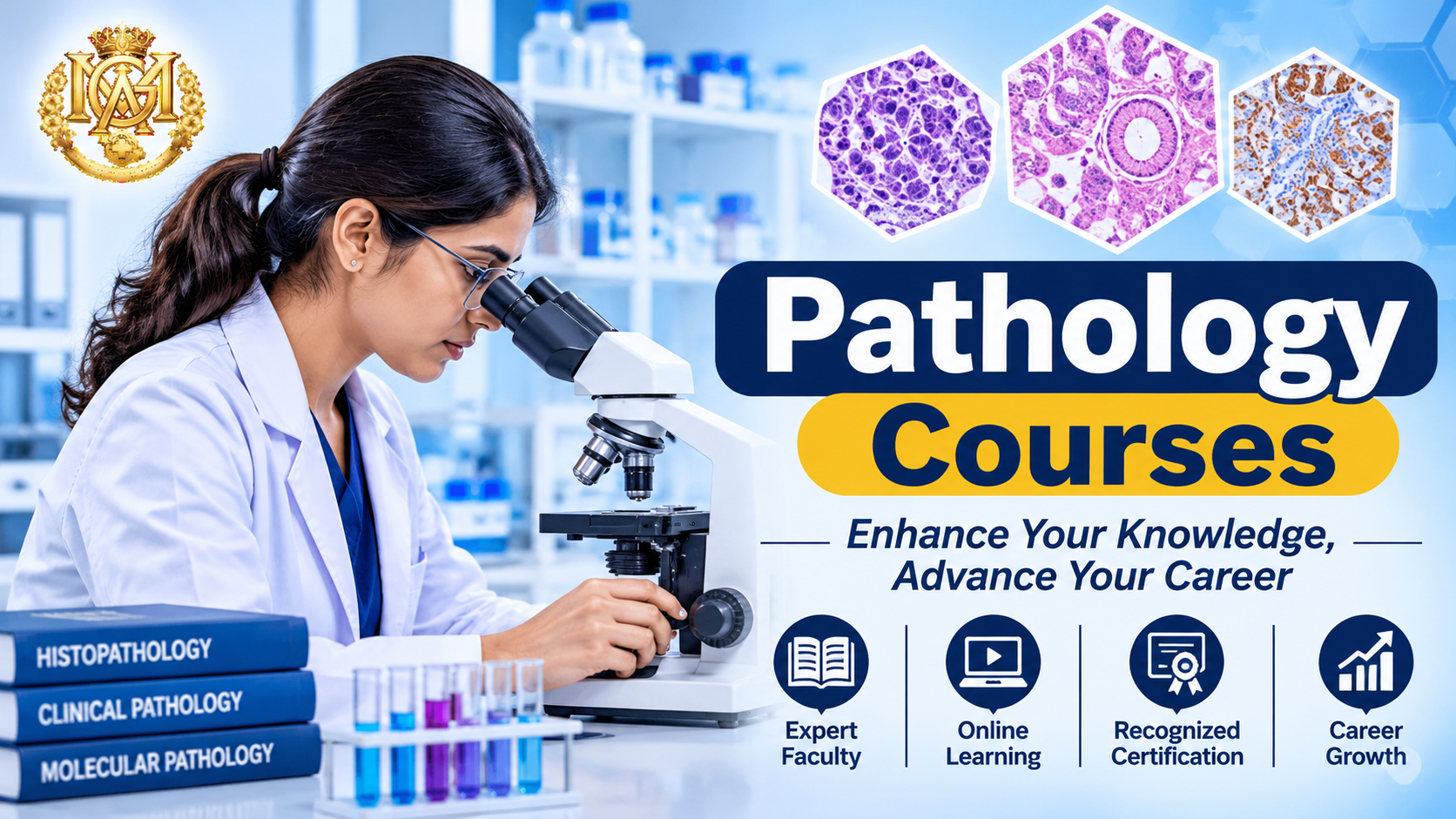
Why pathology course choices need a checklist
Pathology programmes differ in eligibility, format, and accreditation, so comparing them on the course title alone often leads to the wrong choice. A short checklist helps a doctor compare options on the points that matter for practice and for career records. This article sets out those points for medical professionals in India.
What pathology covers: the main branches
Pathology is the study of disease through the examination of tissues, cells, and body fluids. Doctors encounter it in several branches, including histopathology, cytopathology, haematopathology, and molecular pathology. Each branch uses different methods and suits different career paths, so the first step is to identify which branch matches your clinical work.
Eligibility for medical professionals
MGA's programmes are open only to eligible medical professionals. Before you apply, confirm the eligibility rules printed on the specific course page, because they differ by level. Fellowship programmes require a minimum of four years of post-qualification experience. Check your own degree and experience against the course page rather than assuming you qualify.
Certificate, diploma and fellowship levels
Pathology education is offered at three levels: certificate, PG diploma, and fellowship. A certificate suits a focused skill update. A PG diploma covers a broader curriculum. A fellowship is the most advanced option and carries the experience requirement noted above. Choose the level that matches your experience and your next professional step, not the one with the most attractive title.
Online, hybrid, and practical training
MGA's molecular pathology programmes are delivered online and in hybrid format. They do not include lab-based or clinical training. Before enrolling, confirm the delivery format on the course page and decide whether it fits your practice. A programme without hands-on lab training will not replace bench experience, so plan that separately if you need it.
Course length and the written schedule
Course length and the study schedule vary by programme, so read the duration and schedule on the individual course page. Ask for the schedule in writing before you commit. A clear written schedule shows the modules, the assessment dates, and the expected weekly study time, which makes it easier to fit the course around clinical duties.
Accreditation wording
MGA's programmes carry CPD accreditation. They are not approved by the National Medical Commission (NMC) and are not government approved. Read accreditation statements carefully and do not treat CPD accreditation as equivalent to government recognition. Check the exact wording on the course page and keep the accreditation certificate for your records.
Checklist before enrolling
- Confirm you meet the eligibility rules on the course page.
- Identify the branch of pathology that matches your practice.
- Choose the level (certificate, PG diploma, or fellowship) that fits your experience.
- Check the delivery format: online, hybrid, or practical.
- Read the duration and written schedule.
- Confirm the exact accreditation wording.
- Compare two or three programmes on the same points before deciding.
Frequently asked questions
Are MGA pathology courses open to non-doctors?
No. Programmes are open only to eligible medical professionals.
Are MGA courses NMC approved?
No. MGA programmes carry CPD accreditation and are not NMC approved or government approved.
Do fellowships need prior experience?
Yes. Fellowship programmes require a minimum of four years of post-qualification experience.
Are molecular pathology courses hands-on?
They are online and hybrid only and do not include lab-based or clinical training.
Summary and next steps
Choosing a pathology course is easier when you compare programmes on eligibility, level, delivery format, schedule, and accreditation wording. To explore the full range of programmes from Medical Global Academy, visit the courses page or the Medical Global Academy homepage.
This article is general information for eligible medical professionals. It is not medical advice. Confirm all course details on the official course page before enrolling.

 Arabic
 French
 Spanish
 Portuguese
 Deutsch
 Turkish
 Dutch
 Italiano
 Russian
 Romaian
 Portuguese (Brazil)
 Greek
