Global Water Soluble Fertilizer Market to Reach USD 28.6 Billion by 2032, Growing at a CAGR of 6.5%
Maximize Market Research | Tuesday, November 24, 2026 | Submitted by Maximize Market Research
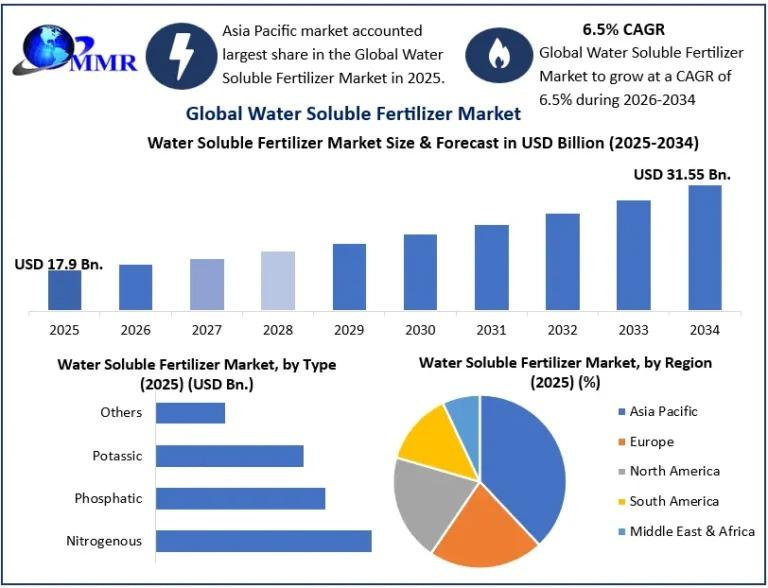
NEWARK, Del., November 24, 2026 — The Water Soluble Fertilizer Market was valued at USD 17.9 billion in 2025 and is projected to reach USD 28.6 billion by 2032, registering a CAGR of 6.5% during the forecast period from 2026 to 2032. The market is expected to generate an incremental value of USD 10.7 billion over the forecast period, driven by increasing demand for efficient agricultural inputs, rising food consumption, precision farming practices, and the growing adoption of micro-irrigation systems. Water-soluble fertilizers dissolve completely in water and deliver essential nutrients directly to plants, supporting improved nutrient absorption, crop productivity, and efficient fertilizer utilization. Their increasing application across horticulture, field crops, and commercial agriculture is strengthening global market demand.
As agricultural producers focus on improving crop yields, conserving water resources, and maintaining soil nutrient levels, water-soluble fertilizers are gaining importance as an efficient crop nutrition solution. Government initiatives promoting micro-irrigation, technological advancements in fertilizer formulations, and growing awareness of environmentally friendly agricultural practices are further supporting market expansion.
Request a Sample Report: https://www.maximizemarketresearch.com/request-sample/33171/
Global Water Soluble Fertilizer Market Size & Growth Forecasts
- Base Year Market Size (2025): USD 17.9 Billion
- Projected Market Size (2032): USD 28.6 Billion
- CAGR (2026–2032): 6.5%
- Added Market Value: USD 10.7 Billion
The Short Version: Key Market Takeaways
- Steady Expansion: The global water-soluble fertilizer market is expected to expand steadily, supported by increasing agricultural expenditure, rising food requirements, and the need to improve crop productivity.
- Specialty Fertilizer Demand: Nitrogenous fertilizers dominated the market in 2025 with a 60.2% share, while horticultural crops represented the leading crop-type segment due to their specific nutrient requirements and higher market value.
- Sustainable and Technological Solutions: Increasing adoption of fertigation, micro-irrigation, precision agriculture, and controlled-release fertilizer formulations is creating opportunities for efficient nutrient delivery and reduced resource wastage.
- Main Industrial Applications: Water-soluble fertilizers are increasingly used in field crops, horticulture, plantation crops, turf, and ornamental applications through fertigation and foliar application methods.
Growth Drivers of the Global Water Soluble Fertilizer Market
The global water-soluble fertilizer market is experiencing growth due to the increasing requirement for agricultural productivity, efficient nutrient management, and sustainable farming practices. Rising global food consumption, government support for modern agricultural techniques, and advancements in fertilizer technologies are encouraging farmers and agricultural businesses to adopt water-soluble fertilizer products.
Key growth drivers include:
- Increasing Demand for Agricultural Productivity: Rising population levels and growing food consumption are increasing the requirement for improved agricultural output. The global population is expected to reach 9.7 billion by 2050, strengthening the need for modern agricultural materials that support higher crop yields and efficient nutrient management.
- Government Initiatives and Agricultural Support Programs: Government policies, financial incentives, subsidies, reduced import taxes, and farmer education programs are encouraging the adoption of water-soluble fertilizers. Initiatives supporting micro-irrigation and water-use efficiency are further strengthening market development. Demonstration projects and farmer training programs are also improving awareness of fertilizer application techniques.
- Growing Preference for Environmentally Friendly Fertilizers: Water-soluble fertilizers deliver nutrients directly to plant root zones, helping reduce nutrient losses and the risk of groundwater contamination. Their compatibility with fertigation and micro-irrigation systems supports water conservation and efficient nutrient utilization, increasing their attractiveness among farmers adopting sustainable agricultural practices.
- Technological Advancements in Fertilizer Formulations: Developments in controlled-release fertilizers, enhanced nutrient formulations, precision agriculture, and sensor-based irrigation management are improving fertilizer application efficiency. These technologies allow farmers to monitor nutrient requirements, optimize fertilizer usage, and reduce unnecessary resource consumption.
- Increasing Adoption of Micro-Irrigation and Fertigation: The growing use of micro-irrigation systems, particularly across Asia Pacific, is creating additional demand for water-soluble fertilizers. Fertigation enables nutrients to be delivered directly to plant root zones with greater control over application timing and quantities. The method can reduce fertilizer usage by up to 28%, supporting more efficient agricultural production.
Market Opportunities in the Global Water Soluble Fertilizer Market
The increasing adoption of advanced agricultural practices and the expansion of high-value crop cultivation are creating significant opportunities for manufacturers, investors, and fertilizer suppliers.
Key strategic opportunities include:
- Expand Micro-Irrigation-Compatible Fertilizer Solutions: Manufacturers can strengthen their market presence by developing fertilizer products compatible with micro-irrigation and fertigation systems, particularly in regions experiencing increasing demand for water-efficient agricultural practices.
- Invest in Advanced Fertilizer Formulations: Developing specialized nutrient blends, controlled-release products, and enhanced formulations can help companies address specific crop requirements and differentiate their products in the competitive fertilizer industry.
- Strengthen Raw Material Supply Chains: Establishing reliable supplier relationships and monitoring international raw material availability and pricing trends can help manufacturers manage procurement risks and maintain production continuity.
- Develop Strategic Agricultural Partnerships: Collaborations with universities, research institutions, irrigation equipment providers, agricultural extension services, and government organizations can support product innovation, farmer education, and improved fertilizer application practices.
- Target High-Value Horticultural Crops: Increasing demand for fruits, vegetables, and flowers creates opportunities for specialized water-soluble fertilizer products that address crop-specific nutrient requirements and improve agricultural productivity.
- Leverage Government Incentives and Subsidies: Companies can explore opportunities in regions where government initiatives support modern fertilizer usage, micro-irrigation adoption, agricultural research, and farmer training programs.
Explore the Global Water Soluble Fertilizer Market Outlook: https://www.maximizemarketresearch.com/request-sample/33171/
Key Market Considerations / Challenges
Despite favorable growth prospects, the global water-soluble fertilizer market faces several operational, economic, and regulatory challenges that could influence manufacturers and agricultural producers.
- High Product Costs: Water-soluble fertilizers are specialty agricultural inputs with relatively high prices. Their limited cost-effectiveness in certain markets can restrict adoption, particularly among farmers operating with lower profit margins.
- Raw Material Price Fluctuations: Changes in the prices of essential raw materials, including potash and natural gas, can increase manufacturing expenses and affect fertilizer selling prices.
- Supply Chain Disruptions: Technical production outages, export restrictions, geopolitical developments, and interruptions in raw material availability can affect production capacity and product distribution.
- Seasonal Demand and Weather Dependence: Fertilizer demand is influenced by agricultural seasons and changing weather conditions. Heavy rainfall can increase nutrient leaching, reducing fertilizer effectiveness and influencing purchasing decisions.
- Regulatory Compliance Requirements: Fertilizer manufacturers must comply with environmental regulations, product composition standards, licensing requirements, packaging guidelines, storage rules, and manufacturing safety requirements across different countries.
- Intense Market Competition: Competition based on delivered prices, product quality, customer service, and product availability creates pressure on manufacturers to improve operational efficiency and maintain competitive pricing.
- Similar Product Formulations: The increasing presence of manufacturers offering comparable fertilizer formulations can intensify competition and create challenges for companies seeking to differentiate their products.
Analyst Perspective / Conclusion
The Global Water Soluble Fertilizer Market is positioned for consistent expansion through 2032, supported by the increasing requirement for efficient crop nutrition, rising food consumption, and the adoption of modern agricultural practices. The projected increase from USD 17.9 billion in 2025 to USD 28.6 billion by 2032 highlights the growing importance of water-soluble fertilizers in improving nutrient absorption and supporting agricultural productivity. The dominance of nitrogenous fertilizers and the fertigation application segment reflects the importance of targeted nutrient delivery in contemporary farming practices.
From a strategic perspective, advancements in fertilizer formulations, government support for micro-irrigation, and increasing demand for sustainable agricultural solutions are expected to create opportunities for industry participants. Manufacturers focusing on production efficiency, reliable raw material sourcing, specialized fertilizer blends, and partnerships with agricultural institutions can strengthen their competitive positioning. However, managing raw material price volatility, regulatory requirements, seasonal demand fluctuations, and product affordability will remain important considerations throughout the forecast period. Overall, continued improvements in agricultural technologies and efficient nutrient management are expected to support the long-term development of the global water-soluble fertilizer industry.
Explore More Related Reports:
Formaldehyde Market
Tin Market
About Maximize Market Research
Maximize Market Research publishes sector forecasts, competitive analysis, and consulting insight for teams evaluating demand, competition, pricing, and growth strategy across high-value industries.
Contact
MAXIMIZE MARKET RESEARCH PVT. LTD.
2nd Floor, Navale IT Park Phase 3
Pune Banglore Highway, Narhe
Pune, Maharashtra 411041, India
+91 9607365656
sales@maximizemarketresearch.com




 English
 Arabic
 French
 Spanish
 Portuguese
 Turkish
 Dutch
 Italiano
 Russian
 Romaian
 Portuguese (Brazil)
 Greek
