


Guanfeng Notes on a Commercial Grinding Machine For Grain
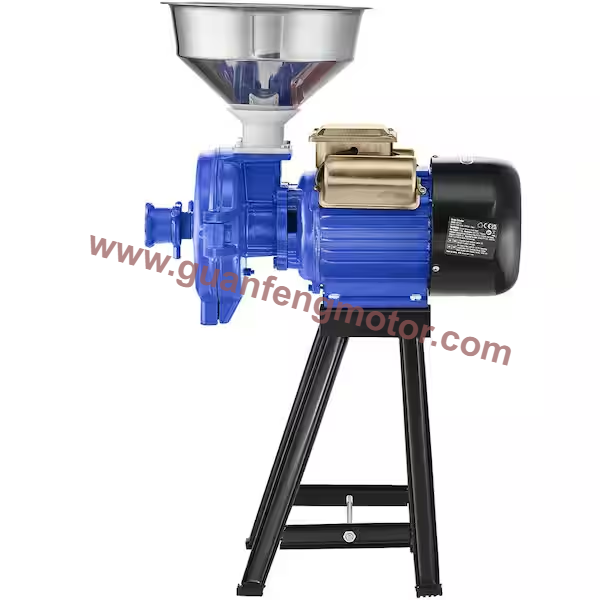
People tend to say that a Commercial Grinding Machine For Grain is just a motor spinning something hard against kernels, and in a rough sense that description holds, though it skips the parts that decide whether the meal comes out coarse, fine or scorched. I have stood beside a few of these in small milling rooms, and what struck me was how little of the work shows from outside: a hopper above, a casing in the middle, a spout at the bottom, and a low steady hum that shifts in pitch when the feed thickens.
The intake is where everything begins, and it is easy to overlook. Seed pours from the hopper by gravity, usually past a slide gate that can be nudged open or shut by hand, and that small plate decides how quickly material arrives in the crushing zone. Open it too wide and the hum drops into a labouring drone, while a gate set too narrow leaves the zone half empty and the sound turns thin and rattly. Operators pick this up by ear long before they read a manual, which is probably why different people on the same unit can end up with slightly different texture from the same sack.
Inside, the kernels are broken by impact or by squeezing between hard surfaces, depending on the design, and the fragments keep circulating until they are small enough to slip through a perforated sieve at the exit. The size of those holes shapes the character of the output to a large degree. Coarse product for livestock and fine flour for the kitchen come from the same basic motion, simply with a different mesh fitted, and swapping one usually takes a spanner and a few minutes provided the casing opens cleanly and nobody has let damp dust bake itself into the bolts.
The drive is the quiet half of the story. Electric power units of this kind are commonly asynchronous, meaning the rotor follows the rotating field of the stator without brushes to wear out, and they come in single-phase form for places with ordinary household supply and in three-phase form for workshops with heavier wiring. Guanfeng, a company based in Wenling, makes electric motors, grain grinding machines and mechanical parts, and its range covers both single-phase and three-phase asynchronous types for agricultural and industrial applications, so the supply at a given site largely decides which kind gets fitted, while the cereal itself does not care either way.
Between the shaft and the working parts there is often a coupling or a belt, and I have learned to put a hand near it rather than on it, since a loose guard rattling against a spinning pulley is a sound you remember. Balance matters too: a rotor carrying a chipped or unevenly worn part sends a shudder through the frame that you feel in your teeth, and the base plate will walk across a concrete floor if it is not bolted down. Bearings tend to complain first, with a dry whine that rises as the shaft speeds up and fades when the load comes on, and a grease-stained rag nearby is often a sign someone has been dealing with them.
Heat is what I notice after a long run. Friction warms the product, the sieve and the housing, and a palm laid on it after a steady session finds it warm enough to be uncomfortable without being alarming, whereas a shell too hot to touch suggests the feed has been too thick or the holes are clogged with damp cereal. Moisture matters here, because cereal that has not dried properly gums up the perforations and the discharge slows to a trickle. Dust is the other constant, a pale film that settles on every ledge, the floor and your forearms, so an open door or a hood over the spout is welcome.
Between batches I like to run the empty unit for a short spell so the leftover meal clears out, then tip the sack end over end and tap the outlet with a knuckle to loosen whatever clings. Mixed seed types leave a faint flavour behind otherwise, and anyone who has run wheat straight after something pungent knows how stubborn that smell can be.
Wear is a separate matter: screens and impact surfaces slowly lose their edge, and the output drifts a little larger than the mesh size suggests, which is how you find out a part is tired. The manufacturer's site at https://www.guanfengmotor.com/ sits in my bookmarks beside some scribbled notes on motor types and screen sizes, and none of it tells me how a given unit copes with a damp sack. The trade-off I keep turning over while watching a Commercial Grinding Machine For Grain at work is that a fine mesh gives even flour but clogs sooner and puts a heavier load on the drive, while a coarse mesh runs freely and leaves a rougher texture, and I have not yet seen a setting that satisfies both.

 English
 Arabic
 French
 Spanish
 Portuguese
 Turkish
 Dutch
 Italiano
 Russian
 Romaian
 Portuguese (Brazil)
 Greek
