


Data Center Security for Banking and Financial Institutions in the UAE
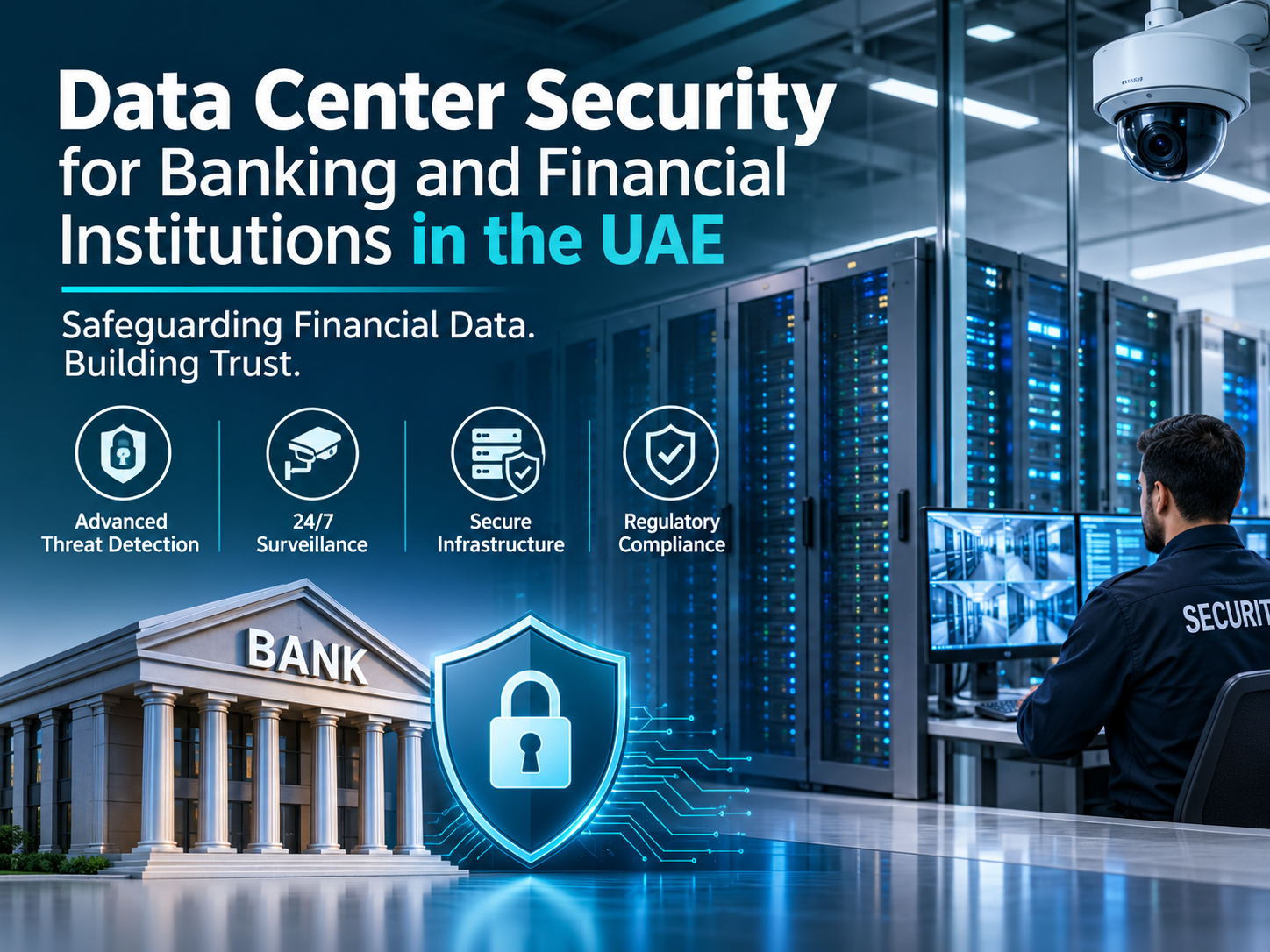
Data Center Security protects the servers that hold every account balance, card payment, and trade at UAE banks, insurers, exchange houses, and fintech firms. This article explains why financial institutions face higher stakes than most, which layers of protection matter, and how to prove to regulators and customers that the controls really work.
Part One: Why Finance Faces Higher Stakes
A bank does not only store data, it stores trust. When a payment system stops for an hour, salaries are late, shops cannot take cards, and customers lose confidence. When customer records leak, the damage to reputation can last for years.
Financial firms are also a favourite target. Criminals want account data, card numbers, and access to payment networks, and some attacks begin with a stolen badge or a bribed contractor rather than a clever piece of code. Physical and digital protection must therefore work as one plan.
Part Two: The Layers a Financial Facility Needs
Layer One: The Outer Boundary
The Data Center Perimeter is the first thing an attacker meets. Fencing, tested vehicle barriers, lighting, thermal cameras, and sensors give early warning, and a staffed gatehouse inspects every vehicle and delivery. Banks should also keep a safe distance between public roads and the building walls.
Layer Two: Doors, Halls, and Cages
Data Center Access Control decides who may enter each space and for how long. Biometrics, cards, mantraps, and permissions linked to approved change tickets let an engineer reach one cage for one window of time, and every entry leaves a record that internal audit can check. Dual authorization for the most sensitive rooms adds another safeguard.
Layer Three: Constant Watching
Data Center Security Monitoring brings doors, cameras, alarms, power, cooling, and network events into a control room that never sleeps. Analytics notice tailgating, loitering, and doors held open, so operators react in seconds, and the system also checks that its own cameras and recorders are alive.
Risk teams that want to see how these layers support each other often begin with layered protection options for UAE banking data halls before they write a specification.
Layer Four: The Connecting Brain
Data Center Security Software joins every system into one view. It correlates alerts, tracks visitors, contractors, and assets, enforces policy, and produces time stamped reports that compliance officers and auditors can rely on. Protected logs and regular updates keep the platform itself from becoming a weak point.
Layer Five: Network and Data
Firewalls divide the network into zones, encryption keeps stored data unreadable if a drive is lost, and strong identity checks guard administrator accounts. Independent penetration tests and regular patching show how a real attacker would try to reach payment systems.
Part Three: One Designed System
Data Center Security Solutions bring all of these layers into one planned system instead of a pile of separate purchases. The design covers the boundary, the building, the halls, the racks, and the network, and gives the bank a single record of every event from the gate to the cage.
Resilience completes the design. Duplicate power and cooling paths, tested generators, batteries, and a second site for disaster recovery keep payments flowing through faults and summer heat. Banks should rehearse failover often, because an untested backup is only a hope.
People are the last layer. Staff need training, clear escalation steps, and drills for intrusion, power loss, ransomware, and fire. Background checks for staff and contractors, and prompt removal of rights when someone leaves, close a gap that technology alone cannot.
Part Four: UAE Regulators and Standards
The Central Bank of the UAE sets expectations for banks, insurers, and payment firms, and its outsourcing and operational resilience rules affect how facilities and suppliers are chosen. The Telecommunications and Digital Government Regulatory Authority and the UAE Information Assurance Regulation guide national practice, and the Dubai Electronic Security Center sets expectations for Dubai entities.
Federal Decree Law Number 45 of 2021 sets duties for protecting personal data. Free zones add their own rules, including the Dubai International Financial Centre and Abu Dhabi Global Market, and card processors follow PCI DSS. Customers also look for ISO 27001 and ISO 22301 certificates, TIA 942 and Uptime tiers, and Civil Defence approvals for life safety.
Part Five: Across the Emirates
A Data Center Security UAE programme should hold every bank site to the same tests, reports, and response times, so group risk teams can audit one standard instead of many. Consistent methods also let headquarters spot a weak branch facility before it fails.
Data Center Security Abu Dhabi projects often serve government related banks, sovereign investors, and energy sector financiers in areas such as Abu Dhabi Global Market and Masdar City. Long contracts and sensitive data make detailed evidence and maintenance plans especially valuable.
Data Center Security Dubai projects serve retail banks, fintech firms, exchange houses, and wealth managers around the Dubai International Financial Centre and Dubai Internet City. Fast growth, dense racks, and heat make cooling, cable discipline, and quick expansion central to every design.
Part Six: Proof Points Regulators Respect
Ask every supplier for a site survey, drawings of doors and cameras, commissioning test records, staff training, a privacy statement, and a support agreement with clear response times. References from banks, insurers, and payment firms show practical experience with audits and incident reporting.
Keep evidence ready at all times: access reviews, alarm test results, backup restore tests, maintenance records, and incident reports with the actions that followed. Findings that are written down, assigned, and closed are the clearest proof that controls are real.
A short assessment is the best first step, and a facility review and resilience roadmap for UAE financial firms will show where the largest gaps lie today.
Part Seven: A Practical Roadmap for Banks
List the ten systems that would hurt most if lost and check who can reach them today. Close easy gaps first, such as unused accounts, shared passwords, and unlogged visits. Then improve one layer at a time, rehearse each change, and review response times every month.
Give every control a named owner, a regular check, and a clear escalation path. Cameras nobody watches and rules nobody reviews create a false sense of safety, while steady improvement creates real strength.
Track a few simple measures: time to detect an alarm, time to respond, number of unreviewed access rights, and days since the last tested recovery. Numbers that improve month after month show the board that the investment is working.
Finally, compare total cost over five years and not only the purchase price. Maintenance, spare parts, software updates, training, and response contracts often decide whether protection stays effective after the first year.
When you are ready to compare designs, explore complete protection planning for critical IT facilities and measure them against your current setup.
Conclusion
Data Center Security is the foundation of trust for every UAE bank and financial institution. Data Center Security Solutions join the Data Center Perimeter and Data Center Access Control into one designed system. Data Center Security Monitoring and Data Center Security Software give early warning, honest records, and audit ready evidence. A planned Data Center Security UAE roadmap, including Data Center Security Abu Dhabi and Data Center Security Dubai sites, keeps payments available and regulators satisfied. Contact Tektronix today to schedule your facility review.
FAQs
1. Why is the Data Center Perimeter the first layer a bank should review?
Fencing, barriers, lighting, and sensors give early warning, and a controlled gatehouse checks every vehicle and visitor.
2. How does Data Center Access Control support internal audit?
Every entry is tied to an approved ticket and recorded, so auditors can see who reached which cage and when.
3. What should Data Center Security Monitoring watch at a financial facility?
It watches doors, cameras, alarms, power, cooling, and network events, and alerts staff when any device stops reporting.
4. Why does Data Center Security Software matter to compliance teams?
It keeps protected, time stamped records and creates reports that regulators and auditors can rely on.
5. What should Data Center Security Dubai projects for banks plan first?
Dense racks, fast growth, and heat make cooling, cable discipline, and quick expansion the priorities.

 English
 Arabic
 French
 Spanish
 Portuguese
 Deutsch
 Turkish
 Dutch
 Italiano
 Romaian
 Portuguese (Brazil)
 Greek
