


Research Antibodies Market Size, Industry Analysis & Forecast 2026-2034
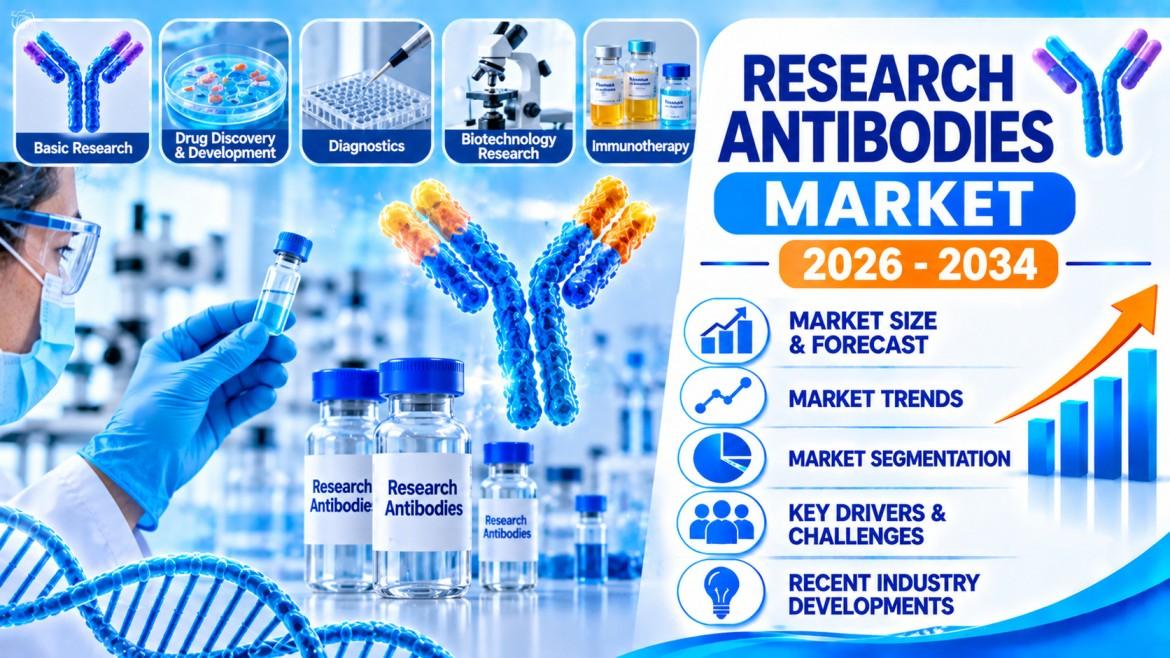
IMARC Group, a leading global market research and management consulting firm, has published its latest market intelligence report on the research antibodies market. The global research antibodies market size reached USD 4.5 Billion in 2025. Looking forward, IMARC Group expects the market to reach USD 7.0 Billion by 2034, exhibiting a growth rate (CAGR) of 4.84% during 2026-2034. The industry is experiencing strong growth momentum, driven by rising cancer research activity, expanding stem cell and immunology programs, sustained public and private R&D funding, and growing demand for reproducible, high-specificity reagents in academic, contract research, and biopharmaceutical laboratories worldwide.
Research antibodies are the working tools of modern biology. Researchers use them to detect, quantify, and localize proteins in applications such as ELISA, western blotting, flow cytometry, immunofluorescence, immunochemistry, and immunoprecipitation. Demand is rising as oncology, neurobiology, and infectious disease programs scale up and drug developers need validated reagents to confirm targets early. Suppliers are also responding to researcher concerns about reproducibility by shifting toward recombinant formats, application-specific validation, and transparent citation data.
How AI is Reshaping the Future of the Research Antibodies Market
- AI-Guided Antibody Selection and Validation: Citation analytics and machine learning tools help researchers compare antibody performance across applications, species, and publications before purchase. This reduces failed experiments, lowers reagent waste, and makes validation data a competitive differentiator for suppliers.
- Computational Design and Recombinant Engineering: AI-driven protein modeling is shortening the path from target selection to candidate antibody. It improves binding specificity and supports consistent recombinant production. This reduces the batch-to-batch variability long associated with animal-derived reagents.
- Automated Imaging and Multiplexed Assay Analysis: Machine learning is being applied to immunofluorescence and flow cytometry datasets to classify cell populations and quantify marker expression at scale. This raises demand for multiplex-ready, highly validated antibody panels in oncology and immunology research.
Grab a sample PDF of this report: https://www.imarcgroup.com/research-antibodies-market/requestsample
Research Antibodies Market Trends and Drivers
- The research antibodies market is witnessing steady expansion, supported by oncology research intensity, stem cell science, public research funding, and a structural move toward better-validated reagents.
- Rising cancer burden is expanding oncology research demand. Antibodies are central to identifying tumor markers, mapping immune cell infiltration, and testing therapeutic targets. According to the IARC GLOBOCAN release covered by UICC in July 2026, the world recorded 20.6 million new cancer cases and 9.8 million cancer deaths, and about one in five people is expected to develop cancer in their lifetime. Every new oncology program, from biomarker discovery to immunotherapy research, needs large volumes of primary and secondary antibodies. This keeps the oncology application segment a steady source of reagent demand.
- Public research funding anchors academic demand. Academic and research institutes remain core buyers. In January 2026, a US congressional compromise spending package set NIH funding at USD 48.7 Billion, an increase of USD 415 Million over the prior fiscal year. That outcome rejected proposed deep cuts and signaled continuity for grant-funded laboratories that buy antibodies, assay kits, and cell biology reagents. In India, the Union Cabinet approved the BioE3 Policy in August 2024. It aims to advance high-performance biomanufacturing and has helped lift the country's bioeconomy from about USD 10 Billion to over USD 130 Billion over the last decade. This supports growing demand for research reagents from domestic institutes and biotech start-ups.
- Stem cell and neurobiology research are widening the application base. Developmental biology, disease modeling, drug screening, and cell therapy studies depend on antibodies to characterize cell identity, differentiation state, and purity. As cell and gene therapy programs expand, antibody use is spreading from basic research into process development and quality workflows.
- Reproducibility and sustainability are reshaping purchasing decisions. Researchers increasingly prefer recombinant antibodies and suppliers that publish validation and citation data. Sustainability is also becoming a purchasing factor. In October 2024, Thermo Fisher Scientific introduced an ambient shipping solution for its 125,000 Invitrogen antibodies. The company expects it to eliminate more than 216,000 pounds of paper and 440,000 pounds of gel ice packs each year, and to cut shipment packaging mass by 90%.
Ask an analyst for a customized report: https://www.imarcgroup.com/request?type=report&id=3581&flag=E
Research Antibodies Industry Segmentation
The report has segmented the market into the following categories:
Breakup By Type:
- Monoclonal Antibodies
- Polyclonal Antibodies
Monoclonal antibodies are valued for single-epitope specificity and lot-to-lot consistency, which suits quantitative and reproducibility-sensitive assays. Polyclonal antibodies remain widely used where broad epitope recognition and signal amplification matter, such as immunochemistry and western blotting.
Breakup By Technology:
- Immunochemistry
- Immunofluorescence
- Western Blotting
- Flow Cytometry
- Immunoprecipitation
- ELISA
- Others
Breakup By Source:
- Mouse
- Rabbit
- Goat
- Others
Breakup By Application:
- Infectious Diseases
- Immunology
- Oncology
- Stem Cells
- Neurobiology
- Others
Breakup By End User:
- Academic and Research Institutes
- Contract Research Organizations
- Pharmaceutical and Biotechnology Companies
Academic institutes drive broad-based reagent consumption through grant-funded research. Pharmaceutical and biotechnology companies and CROs generate demand tied to drug discovery, target validation, and outsourced preclinical studies, where validated and reproducible antibodies directly protect program timelines.
Breakup By Region:
- North America (United States, Canada)
- Asia Pacific (China, Japan, India, South Korea, Australia, Indonesia, Others)
- Europe (Germany, France, United Kingdom, Italy, Spain, Russia, Others)
- Latin America (Brazil, Mexico, Others)
- Middle East and Africa
North America and Europe benefit from dense networks of research universities, biopharma clusters, and established reagent suppliers. Asia Pacific is gaining momentum as government-backed bioeconomy programs and expanding CRO capacity in China, India, Japan, and South Korea raise reagent consumption.
Competitive Landscape
The report provides a comprehensive analysis of the competitive landscape in the research antibodies market, with detailed profiles of major companies, including:
- Abcam Plc
- Agilent Technologies Inc.
- Becton, Dickinson and Company
- Bio-Rad Laboratories Inc.
- Cell Signaling Technology Inc.
- F. Hoffmann-La Roche Ltd.
- Lonza Group AG
- Merck KGaA
- PerkinElmer Inc.
- Thermo Fisher Scientific Inc.
What Does The Full Report Cover?
If you are tracking the research antibodies market for investment decisions, market entry planning, competitive benchmarking, or strategic advisory, IMARC Group's report gives you everything in one place:
- Complete market sizing with revenue analysis across type, technology, source, application, end user, and region
- Quantified driver, restraint, and opportunity analysis across oncology, stem cell, immunology, neurobiology, and infectious disease research
- Sub-segment breakdowns for monoclonal and polyclonal antibodies, key assay technologies, and antibody source species
- Country-level coverage for the United States, Canada, Germany, France, the United Kingdom, Italy, Spain, Russia, China, Japan, India, South Korea, Australia, Indonesia, Brazil, and Mexico
- Competitive profiles of leading companies with strategic landscape assessment
- Porter's Five Forces, value chain analysis, and pricing intelligence
- Latest trends in recombinant antibody adoption, validation standards, and assay multiplexing
Recent News and Developments in Research Antibodies Market
- June 2026: Merck KGaA, Darmstadt, Germany, agreed to acquire Bio-Techne for about USD 11.3 Billion in enterprise value, at USD 73 per share in cash. Bio-Techne is a leader in recombinant proteins, antibodies, and immunoassay kits, with net sales above USD 1.2 Billion in its last fiscal year. The deal targets higher-value reagents, spatial biology, and cell and gene therapy workflows, with about EUR 140 million in cost synergies planned. It is expected to close in late 2026 or early 2027.
- January 2026: The US congressional spending compromise placed NIH funding at USD 48.7 Billion, a USD 415 Million increase. This gave academic and institutional buyers greater budget certainty for antibody and reagent procurement.
- October 2024: Thermo Fisher Scientific introduced ambient shipping for its 125,000 Invitrogen antibodies, aiming to remove more than 216,000 pounds of paper and 440,000 pounds of gel ice packs annually while cutting packaging mass by 90%.
- August 2024: India's Union Cabinet approved the BioE3 Policy to promote biomanufacturing and a bio-based economy. It supports domestic demand for research-grade biological reagents.
Note: If you require specific details, data, or insights that are not currently included in the scope of this report, we are happy to accommodate your request. As part of our customization service, we will gather and provide the additional information you need, tailored to your specific requirements.
Key Questions This Report Answers
- What is the current global research antibodies market size?
- Which type, technology, source, and application segments are shaping demand?
- What are the key drivers of research antibodies market growth?
- Which regions and countries offer the strongest opportunities?
- How are recombinant antibodies, validation standards, and AI tools changing competition?
- Who are the top companies in the research antibodies market and what are their strategies?
- What are the investment and market entry opportunities across oncology, stem cell, and neurobiology research?
About Us
IMARC Group is a global management consulting firm that helps the world's most ambitious changemakers to create a lasting impact. The company provides a comprehensive suite of market entry and expansion services. IMARC offerings include thorough market assessment, feasibility studies, company incorporation assistance, factory setup support, regulatory approvals and licensing navigation, branding, marketing and sales strategies, competitive landscape and benchmarking analyses, pricing and cost research, and procurement research.
Media and Sales Contact
IMARC Group
Email: sales@imarcgroup.com
United States: +1-201-971-6302
India: +91-120-433-0800
United Kingdom: +44-753-714-6104

 English
 Arabic
 Spanish
 Portuguese
 Deutsch
 Turkish
 Dutch
 Italiano
 Russian
 Romaian
 Portuguese (Brazil)
 Greek
