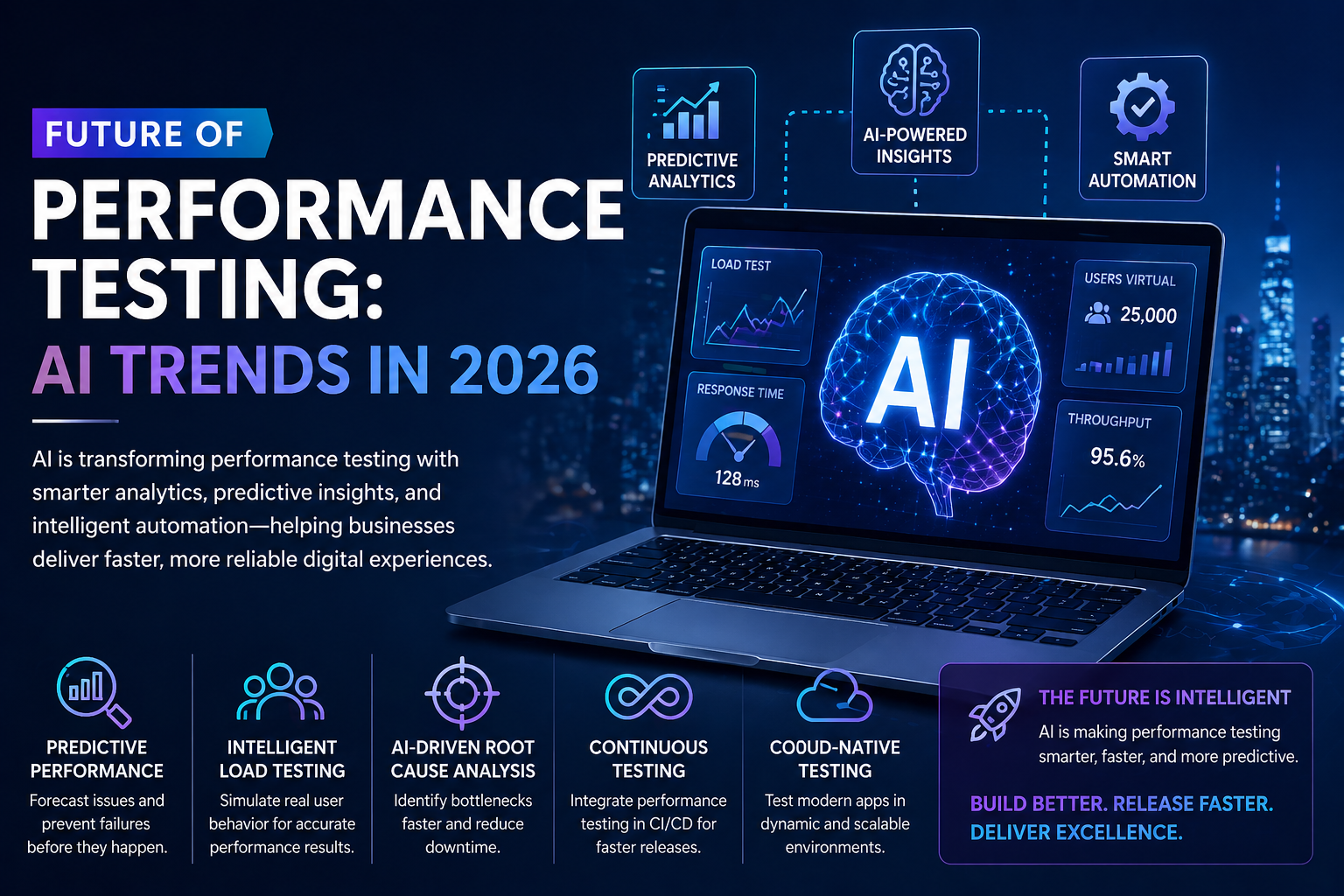
The world of software quality assurance is changing rapidly, and the future of performance testing is being shaped by artificial intelligence, automation, and predictive technologies. As businesses rely more on cloud platforms, mobile applications, SaaS products, and real-time digital services, traditional testing methods are no longer enough. Organizations now need faster, smarter, and more accurate ways to ensure their systems can handle traffic, scale efficiently, and deliver seamless user experiences.
In 2026, AI in performance testing is no longer an emerging concept. It is becoming a core strategy for businesses that want to improve software speed, reduce downtime, and launch products with confidence.
Why Performance Testing Is Evolving
Modern applications are far more complex than they were a few years ago. Many platforms now operate through microservices, APIs, containers, and distributed cloud infrastructure. These systems must support thousands or even millions of users simultaneously. Traditional load testing often struggles to replicate these dynamic environments effectively.
This is why companies are investing in AI-powered performance testing solutions that can simulate realistic traffic patterns, analyze massive data sets quickly, and identify potential failures before they affect users. Instead of reacting after a slowdown or outage occurs, businesses can now take a proactive approach to quality assurance.
AI-Powered Predictive Analytics in Performance Testing
One of the most important trends in the future of performance testing is predictive analytics. AI systems can study historical system behavior, resource consumption, traffic spikes, and user patterns to forecast future risks. This allows organizations to prepare infrastructure in advance and avoid performance bottlenecks during peak usage.
For example, an eCommerce platform preparing for holiday traffic can use predictive performance testing to estimate demand and scale systems before customers experience delays. This reduces lost revenue and improves customer satisfaction.
Intelligent Load Testing for Real-World Scenarios
Traditional load testing usually relies on static scripts and predefined traffic volumes. In contrast, intelligent load testing uses AI to model real user behavior, changing traffic conditions, and region-based usage trends. This creates more realistic testing environments and delivers more accurate results.
As applications become more global and customer expectations continue to rise, realistic simulation is becoming essential. Businesses that use automated load testing can better understand how their systems behave under actual market conditions.
Faster Root Cause Analysis with AI
When a website or application becomes slow, identifying the reason can take hours or even days. AI dramatically improves this process by reviewing logs, metrics, traces, and infrastructure data in real time. This helps teams pinpoint issues such as database delays, server overload, API latency, or memory leaks much faster.
This trend is making performance bottleneck detection more efficient and reducing downtime for businesses that depend on uninterrupted digital operations.
Continuous Performance Testing in DevOps
Another major shift in the future of performance testing is the integration of testing into DevOps pipelines. Rather than waiting until the end of development, teams now run tests continuously throughout the software lifecycle. AI helps prioritize the most critical tests, optimize execution time, and provide faster feedback to developers.
This approach, often called shift-left performance testing, enables companies to release updates faster while maintaining quality and stability.
Why Businesses Need AI in Performance Testing
The business value of AI-driven performance testing is significant. Faster issue detection means fewer production failures. Better capacity planning prevents overspending on infrastructure. Improved system speed enhances user experience, which can directly impact conversions, engagement, and customer loyalty.
For industries such as fintech, healthcare, SaaS, and eCommerce, reliable performance is no longer optional. It is a competitive advantage.
Final Thoughts
The future of performance testing in 2026 is intelligent, predictive, and deeply integrated into modern software delivery. Organizations that continue relying only on traditional methods risk slower releases, poor user experiences, and unexpected outages. AI is transforming testing from a reactive process into a strategic advantage.
Businesses looking to modernize their quality engineering approach can partner with experts like SDET Tech, which provides advanced performance testing services, AI-powered automation, and scalable QA solutions designed for today’s high-demand digital environments.




 English
 Arabic
 French
 Spanish
 Portuguese
 Deutsch
 Turkish
 Dutch
Dutch
 Italiano
 Russian
 Romaian
 Portuguese (Brazil)
