


Amblyopia Therapy for Adults: A Complete Guide to Adult Lazy Eye Care
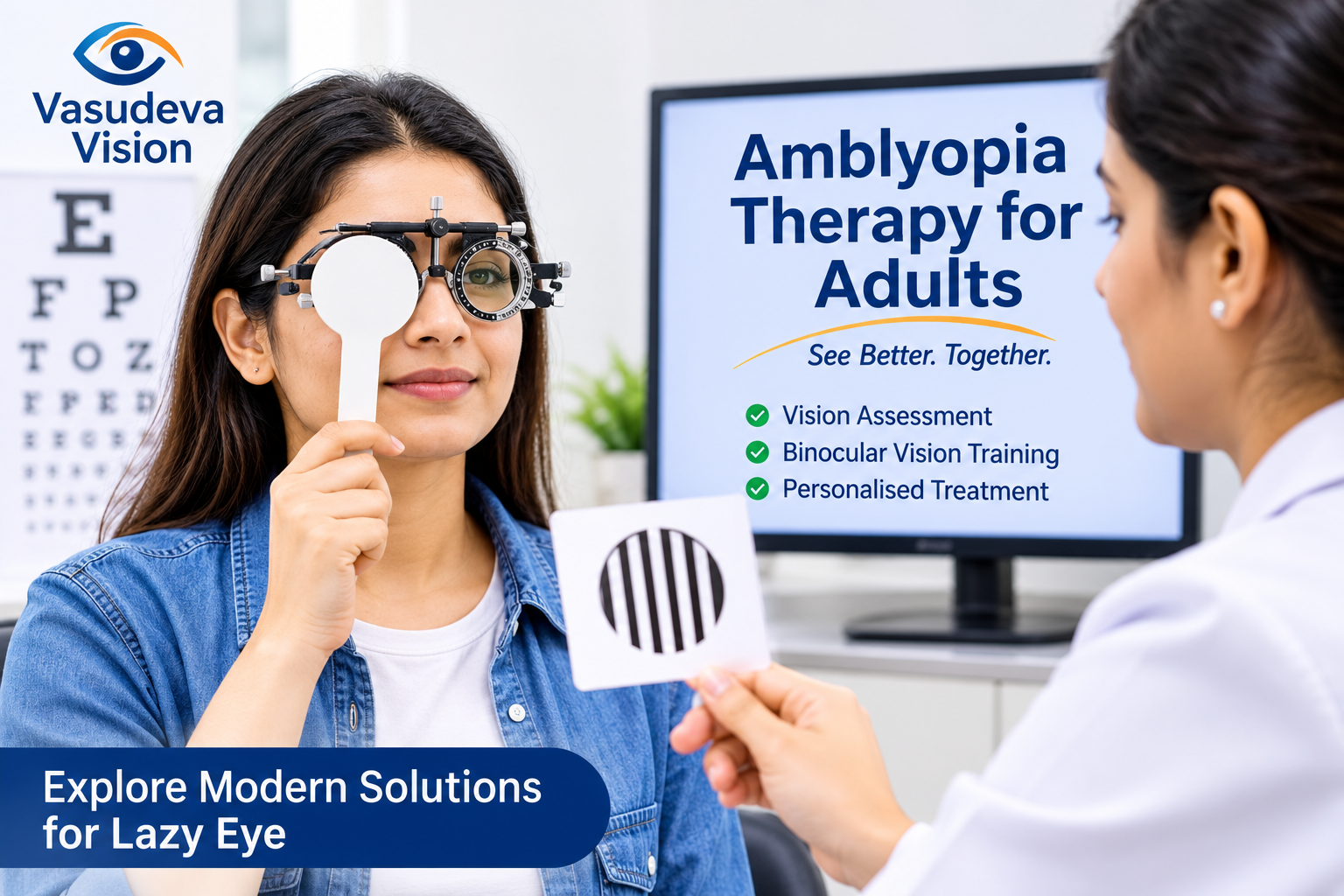
Good vision plays an important role in our everyday lives. From reading and driving to working on computers, we depend on our eyes for almost everything. But what happens when one eye does not see as clearly as the other?
This condition may be associated with amblyopia, commonly known as lazy eye. Although it usually develops during childhood, its effects can continue into adulthood.
Many adults assume that nothing can be done once they pass their teenage years. However, developments in vision research have encouraged further exploration of adult treatment approaches.
Amblyopia therapy for adults focuses on assessing reduced vision, understanding the relationship between both eyes, and exploring appropriate treatment options based on individual visual needs.
In this guide, we will discuss how adult amblyopia is diagnosed, available therapy approaches, and why professional eye care matters.
What Is Adult Amblyopia?
Amblyopia is a developmental vision condition in which one or both eyes have reduced visual acuity that cannot be fully explained by an ordinary glasses prescription or another eye condition.
It develops when the brain does not receive or process normal visual input during childhood.
The brain may gradually favour the eye that provides clearer information, resulting in reduced visual function in the other eye.
Adults with amblyopia may have lived with the condition for many years without receiving a proper diagnosis.
Why Do Adults Need Lazy Eye Treatment?
Amblyopia can affect different aspects of visual performance.
Even when the stronger eye provides good vision, the weaker eye may continue to have reduced visual acuity.
Some common difficulties include:
-
Reduced clarity in one eye.
-
Difficulty judging the distance between objects.
-
Poor stereoscopic depth perception.
-
Reduced binocular coordination.
-
Difficulty with certain visually demanding activities.
-
Dependence on the stronger eye.
Seeking professional guidance helps identify whether these difficulties are related to amblyopia or another eye condition.
Is Amblyopia Therapy for Adults Different From Children's Treatment?
Yes. Adult and childhood amblyopia management can differ because the visual system changes with age.
Children generally respond better to conventional amblyopia treatment because their visual systems are still developing.
Adults may require a different approach based on their visual history, severity of amblyopia and binocular function.
While traditional childhood approaches may not produce the same results in adults, researchers have explored methods involving neuroplasticity and structured binocular training.
The aim is to identify suitable opportunities for improving visual performance rather than promising complete recovery.
How Is Amblyopia Diagnosed in Adults?
Before starting any treatment, a comprehensive eye examination is important.
The assessment may include the following:
1. Visual Acuity Testing
This checks how clearly each eye can see at different distances.
It helps identify differences in visual performance between the two eyes.
2. Refraction Testing
A refraction assessment determines whether glasses or contact lenses are needed to correct refractive errors.
3. Eye Alignment Assessment
The professional checks whether both eyes are properly aligned or whether a squint is present.
4. Binocular Vision Assessment
This evaluates how effectively both eyes work together and whether suppression or other binocular difficulties are present.
5. General Eye Health Examination
An eye examination helps rule out other conditions that may cause reduced vision, such as cataracts, retinal problems or optic nerve disorders.
These findings help determine whether amblyopia therapy may be appropriate.
What Treatment Options Are Available for Adults With Lazy Eye?
There is no universal treatment for every adult with amblyopia. Treatment depends on the examination findings and individual goals.
Here are some approaches that may be considered.
Corrective Optical Treatment
Appropriate glasses or contact lenses may help correct refractive errors and provide clearer visual input.
This is often an important starting point when one eye has a different prescription from the other.
Binocular Vision Therapy
Binocular vision therapy aims to encourage both eyes to work together.
Selected programs use activities that present different visual information to each eye. These exercises are designed to encourage binocular cooperation.
Digital or Computer-Assisted Vision Training
Some vision training programs use interactive computer activities to support specific visual functions.
Dichoptic training is one approach being investigated for amblyopia. It presents different images to the two eyes during a visual task.
Perceptual Learning
Perceptual learning uses repeated visual tasks to improve performance in specific areas of visual processing.
Research has investigated its potential in adults with amblyopia, although results differ between individuals.
Follow-Up Vision Assessments
Regular examinations help monitor visual performance and determine whether treatment goals are being achieved.
The professional may adjust the treatment plan according to the patient's progress.
Can Adults Improve Their Weaker Eye Through Vision Therapy?
This is one of the most frequently asked questions about adult lazy eye treatment.
Research into adult neuroplasticity suggests that the visual system retains some capacity to adapt.
Some studies have reported improvements in visual acuity and binocular function following selected training programs.
However, these findings do not mean that every adult will experience significant improvement.
The outcome depends on several factors:
-
Age and visual development history.
-
Severity of amblyopia.
-
Previous treatment.
-
Underlying cause.
-
Type of training program.
-
Individual response to therapy.
A professional assessment helps establish realistic expectations.
How Does Vasudeva Vision Support Amblyopia Care?
At Vasudeva Vision, we understand that every patient has different visual requirements.
Our approach focuses on evaluating the patient's visual condition and identifying suitable therapy options.
Depending on individual findings, the care approach may include:
-
Assessment of visual acuity.
-
Evaluation of refractive errors.
-
Eye alignment examination.
-
Binocular vision assessment.
-
Structured vision therapy.
-
Software-based binocular training where appropriate.
-
Follow-up and progress monitoring.
We believe that informed decisions and personalised care are important when exploring treatment options for adult lazy eye.
If you are looking for more information about our services, visit our dedicated page:
Learn More About Amblyopia Therapy at Vasudeva Vision
When Should You Visit an Eye Care Professional?
Do not ignore persistent differences in vision between your eyes.
Consider scheduling an eye examination if:
-
One eye consistently sees less clearly.
-
You have a childhood history of lazy eye.
-
You experience difficulty with depth perception.
-
You have a history of squint.
-
Your vision does not become clear even with glasses.
-
You notice a recent or unexplained change in vision.
Sudden vision loss or sudden changes in vision require urgent medical attention.
Frequently Asked Questions
1. Is amblyopia therapy available for adults?
Yes. Adults can undergo an amblyopia assessment and explore selected treatment approaches, including binocular vision training where appropriate.
2. Can lazy eye improve after age 30?
Some adults may experience improvements in selected visual functions, but outcomes vary. Age, severity and treatment history all influence the potential response.
3. Does amblyopia always affect depth perception?
Not always. However, some people with amblyopia have reduced stereoscopic depth perception because both eyes do not work together effectively.
4. How long does adult amblyopia therapy take?
There is no standard duration. Treatment time depends on the individual's condition, therapy approach and response to treatment.
5. Can glasses alone treat adult lazy eye?
Glasses can correct refractive errors but may not fully resolve established amblyopia. Additional treatment may be considered after a professional assessment.
Conclusion
Adult lazy eye can affect visual clarity, depth perception and the way both eyes work together. Although amblyopia treatment is generally more effective during childhood, adults can still seek professional assessment and explore available options.
Amblyopia therapy for adults focuses on understanding individual visual needs and considering appropriate approaches to improve visual function where possible.
At Vasudeva Vision, our aim is to help patients understand their condition and explore structured vision therapy options.
Do not let assumptions prevent you from seeking advice about your eye health. Contact Vasudeva Vision to learn more about adult amblyopia assessment and treatment options.
Vasudeva Vision – Meerut, Uttar Pradesh, India

 English
 Arabic
 French
 Spanish
 Portuguese
 Deutsch
 Turkish
 Italiano
 Russian
 Romaian
 Portuguese (Brazil)
 Greek
