


Buying a Complicated Watch Pre-Owned: Questions Documentation Cannot Answer Alone
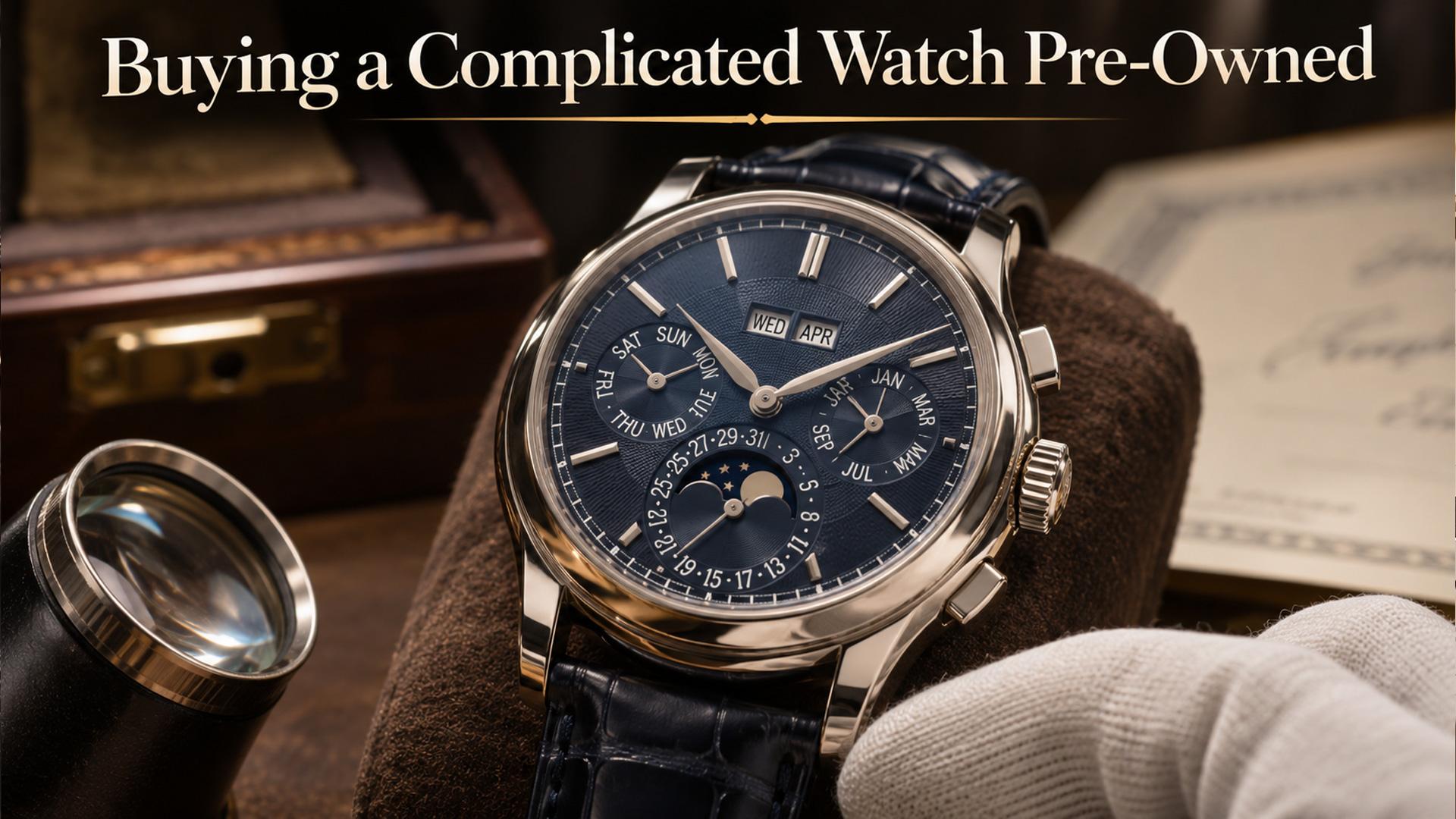
Box, Papers and a Perfect Dial Are Reassuring—But They Cannot Tell You Everything About the Movement
When purchasing pre-owned complicated watches, collectors often begin with the reference number, original papers and overall condition. These are reasonable starting points, particularly for a valuable watch from a manufacturer such as Patek Philippe. However, a complete set of documents does not necessarily establish that every mechanical function operates correctly.
A complicated watch can keep accurate time while an annual calendar, chronograph, moon-phase display or chiming mechanism requires attention. Some faults may be visible during a demonstration; others require specialist inspection.
Understanding the difference between documentary evidence and mechanical condition is essential before making a high-value purchase.
The right questions depend on the complications involved, the watch's age, its service history and the limitations of the available information.
What Makes a Mechanical Watch Complicated?
In traditional watchmaking, a complication is a function beyond the ordinary indication of hours, minutes and seconds.
Common examples include chronographs, annual calendars, perpetual calendars, moon phases, multiple time zones and mechanical alarms.
More elaborate watches can incorporate minute repeaters, split-seconds chronographs or several complications within the same movement.
The challenge for pre-owned buyers is that each additional mechanism introduces functions that deserve to be evaluated independently.
Not All Complications Require the Same Inspection
A chronograph is designed to measure elapsed time. Its start, stop and reset functions can be demonstrated using the manufacturer's instructions.
An annual calendar is designed to account automatically for months containing 30 and 31 days, generally requiring a correction at the end of February.
A perpetual calendar also accounts for the ordinary leap-year cycle, although traditional mechanisms have limitations related to exceptional calendar years.
A minute repeater is a different category of complication altogether. It requires careful assessment of its acoustic mechanism and associated controls.
One generic inspection checklist cannot establish the condition of every type of complication.
1. What Does the Original Certificate Actually Prove?
An original manufacturer document may support the watch's reference, identifying numbers and original sale information.
For example, Patek Philippe distinguishes its Certificate of Origin from an Extract from the Archives.
The Certificate of Origin is supplied with a new watch and identifies information such as the movement, case and reference numbers.
An Extract from the Archives is a record of selected historical information retained by the manufacturer. It is not a duplicate Certificate of Origin.
That distinction is important because collectors sometimes use the words certificate, extract and papers as though they mean the same thing.
Documentation Has Limits
Even an authentic original certificate cannot establish that a watch has never been damaged, serviced, modified or repaired.
It also does not establish the current condition of every internal component.
Likewise, an archive extract does not replace a mechanical examination or automatically establish the watch's present originality.
Documentation should support the assessment, not replace it.
2. Does the Watch's Service History Explain What Was Actually Done?
A seller may describe a watch as recently serviced. That statement is more useful when supported by documentation identifying the work performed.
Service records can reveal whether a movement was inspected, repaired or adjusted and whether components were replaced.
For a complicated watch, ask whether the relevant complications were examined during the service.
Questions About Previous Maintenance
-
When was the watch serviced?
-
Who performed the work?
-
Does the invoice identify the watch?
-
Were the calendar or chronograph mechanisms repaired?
-
Were any movement components replaced?
-
Was water resistance assessed where applicable?
-
Are there outstanding recommendations for further work?
It is also worth distinguishing a movement service from an aesthetic refurbishment.
Case polishing may improve appearance, but it does not establish that the movement has been overhauled.
3. Annual Calendars: Look Beyond the Date Window
An annual calendar is designed to display calendar information while accounting for ordinary differences between 30-day and 31-day months.
A watch may show today's date correctly without proving that the entire calendar mechanism works as intended.
A suitable inspection should examine the relationship between the day, date and month indications.
The manufacturer-specific correction procedure is important because certain calendar mechanisms should not be adjusted casually during particular operating periods.
Questions to Ask Before Buying
Can the seller demonstrate the correct calendar indications? Are the corrector controls functioning normally? Has a previous calendar repair been disclosed?
Where there is uncertainty, an experienced watchmaker can determine whether the complication requires further examination.
Do not attempt to force unfamiliar calendar controls simply to verify operation yourself.
4. Perpetual Calendars: Mechanical Sophistication Requires Care
A perpetual calendar is designed to account for the ordinary Gregorian leap-year cycle, making it more elaborate than a standard annual calendar.
Depending on the watch, the display can include day, date, month, leap-year information and moon phases.
These indications are mechanically coordinated, and incorrect setting can create problems.
For a pre-owned perpetual calendar, request the manufacturer's operating instructions and information about previous servicing.
Why a Static Photograph Is Not Enough
A photograph can show a beautifully arranged perpetual-calendar dial, but it does not establish that every calendar indication advances correctly.
Similarly, a watch showing the correct date at the time of photography may still have an issue with the leap-year or month-change mechanism.
Such watches deserve evaluation appropriate to their mechanical complexity.
5. Chronographs: Running Seconds Are Not Proof of Full Functionality
Chronographs introduce another set of inspection considerations.
A chronograph movement provides elapsed-time measurement in addition to ordinary timekeeping.
Depending on its architecture, it may include a central chronograph hand, minute counter, hour counter or flyback function.
The watch's ordinary seconds indication may continue operating even when the chronograph mechanism has a fault.
A Practical Chronograph Demonstration
-
Confirm the chronograph starts correctly.
-
Observe the elapsed-time counters.
-
Check that stopping the chronograph works.
-
Verify correct reset behavior.
-
Test flyback functionality where the movement provides it.
-
Review the condition of crowns and pushers.
Unusual resistance, inconsistent hand resetting or unexpected counter behavior deserves further investigation.
A short demonstration does not necessarily establish the condition of the entire movement.
6. Moon Phases: Attractive Displays Still Need Verification
Moon-phase complications represent the lunar cycle through a mechanically driven display.
Their appearance can make them especially attractive to collectors interested in traditional horology.
However, the indication should correspond to the watch's original reference and be adjustable through the manufacturer's prescribed procedure.
Ask whether the moon-phase mechanism has ever required repair.
For models combining moon phases with an annual or perpetual calendar, assess the relationship between the different displays rather than evaluating them independently.
7. Chiming Watches: An Audible Function Requires More Than a Video
Chiming watches introduce a different level of complexity.
A mechanical alarm produces an audible signal at a selected time, while a minute repeater strikes the time in response to its operating control.
These mechanisms should not be confused simply because both produce sound.
The acoustic result, proper activation and associated mechanical functions may require specialist evaluation.
A recorded video can demonstrate that a watch produced a sound during filming, but it cannot establish the full condition of the chiming mechanism.
Audio can also be affected by recording equipment, editing and the surrounding environment.
For a valuable chiming watch, request an appropriate demonstration or specialist inspection rather than relying exclusively on promotional footage.
8. Originality Is Separate From Mechanical Function
A complicated watch can function properly while containing replacement components.
Those components may be genuine manufacturer service parts or independently produced aftermarket parts.
The distinction can matter to collectors who prioritize original configurations.
Similarly, a watch retaining its original dial and case may have unresolved internal maintenance needs.
Buyers should therefore assess originality and mechanical condition as separate questions.
What Should Be Disclosed?
Ask whether the dial, hands, crown, pushers, case components or movement parts have been replaced.
Review available service records and compare the watch with accurate manufacturer specifications.
Any uncertainty about the origin of a component should be acknowledged rather than converted into an unsupported authenticity claim.
9. How to Compare Two Complicated Watches Fairly
Two watches from the same manufacturer may have different complications and very different ownership requirements.
A Patek Philippe annual-calendar chronograph should not be evaluated using the same technical assumptions as a time-only Calatrava or a perpetual-calendar minute repeater.
Before comparing asking prices, identify the exact references and the movements fitted to each watch.
Consider condition, service documentation, original accessories and the possible need for specialist maintenance.
Buyers who want to understand the breadth of available references can review pre-owned Patek Philippe watches and compare each listing's stated complications and configuration before making an enquiry.
Commercial asking prices should not be mistaken for completed sales or used as guarantees of future value.
10. A Final Inspection Framework for Serious Collectors
Before purchasing a complicated watch, establish answers to five essential questions.
-
Identity: Is the exact reference and movement correctly identified?
-
Functionality: Have the relevant complications been demonstrated or professionally assessed?
-
Originality: Are known replacement or aftermarket components disclosed?
-
History: What do the original documents and service records actually support?
-
Ownership: Are maintenance requirements, fit, available accessories and purchasing terms understood?
If important questions remain unanswered, it may be more sensible to obtain further information than to proceed on the strength of the watch's appearance.
Frequently Asked Questions
Do box and papers guarantee that a complicated watch works correctly?
No. They may support the watch's identity and history, but they cannot establish the present condition of its movement and complications.
Is an Extract from the Archives the same as a Patek Philippe Certificate of Origin?
No. Patek Philippe distinguishes an archive extract from the original Certificate of Origin supplied with a new watch. The documents serve different purposes.
Can a chronograph keep time while its stopwatch mechanism is faulty?
Yes. Ordinary timekeeping and chronograph functions involve different mechanisms, so each should be assessed appropriately.
Should I operate every complication before buying?
Relevant functions should be verified, but demonstrations must follow the manufacturer's instructions. Unfamiliar or sensitive mechanisms should be handled by an appropriately qualified professional.
Does a recent service eliminate future maintenance concerns?
No. Service records can provide useful information, but buyers still need to understand what work was performed and whether any issues remain.
Final Thoughts: Documentation Supports Confidence, but Functionality Must Be Established
Buying pre-owned complicated watches requires a more detailed process than checking the case, dial and original box.
Annual calendars, chronographs, moon phases and chiming mechanisms each introduce different inspection questions. The right documentation can explain a watch's history, but it cannot independently establish the condition of every complication.
Collectors who distinguish original configuration, mechanical operation and maintenance history are better positioned to evaluate what they are actually purchasing.

 English
 Arabic
 French
 Spanish
 Portuguese
 Deutsch
 Turkish
 Dutch
 Italiano
 Romaian
 Portuguese (Brazil)
 Greek
