


Humanoid Robot Market Trends and Outlook: Manufacturing Applications, AI Innovation and Global Growth
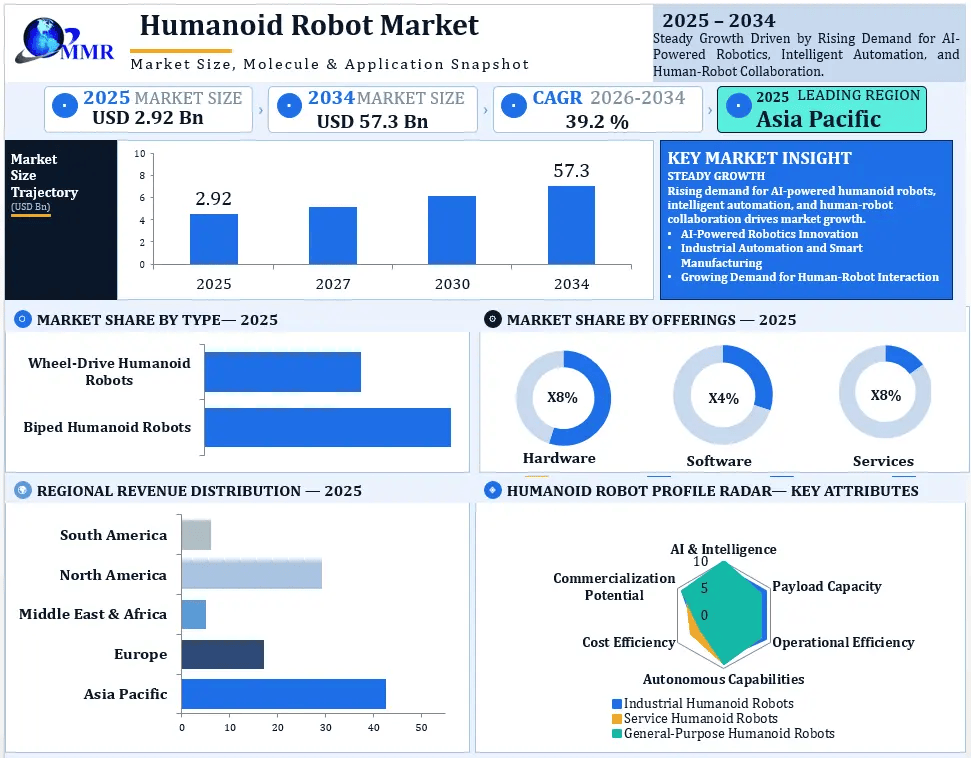
Humanoid Robots Market to Witness Exponential Growth, Reaching USD 57.3 Billion by 2034, Driven by AI Advancements and Industrial Automation
1. Humanoid Robots Market Estimation, Growth Drivers and Opportunities
The global humanoid robots market was valued at approximately USD 2.92 billion in 2025 and is projected to reach USD 57.3 billion by 2034, registering a compound annual growth rate (CAGR) of 39.2% during the forecast period of 2026–2034. Humanoid robots are designed to replicate human body structures, movements, and interactions, enabling them to perform tasks in environments originally developed for people. These robots integrate artificial intelligence (AI), machine learning, computer vision, sensors, actuators, and advanced mechanical systems to perform activities across manufacturing, logistics, healthcare, education, research, and personal assistance.
The humanoid robot market is experiencing significant growth, driven by the increasing adoption of industrial automation and persistent labor shortages across various industries. Manufacturing companies are increasingly adopting humanoid robots to handle repetitive, physically demanding, and hazardous tasks while enhancing productivity, operational efficiency, and workplace safety. Their ability to function in human-designed environments without requiring major infrastructure modifications makes them suitable for applications in factories, warehouses, and distribution facilities.
Technological advancements in generative artificial intelligence (AI), machine learning, robotics software, and sensor systems are further accelerating market growth. Modern humanoid robots are becoming more sophisticated, with improved capabilities in voice command recognition, object identification, autonomous navigation, and task execution through demonstrations. In addition, innovations in battery performance, lightweight materials, precision actuators, and robotic hand technology are improving their mobility, flexibility, accuracy, and overall operational efficiency.
Emerging applications in healthcare, elderly care, household assistance, and logistics are creating substantial growth opportunities for the humanoid robot market. The growing elderly population and increasing demand for caregiving services are encouraging the development of robots capable of supporting patients, assisting with mobility, and performing routine household activities. Meanwhile, the rapid expansion of e-commerce and warehouse automation is increasing demand for humanoid robots in material handling, inventory management, and repetitive logistics operations. Furthermore, the integration of advanced AI foundation models and simulation technologies is expected to enhance robotic intelligence, streamline development processes, reduce production costs, and support wider commercial adoption.
To know the most attractive segments, click here for a free sample of the report: https://www.maximizemarketresearch.com/market-report/global-humanoid-robot-market/10567/
2. U.S. Humanoid Robots Market: Latest Trends and Investments in 2024
The United States maintained a leading position in the humanoid robotics industry in 2024, driven by substantial venture capital investments, rapid advancements in artificial intelligence, and increasing collaborations between technology developers and industrial manufacturers. One of the most significant developments occurred on February 29, 2024, when Figure AI secured approximately USD 675 million through its Series B funding round, achieving a company valuation of USD 2.6 billion. The funding attracted prominent investors, including Microsoft, NVIDIA, OpenAI Startup Fund, Intel Capital, and Jeff Bezos. Figure AI also announced a strategic partnership with OpenAI to develop advanced artificial intelligence models aimed at improving humanoid robots' ability to understand natural language instructions and interact more effectively with humans. Another important industry development took place in March 2024, when NVIDIA introduced Project GR00T, a foundation model initiative designed to accelerate the development of general-purpose humanoid robots. The company also advanced its Isaac robotics platform and simulation technologies to support robot training, testing, and deployment. Meanwhile, automotive manufacturers increasingly explored the integration of humanoid robots into industrial production environments, particularly for repetitive tasks, material handling, and warehouse operations. These investments, technological innovations, and strategic partnerships highlighted growing commercial interest in intelligent robotic systems and reinforced the United States' position as a major hub for humanoid robotics innovation and development.
3. Humanoid Robots Market Segmentation: Dominant Segments and Market Share
The global humanoid robots market is classified based on type, application, primary use case, and geographical region. Increasing investments in intelligent automation, artificial intelligence, and advanced robotic technologies are contributing to the expansion of these segments. Among the different categories, biped humanoid robots, manufacturing applications, and general-purpose robotic systems represent important areas of market development.
By Type: The biped humanoid segment dominated the global humanoid robots market, accounting for approximately 61% of the total market share in 2025. Its leading position is primarily attributed to its ability to navigate stairs, narrow pathways, uneven surfaces, and other environments designed for human movement. Unlike conventional wheeled robotic systems, biped humanoids can operate within existing human-oriented workplaces without requiring extensive infrastructure modifications. Their increasing application across manufacturing facilities, healthcare institutions, warehouses, and other commercial environments is further supporting segment growth.
By Application: Manufacturing and industrial applications represent a major segment of the humanoid robots market, driven by the growing adoption of automation technologies across production facilities. Businesses are increasingly deploying humanoid robots to perform repetitive activities, material transportation, assembly operations, inspection, and workplace assistance. Additionally, logistics and warehousing applications are gaining momentum due to expanding e-commerce operations, rising inventory management requirements, and the growing need for efficient order fulfillment. Increasing investments in smart factories and automated supply chains are expected to create further opportunities across these applications.
By Primary Use Case: General-purpose humanoid robots represent an important market category because of their ability to perform multiple tasks across different operational environments. Unlike robots developed for specific functions, general-purpose systems are designed to adapt to diverse activities through artificial intelligence, machine learning, computer vision, and advanced environmental perception technologies. Continuous improvements in autonomous navigation, human-robot interaction, and AI-based learning capabilities are expected to accelerate their adoption across manufacturing, logistics, healthcare, and service industries.
By Region: Asia Pacific represents the leading regional market for humanoid robots, supported by its established robotics manufacturing ecosystem, technological advancements, government-backed automation initiatives, and increasing investments in artificial intelligence. Countries such as China, Japan, and South Korea are actively advancing humanoid robotics development through research programs, industrial collaborations, and commercial production initiatives. Growing demand for intelligent automation across manufacturing and service industries is further strengthening the region's market position.
4. Competitive Analysis: Major Humanoid Robots Market Companies
The global humanoid robots market is highly competitive, with established robotics manufacturers, automotive companies, and AI technology developers investing in advanced robotic systems. Competition is primarily influenced by artificial intelligence capabilities, hardware innovation, mobility, manufacturing efficiency, product reliability, and commercialization strategies. Five major companies listed in the referenced market report are:
1. Tesla
Tesla is developing its Optimus humanoid robot to automate repetitive and physically demanding activities in manufacturing facilities. In July 2024, CEO Elon Musk announced plans to produce humanoid robots in limited quantities for internal use in 2025, with potential higher-volume production for other companies in 2026. Tesla's strategy combines its autonomous driving AI, computer vision, neural networks, and large-scale manufacturing capabilities. Its expertise in battery systems, electric motors, and advanced manufacturing could help reduce production costs and improve the commercial viability of humanoid robots.
2. Boston Dynamics
Boston Dynamics is recognized for its advanced robotic mobility, balance, and manipulation technologies. In April 2024, the company introduced a fully electric version of its Atlas humanoid robot, replacing its previous hydraulic platform. The new design focuses on improved strength, agility, dexterity, and practical industrial applications. Hyundai Motor Group's investment and manufacturing expertise provide an important foundation for the company's commercialization strategy. The initial development focus includes automotive manufacturing, industrial material handling, and operations involving physically demanding tasks.
3. Figure AI
Figure AI is developing general-purpose humanoid robots designed to operate in manufacturing, logistics, and other human-oriented environments. Its Figure 01 and Figure 02 platforms combine robotic hardware with AI-based perception and task execution capabilities. In February 2024, the company secured USD 675 million in Series B funding at a USD 2.6 billion valuation, with investments from Microsoft, NVIDIA, OpenAI Startup Fund, Intel Capital, and Jeff Bezos. Its collaboration with OpenAI aims to develop advanced AI models that enable robots to understand language, interpret instructions, and perform complex tasks. This combination of AI and robotics represents an important technological opportunity for the industry.
4. Agility Robotics
Agility Robotics focuses on developing practical humanoid robots for logistics, warehousing, and manufacturing applications. Its Digit robot is designed to move through industrial environments and perform activities such as moving containers and handling materials. The company has attracted attention through its relationship with Amazon and its efforts to commercialize bipedal robotics. Its RoboFab manufacturing facility in Salem, Oregon, was developed to support large-scale production, with a designed capacity of up to 10,000 robots annually. Investments in manufacturing infrastructure, robot reliability, and fleet management technologies can support broader industrial adoption.
5. Apptronik
Apptronik is developing Apollo, a general-purpose humanoid robot intended for manufacturing, logistics, and industrial environments. In March 2024, the company announced a commercial agreement with Mercedes-Benz to explore the deployment of Apollo in automotive manufacturing facilities. Apptronik also collaborated with NVIDIA through Project GR00T, enabling Apollo to learn tasks from human demonstrations and improve its ability to perform complex activities. Its force-control architecture, human-centered design, and AI integration are important innovations that could accelerate industrial adoption.
5. Regional Analysis: Major Country Markets
United States: The United States is a major center for humanoid robot innovation, supported by venture capital, advanced AI research, semiconductor development, and industrial automation. Investments from Microsoft, NVIDIA, OpenAI, and other technology companies are strengthening the domestic robotics ecosystem. Government initiatives supporting advanced manufacturing, semiconductor production, and AI research are also creating favorable conditions for humanoid robot development. Manufacturing labor shortages and demand for warehouse automation represent significant growth opportunities.
China: China is emerging as a major humanoid robotics manufacturing and deployment hub. Strong electronics, automotive, semiconductor, and industrial manufacturing ecosystems are supporting the development of cost-efficient robotic systems. In January 2024, China's Ministry of Industry and Information Technology published guidelines outlining its ambition to establish a domestic humanoid robot innovation system and achieve breakthroughs in core technologies by 2025. The country's focus on intelligent manufacturing, AI integration, and industrial modernization is creating opportunities for companies such as UBTech, Unitree Robotics, and XPeng.
Germany: Germany represents an important European market because of its advanced automotive manufacturing, industrial automation, and engineering capabilities. Companies are exploring humanoid robots to address labor shortages and improve productivity in factories and logistics facilities. Government support for Industry 4.0, AI research, and industrial digitalization is helping strengthen the country's robotics ecosystem. Partnerships between automotive manufacturers and robotics developers are expected to encourage further adoption.
United Kingdom: The UK humanoid robotics market benefits from its artificial intelligence research ecosystem, advanced engineering capabilities, and growing automation requirements. Government initiatives such as the National AI Strategy and support for robotics research are encouraging technological innovation. Investments in AI startups, university research, healthcare automation, and advanced manufacturing are creating opportunities for humanoid robot developers.
France: France is strengthening its robotics ecosystem through investments in artificial intelligence, industrial modernization, and research and development. The national France 2030 investment program supports strategic technologies, including robotics, AI, and advanced manufacturing. Growing demand for industrial automation, healthcare assistance, and logistics solutions is expected to support the adoption of humanoid robots.
Japan: Japan has a well-established robotics industry supported by advanced engineering, precision manufacturing, and automation expertise. An aging population and increasing demand for elderly care are creating opportunities for humanoid robots in healthcare and personal assistance. Government-backed initiatives supporting Society 5.0, automation, and advanced robotics research are further strengthening the market. Companies such as Toyota and SoftBank Robotics are contributing to technological development and commercial applications.
At the regional level, Asia Pacific dominates the global humanoid robots market, supported by China's manufacturing capabilities, Japan's robotics expertise, and South Korea's industrial technology investments. North America remains a major innovation and investment center, while Europe benefits from established automotive and industrial automation industries.
6. Conclusion
The global humanoid robots market is poised for substantial growth as advancements in artificial intelligence, robotics engineering, and industrial automation continue to transform the way businesses operate. The market's projected expansion to USD 57.3 billion by 2034 reflects the increasing commercial potential of human-like robotic systems across manufacturing, logistics, healthcare, and other industries. Growing investments in intelligent automation and the development of general-purpose humanoid robots are expected to accelerate their adoption across diverse operational environments.
Industrial manufacturing and logistics are likely to emerge as major growth opportunities, as businesses increasingly explore humanoid robots to overcome labor shortages, enhance workplace safety, streamline production activities, and automate repetitive tasks. Furthermore, the integration of generative AI, advanced sensors, lightweight materials, high-performance batteries, and precision actuators will play a crucial role in improving robotic intelligence, mobility, operational efficiency, and cost-effectiveness.
Healthcare and elderly assistance also present promising opportunities, particularly in countries facing aging populations and increasing demand for care services. Humanoid robots could support patient assistance, routine activities, rehabilitation, and elderly care. However, high development and manufacturing costs, limited battery performance, complex safety requirements, and difficulties in executing tasks in unpredictable real-world environments continue to restrict widespread commercialization.
To strengthen their competitive positions, market participants will need to prioritize affordable hardware development, advanced AI integration, scalable manufacturing capabilities, and strategic partnerships with industrial and commercial organizations. Overall, continuous technological innovation, expanding automation requirements, and increasing demand for versatile robotic solutions are expected to play a significant role in shaping the long-term development of the global humanoid robots market.
To know the most attractive segments, click here for a free sample of the report: https://www.maximizemarketresearch.com/request-sample/10567/
About us
Maximize Market Research publishes sector forecasts, competitive analysis, and consulting insight for teams evaluating demand, competition, pricing, and growth strategy across high-value industries.
MAXIMIZE MARKET RESEARCH PVT. LTD.
2nd Floor, Navale IT Park Phase 3
Pune Banglore Highway, Narhe
Pune, Maharashtra 411041, India
+91 9607365656
sales@maximizemarketresearch.com

 English
 Arabic
 French
 Spanish
 Portuguese
 Turkish
 Dutch
 Italiano
 Russian
 Romaian
 Portuguese (Brazil)
 Greek
