


NLP in Healthcare and Life Sciences Market: Trends, Drivers, and Future Outlook through 2034
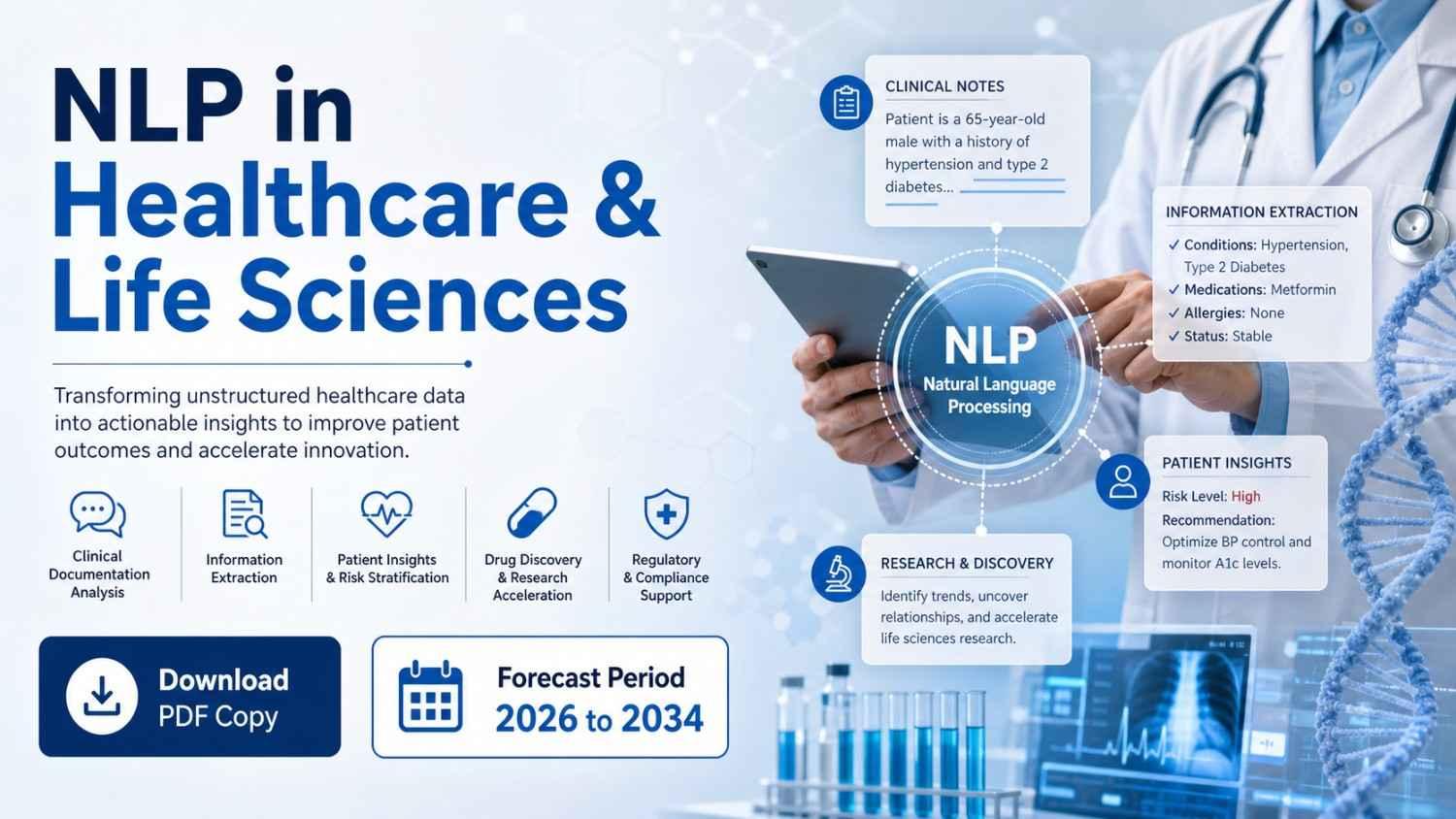
The integration of Natural Language Processing (NLP) within the healthcare and life sciences sectors is transforming how clinical data is captured, analyzed, and utilized. As the industry shifts toward data driven decision making, NLP serves as the vital bridge between unstructured human language and actionable digital insights. The global NLP in healthcare & life sciences market size is projected to reach US$ 115.71 billion by 2034 from US$ 8.95 billion in 2025. The market is anticipated to register a CAGR of 32.89% during the forecast period 2026-2034.
Market Dynamics and Growth Catalysts
The primary driver for the NLP in healthcare and life sciences market is the exponential growth of unstructured data. It is estimated that over 80 percent of healthcare data exists in the form of clinical notes, discharge summaries, and pathology reports. Traditional data processing tools struggle to categorize this information, leading to a surge in demand for NLP solutions that can extract meaningful entities from text.
Another significant driver is the global transition toward Electronic Health Records (EHR). While EHRs have streamlined data storage, they have also increased the documentation burden on clinicians. NLP powered speech recognition and clinical documentation improvement tools allow doctors to dictate notes directly into systems, reducing burnout and improving the accuracy of patient charts.
Furthermore, the rising demand for predictive analytics in population health management is propelling the market. NLP algorithms can scan thousands of patient records to identify individuals at high risk for chronic conditions, enabling early intervention and reducing long term healthcare costs. In the life sciences sector, NLP is becoming indispensable for drug discovery by accelerating the literature review process and identifying potential drug targets from existing scientific publications.
Emerging Opportunities
The next decade presents significant opportunities for NLP providers, particularly in the realm of precision medicine. As genomic data becomes more accessible, NLP can be used to cross reference genetic profiles with clinical outcomes documented in medical literature. This creates a personalized approach to treatment that was previously impossible.
Clinical trial optimization represents another massive opportunity. Finding eligible candidates for clinical trials is often a manual and time consuming process. NLP can automate the screening of patient records against complex inclusion and exclusion criteria, significantly shortening the recruitment phase and bringing life saving therapies to market faster.
Additionally, the expansion of telehealth and virtual assistants offers a new frontier. NLP driven chatbots are evolving from simple FAQ tools into sophisticated diagnostic aids that can triage patients based on described symptoms. These tools help healthcare providers manage patient loads more efficiently while ensuring that urgent cases receive immediate attention.
Technological Advancements in Life Sciences
In the life sciences industry, NLP is being utilized to streamline regulatory compliance and pharmacovigilance. Monitoring social media, medical forums, and clinical reports for adverse drug reactions is a monumental task. NLP systems can monitor these channels in real time, alerting pharmaceutical companies to potential safety issues immediately.
The integration of Large Language Models (LLMs) and generative AI with domain specific healthcare data is also expected to redefine the market landscape. These advanced models provide more contextually aware translations and summaries, making medical information more accessible to both professionals and patients across different languages and regions.
Leading Market Participants
The competitive landscape of the NLP in healthcare and life sciences market features a mix of established technology giants and specialized niche players. These organizations are focusing on strategic partnerships, clinical validations, and continuous product innovation to maintain their market positions. Key players include:
- Microsoft Corporation (Nuance Communications)
- IBM Corporation
- Google LLC (Alphabet Inc.)
- Amazon Web Services (AWS)
- IQVIA
- Cerner Corporation (Oracle)
- Health Fidelity (Revelae)
- Dolbey Systems
- Linguamatics (an IQVIA company)
- 3M Company (M*Modal)
Future Outlook
Looking toward 2034, the role of NLP will transition from a supportive tool to a foundational component of the global healthcare infrastructure. The focus will shift from simple keyword extraction to deep semantic understanding, where machines can comprehend the nuances of clinical intent and patient sentiment. We can expect to see seamless interoperability between different healthcare systems, where NLP acts as a universal translator for medical data. As ethical AI frameworks and data privacy regulations mature, the adoption of cloud based NLP services will likely accelerate, providing even small practices with access to high level analytical capabilities.
Frequently Asked Questions
What are the primary applications of NLP in the life sciences industry?
In life sciences, NLP is predominantly used for drug discovery, accelerating clinical trials, and pharmacovigilance. It helps researchers analyze vast amounts of scientific literature and automates the monitoring of adverse drug events from various unstructured data sources.
How does NLP improve patient care in clinical settings?
NLP improves care by enabling more accurate and comprehensive clinical documentation. It allows for better risk stratification by identifying high risk patients through their medical history and reduces the administrative burden on doctors, allowing them to spend more face to face time with patients.
What is the expected impact of NLP on healthcare administrative costs?
By automating coding, billing, and data entry tasks, NLP significantly reduces administrative overhead. It minimizes manual errors in medical billing and streamlines insurance claims processing, leading to faster reimbursements and lower operational costs for healthcare facilities.

 English
 Arabic
 French
 Spanish
 Portuguese
 Deutsch
 Turkish
 Dutch
Dutch
 Italiano
 Russian
 Romaian
 Greek
Greek
