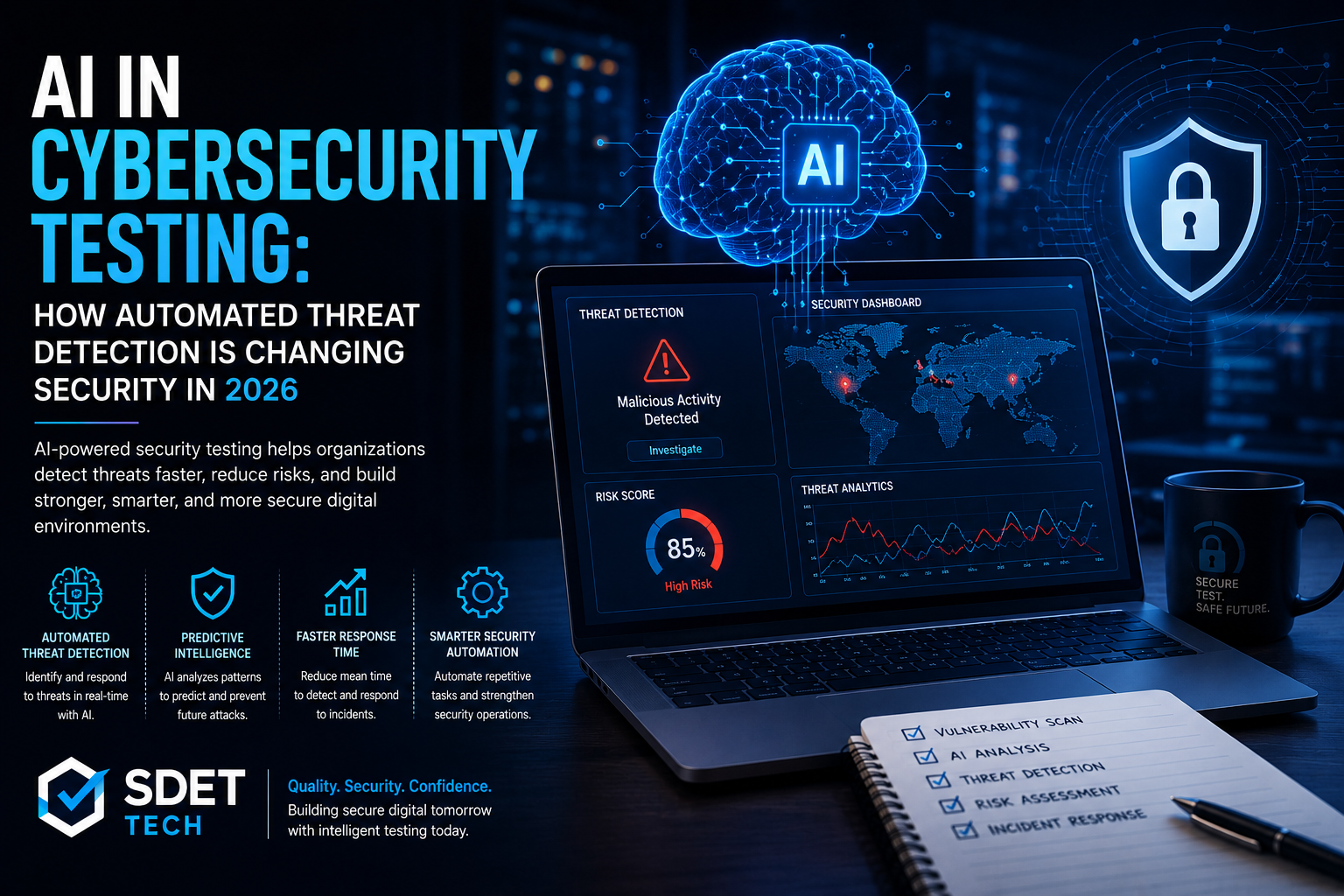
Cyber threats are evolving faster than ever. Modern businesses face increasingly sophisticated attacks targeting cloud platforms, APIs, enterprise applications, mobile systems, and connected devices. Traditional security methods are struggling to keep pace with the scale and speed of today’s digital environments. This is why AI in cybersecurity testing is becoming one of the most important advancements in modern security strategies.
In 2026, organizations are rapidly adopting automated threat detection and AI-powered security testing solutions to identify vulnerabilities faster, reduce response times, and strengthen overall cybersecurity posture. Artificial intelligence is transforming cybersecurity from a reactive process into a proactive and predictive defense system.
Why Cybersecurity Testing is Evolving
The modern technology ecosystem is highly dynamic. Businesses now operate across cloud-native architectures, hybrid environments, remote work infrastructures, and interconnected APIs. These environments generate enormous volumes of security data that are difficult for human teams to monitor manually.
Traditional security testing methods often rely on periodic scans and rule-based detection systems. While still valuable, these methods can miss emerging attack patterns and zero-day threats.
This growing complexity is driving the adoption of AI-powered cybersecurity testing, where intelligent systems continuously analyze behaviors, detect anomalies, and identify suspicious activity in real time.
What is AI in Cybersecurity Testing?
AI in cybersecurity testing refers to the use of artificial intelligence and machine learning technologies to automate security analysis, vulnerability detection, threat intelligence, and risk assessment.
AI systems can process massive amounts of security telemetry far faster than human analysts. These platforms learn from historical attack patterns and continuously improve their ability to identify new threats.
Unlike traditional security tools that depend heavily on predefined signatures, AI-driven systems can recognize abnormal behaviors even when encountering previously unknown attacks.
This makes automated threat detection one of the most valuable innovations in cybersecurity today.
How Automated Threat Detection is Transforming Security
Real-Time Threat Detection
One of the biggest advantages of AI-powered threat detection is speed. AI systems continuously monitor networks, endpoints, applications, and cloud infrastructures to identify suspicious activity instantly.
This enables organizations to respond to threats before they escalate into major security incidents.
Instead of waiting for manual investigation, intelligent systems can automatically flag anomalies such as unusual login attempts, abnormal traffic spikes, or unauthorized access behavior.
Predictive Security Intelligence
AI is changing cybersecurity from reactive defense to predictive risk management. By analyzing historical attack patterns and behavioral trends, AI platforms can identify vulnerabilities likely to be targeted in the future.
This form of predictive cybersecurity testing allows businesses to strengthen defenses proactively rather than responding after a breach occurs.
Predictive analytics is becoming especially valuable for enterprise applications, financial systems, and cloud infrastructures.
Faster Vulnerability Detection
Traditional vulnerability assessments can be time-consuming and resource-intensive. AI dramatically accelerates the process by scanning systems continuously and prioritizing risks based on severity and exploitability.
This improves the efficiency of cybersecurity testing services and helps security teams focus on critical threats first.
Organizations can reduce remediation times while improving overall security resilience.
Intelligent Security Automation
Modern AI-driven platforms can automate repetitive security tasks such as log analysis, malware detection, incident classification, and compliance monitoring.
This reduces operational workload for security teams and improves response efficiency.
With increasing cybersecurity talent shortages worldwide, security automation testing is becoming essential for scaling protection strategies.
Enhanced Cloud Security Testing
As businesses migrate to multi-cloud and hybrid infrastructures, cloud security risks continue to grow. AI improves cloud cybersecurity testing by monitoring distributed environments continuously and identifying configuration weaknesses automatically.
AI-powered systems can detect insecure APIs, excessive permissions, exposed storage, and abnormal cloud activity more effectively than traditional monitoring tools.
Benefits of AI in Cybersecurity Testing
The rise of AI-driven cybersecurity testing provides several major advantages for organizations.
Faster Incident Response
AI systems detect and analyze threats in real time, reducing response delays.
Improved Threat Accuracy
Machine learning models reduce false positives and improve detection precision.
Better Scalability
AI platforms can monitor large, distributed infrastructures continuously.
Reduced Operational Costs
Automation minimizes manual analysis and repetitive security tasks.
Stronger Compliance Management
Continuous monitoring helps organizations maintain regulatory compliance more effectively.
Industries Adopting AI-Powered Security Testing
Several industries are rapidly investing in AI cybersecurity testing services due to increasing cyber risks.
Financial Services
Banks and fintech companies require real-time fraud and threat detection.
Healthcare
Healthcare organizations need stronger protection for patient data and critical systems.
E-Commerce
Retail platforms must defend against payment fraud, account takeovers, and API attacks.
SaaS and Cloud Platforms
Cloud-native businesses rely heavily on automated security validation.
Enterprise Technology
Large enterprises use AI to monitor complex infrastructures across global operations.
Challenges of AI in Cybersecurity Testing
Although AI offers powerful capabilities, organizations still face challenges when implementing intelligent security systems.
AI models require high-quality data to operate effectively. Poor data quality can reduce detection accuracy.
Businesses may also face skill gaps in managing advanced AI security tools. Human expertise remains essential for interpreting risks, making strategic decisions, and handling complex incidents.
Additionally, cybercriminals are increasingly using AI themselves, creating an ongoing security arms race.
This means organizations must continuously evolve their cybersecurity testing strategies to stay protected.
The Future of AI in Cybersecurity
The future of automated threat detection is becoming increasingly intelligent and autonomous. AI-powered systems are expected to evolve toward:
- Autonomous incident response
- Real-time adaptive defense systems
- Behavioral threat prediction
- AI-driven penetration testing
- Advanced zero-day attack detection
- Continuous cloud security monitoring
As cyber threats become more sophisticated, AI will play a central role in protecting digital ecosystems.
Final Thoughts
The rise of AI in cybersecurity testing is transforming how organizations defend against modern cyber threats. Traditional security methods alone are no longer sufficient for today’s fast-moving digital environments.
By adopting automated threat detection and intelligent security testing solutions, businesses can improve threat visibility, accelerate incident response, and strengthen long-term resilience.
Organizations looking to modernize their security strategy can partner with experts like SDET Tech, which provides advanced cybersecurity testing services, AI-driven security validation, cloud security testing, penetration testing, and end-to-end quality engineering solutions for modern digital infrastructures.




 English
 Arabic
 Spanish
 Portuguese
 Deutsch
 Turkish
 Dutch
Dutch
 Italiano
 Russian
 Romaian
 Portuguese (Brazil)
 Greek
Greek
