


Why Do Chefs Rely on Aluminum Cookware Sets?
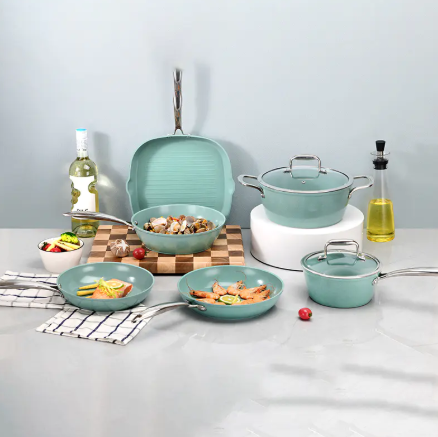
Speed and uniformity define professional cooking. Aluminum Cookware Sets dominate restaurant kitchens not by accident, but by physics. Understanding thermal diffusivity separates good cooks from great ones. Let’s break down the numbers.
Aluminum has a thermal diffusivity of approximately 97 mm²/s. Compare that to stainless steel at 4.2 mm²/s or cast iron at 12 mm²/s. This means an aluminum pan responds to temperature changes roughly 23 times faster than stainless steel. When you turn the burner from medium to high, the entire cooking surface reaches the new temperature in 8–12 seconds, versus over a minute for steel.
Here are the key performance parameters for Aluminum Cookware Sets:
Base thickness matters tremendously – Budget sets use 2.0 mm gauge aluminum. Professional-grade sets use 3.5–4.0 mm. At 4.0 mm, the heat spreads laterally with less than 2% variation from center to edge. At 2.0 mm, the center can be 50°F hotter than the rim, causing burnt centers and undercooked edges.
Induction compatibility requires a bonded disc – Pure aluminum is non-magnetic. Quality Aluminum Cookware Sets for induction hobs include a 2.5 mm thick stainless steel or magnetic steel base plate. Check for a “induction-ready” symbol; the disc must cover at least 80% of the base diameter for proper energy transfer.
Response time for delicate sauces – A 3.0 mm aluminum saucepan can go from a rolling boil to a gentle simmer (212°F to 185°F) in just 6 seconds after reducing the flame. A tri-ply stainless pan requires 25 seconds. This precision prevents broken emulsions like hollandaise or custards.
Hot spots under 500°F – Even heating means fewer burned spots. Using a thermal camera, a good 10-inch aluminum fry pan shows a maximum temperature variance of ±8°F at 400°F surface temp. Cheap steel pans often show ±35°F variance.
Weight-to-performance ratio – A 12-inch aluminum fry pan weighs 1.8 lbs. A comparable stainless pan weighs 3.6 lbs. Wrist fatigue is real during 20-minute sauté sessions. This is why line cooks prefer Aluminum Cookware Sets for high-volume nights.
However, one downside: warping. At 500°F, aluminum’s coefficient of thermal expansion is 23.1 µm/(m·K). Suddenly quenching a hot pan with cold water can permanently warp it by 2–3 mm, breaking flatness. Always cool before washing. When used correctly, the heat control of Aluminum Cookware Sets is unmatched, making them the speed demons of the kitchen.

 English
 Arabic
 French
 Spanish
 Portuguese
 Deutsch
 Turkish
 Dutch
Dutch
 Italiano
 Russian
 Romaian
 Greek
Greek
