


How Brass Padlocks Achieve Secure Locking
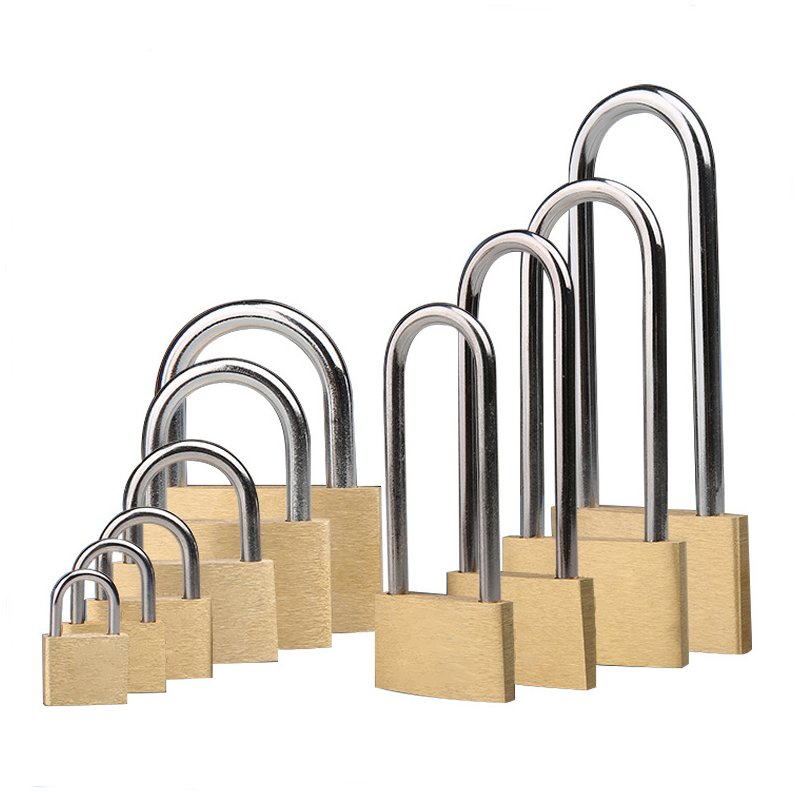
The long shackle Brass padlock is not only defined by its external shape but also by its internal mechanical structure. Understanding its design helps explain why it is widely used in both residential and industrial applications.
At the core of the lock is the pin tumbler mechanism. This system consists of a series of spring-loaded pins aligned inside a cylindrical plug. When the correct key is inserted, the pins align at the shear line, allowing the plug to rotate and release the shackle.
The brass body serves as the housing for this mechanism. Brass is commonly used because it is easy to machine, corrosion-resistant, and stable under environmental stress. Inside the body, precision-drilled chambers hold the pins and springs that interact with the key.
The defining feature—the long shackle—is typically made of hardened steel rather than brass. This is because the shackle must resist cutting, sawing, and leverage attacks. A typical shackle may have:
Diameter: 5mm–8mm
Clearance height: 60mm–80mm
Locking points: dual locking (heel and toe) in higher-security versions
When locked, both ends of the shackle are secured inside the brass body. In double-locking designs, the shackle is held at two points, increasing resistance against pulling or prying.
The extended shackle design does not alter the internal mechanism but modifies the geometry of how the lock interacts with external hardware. This allows it to secure:
Wide gate hasps
Thick industrial chains
Deep recessed locking brackets
Non-standard metal fixtures
Manufacturing precision is critical. Even small misalignments in shackle length or diameter can prevent proper locking engagement. This is why tolerances are tightly controlled during production.
Another important feature is corrosion protection. Some models include protective seals around the keyway to prevent dust and moisture intrusion. Combined with the brass housing, this improves long-term reliability.
In summary, the long shackle Brass padlock is a mechanical adaptation of a traditional lock system designed to solve spatial constraints without compromising basic security functions.

 English
 Arabic
 French
 Spanish
 Deutsch
 Turkish
 Dutch
Dutch
 Italiano
 Russian
 Romaian
 Portuguese (Brazil)
 Greek
Greek
