


How Wheel Materials Influence Riding Behavior
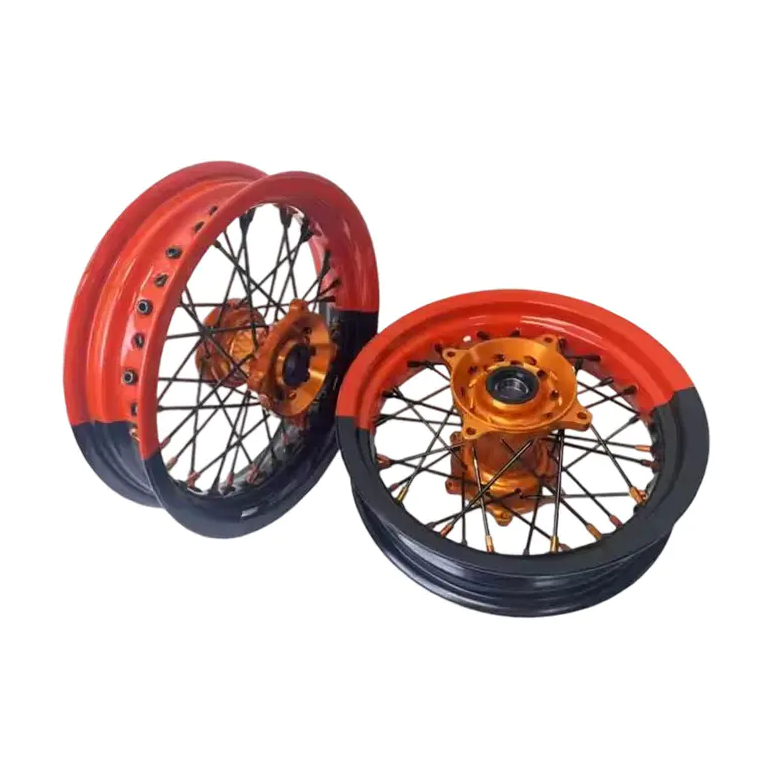
The performance of Motorcycle Wheels is heavily influenced by the materials used in their construction. Different materials offer unique combinations of strength, weight, heat resistance, and cost efficiency.
Steel is one of the earliest materials used in wheel manufacturing. It offers excellent toughness and resistance to deformation. However, steel wheels are relatively heavy, which increases unsprung mass and reduces agility. This is why steel is now mostly limited to low-speed or utility motorcycles.
Aluminum alloy has become the dominant material in modern Motorcycle Wheels. It provides an excellent balance between weight reduction and structural strength. Alloy wheels also offer good corrosion resistance and heat dissipation, which is particularly important in braking systems. Typical aluminum alloy wheels have densities around 2.7 g/cm³, significantly lower than steel.
Magnesium alloy wheels are used in high-performance and racing environments. Magnesium is approximately 30–35% lighter than aluminum, allowing for faster acceleration and improved suspension response. However, magnesium is more susceptible to corrosion and requires protective coatings, increasing maintenance demands.
Carbon fiber wheels represent the most advanced material category. They offer extremely low weight and high stiffness. Carbon fiber also reduces rotational inertia significantly, which improves braking and cornering response. However, production costs are high, limiting their widespread use.
The choice of material in Motorcycle Wheels directly impacts ride quality. Lighter wheels reduce gyroscopic effect, making steering more responsive. Heavier wheels increase stability but reduce agility.
Thermal conductivity is another important factor. Aluminum alloy wheels dissipate heat generated by braking more effectively than steel, reducing brake fade during long rides or downhill braking conditions.
In conclusion, material selection in Motorcycle Wheels is a critical engineering decision that defines performance, safety, and cost structure. Manufacturers carefully evaluate riding conditions, target market, and production cost before selecting materials.

 English
 Arabic
 French
 Spanish
 Portuguese
 Turkish
 Dutch
Dutch
 Italiano
 Russian
 Romaian
 Portuguese (Brazil)
 Greek
Greek
