


Inside the Bumper Mold Production Process
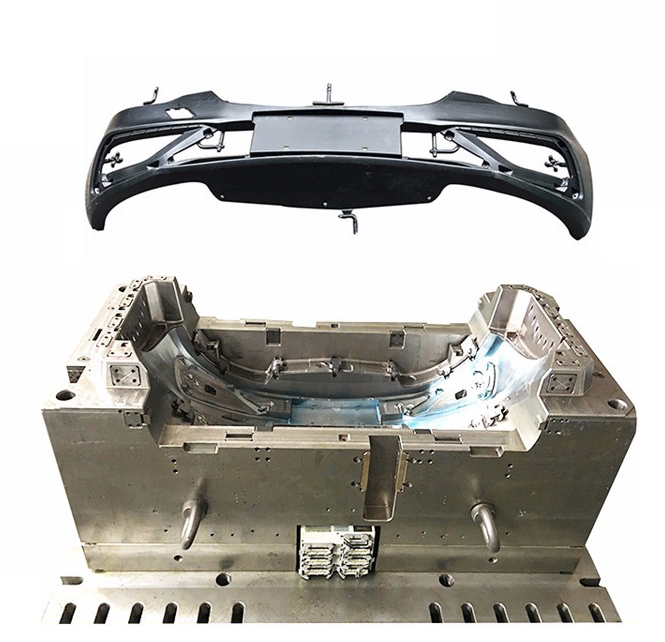
The production of a Bumper Mold involves multiple precision machining and engineering stages, combining CAD design, CNC processing, heat treatment, and final assembly to achieve high-performance tooling for automotive applications.
The process starts with product analysis. Engineers evaluate the bumper geometry, including draft angles (typically 3°–5°), undercut positions, and parting line design. Once the structure is confirmed, mold flow analysis is conducted to simulate molten plastic behavior inside the cavity.
The next stage is material preparation. Mold base steels such as P20 or 718 are selected for general production, while hardened steels like H13 are used for high-wear areas. Steel blocks are rough-cut using CNC milling machines with tolerances around ±0.05 mm.
After rough machining, EDM (Electrical Discharge Machining) is used to form complex geometries such as deep ribs and sharp corners. Wire-cut EDM is also used for precision inserts where accuracy can reach ±0.01 mm.
Heat treatment follows machining, increasing hardness to approximately 28–52 HRC depending on steel type. This step ensures durability during high-pressure injection cycles, which can exceed 100,000 to 500,000 cycles in automotive production environments.
The assembly stage integrates cooling systems, ejector mechanisms, and hot runner systems. Cooling channels are typically drilled with diameters between 8 mm and 12 mm to ensure efficient heat removal. Cycle time optimization is a major focus, with standard bumper molding cycles ranging from 45 to 90 seconds.
Finally, trial molding (T1, T2 stages) is conducted. Engineers adjust injection pressure, holding time, and cooling duration to eliminate defects such as weld lines or flow marks.
A well-manufactured Bumper Mold ensures consistent production quality, reduced scrap rates, and improved efficiency for automotive manufacturers.

 English
 Arabic
 Spanish
 Portuguese
 Deutsch
 Turkish
 Dutch
Dutch
 Italiano
 Russian
 Romaian
 Portuguese (Brazil)
 Greek
Greek
