


Engineering Shapes of Compression Springs and Their Uses
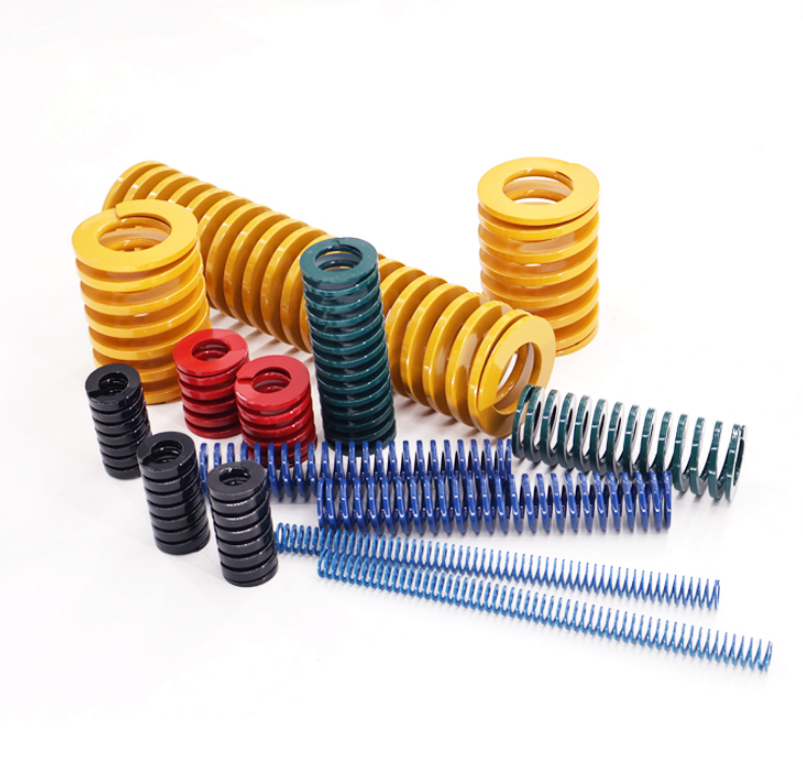
Not all compression springs share the same geometry. While cylindrical helical springs are the most common form, several specialized designs exist to meet different mechanical requirements.
The standard cylindrical type features a constant coil diameter and uniform pitch. This design provides linear force response and is widely used in general mechanical systems.
A conical compression spring tapers from a larger diameter to a smaller one. This allows coils to nest inside each other when fully compressed, significantly reducing solid height. This makes it ideal for compact assemblies where space is limited.
Barrel-shaped springs, also known as convex designs, have a larger diameter in the center and smaller diameters at both ends. This structure improves stability and reduces the risk of buckling under axial load. It also produces a slightly progressive spring rate, meaning stiffness increases as compression progresses.
Hourglass-shaped springs, or concave designs, are the inverse of barrel springs. They provide self-centering behavior and are often used where alignment stability is critical.
Miniature compression springs are also widely used in electronics and medical devices. These springs may have free lengths as small as a few millimeters while still maintaining precise force control.
Regardless of geometry, all compression spring designs are engineered to manage compressive stress and energy storage efficiently. Each variation is selected based on space constraints, load requirements, and stability conditions.
By selecting the correct structural type, engineers can optimize performance, extend service life, and improve system reliability.

 English
 Arabic
 French
 Spanish
 Portuguese
 Turkish
 Dutch
Dutch
 Italiano
 Russian
 Romaian
 Portuguese (Brazil)
 Greek
Greek
