


Dental Billing Professionals in the USA: Building a Stronger Revenue Cycle for Modern Dental Practices
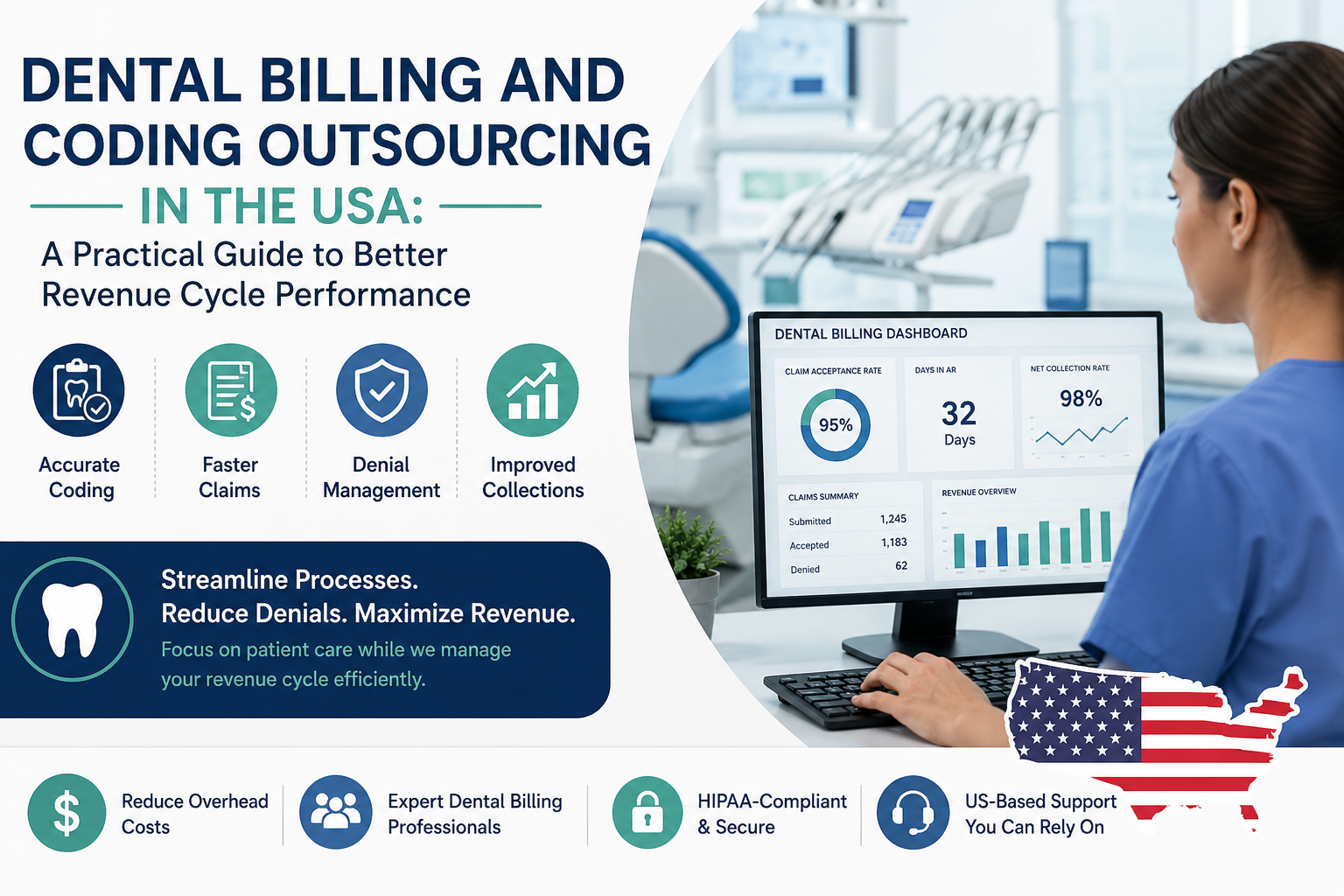
Running a dental practice involves much more than providing quality clinical care. Dentists and their teams also have to manage insurance claims, patient balances, coding requirements, eligibility checks, payment posting, and follow-up on unpaid accounts. When these administrative tasks begin taking time away from patient care, the role of dental billing professionals becomes increasingly important.
A well-managed billing process can make a noticeable difference in how consistently a practice collects revenue. On the other hand, small errors in patient information, coding, documentation, or claim submission can create delays that eventually affect cash flow.
This is why many practices are evaluating external dental billing companies, specialized billing teams, and technology-supported revenue cycle solutions. The goal is not simply to submit more claims. It is to create a reliable process from patient registration through final payment.
Why Dental Billing Has Become More Complex
Dental billing may appear straightforward from the outside, but the process involves multiple steps that have to work together.
A patient's insurance information needs to be verified before treatment. The services provided must be documented correctly. Appropriate procedure codes need to be selected, claims must contain accurate information, and payments have to be posted against the correct accounts.
A problem at any stage can affect the rest of the revenue cycle.
For example, imagine a patient receives a procedure that requires specific documentation for insurance reimbursement. If the submitted claim does not contain the necessary information, the payer may request additional details or deny the claim. The practice then has to investigate the issue, correct the documentation, resubmit the claim, and wait again for processing.
These repeated steps consume staff time.
Professional dental billing teams help practices establish a more organized workflow so that billing problems can be identified earlier rather than after a claim has already been rejected.
What Do Dental Billing Professionals Actually Handle?
The responsibilities of dental billing professionals can extend well beyond basic claim submission. Depending on the practice and service arrangement, a billing team may support several stages of the revenue cycle.
Common responsibilities include:
- Patient demographic and insurance verification
- Eligibility and benefits checks
- Dental claim preparation and submission
- Procedure and diagnosis code review
- Claim status monitoring
- Denial and rejection management
- Payment posting
- Patient balance follow-up
- Accounts receivable management
- Insurance correspondence
- Aging account analysis
- Reporting and revenue tracking
The advantage of having specialists handle these activities is consistency. Instead of billing becoming something the front-desk team manages whenever they have spare time, it becomes a structured operational function.
How Dental Billing Companies Support Practice Revenue
Not all dental billing companies operate in exactly the same way. Some focus primarily on claims, while others provide broader revenue cycle support.
The better approach depends on the practice's size, specialty mix, payer environment, software, and internal staffing.
For a small dental office, outsourcing may reduce the administrative workload placed on front-office employees. For a larger group practice, external billing specialists may provide additional support for aging accounts, denial trends, and multi-location reporting.
A strong billing partner should also look beyond individual claims.
For instance, if a practice repeatedly experiences delayed payments from a particular payer, simply resubmitting individual claims does not solve the underlying problem. Reviewing the pattern can reveal whether the issue involves eligibility, documentation, coding, authorization, claim formatting, or payer-specific requirements.
That broader perspective is where experienced billing professionals can provide value.
Dental Billing Companies in the USA: What Practices Should Look For
When comparing dental billing companies in USA, practices should avoid choosing a provider based only on price.
The lowest monthly fee does not necessarily represent the lowest overall cost. A billing company that provides limited follow-up may leave significant revenue sitting in aging accounts.
Instead, practices should evaluate the company's processes and performance standards.
Important questions include:
Does the company understand dental billing workflows?
Dental practices have their own coding, insurance, documentation, and claim requirements. A team should understand the difference between routine administrative work and situations requiring deeper claim analysis.
How are denied claims handled?
Denial management should not end with identifying a denied claim. The billing team should determine why it was denied, correct the underlying issue when possible, and track recurring denial patterns.
How is accounts receivable monitored?
A healthy billing operation should regularly review aging accounts. Older balances require different strategies from recently submitted claims.
What reporting is available?
Practice owners need visibility into collections, outstanding balances, denial trends, claim status, and other useful financial indicators.
How does the company communicate?
Billing is closely connected to clinical and front-office operations. Clear communication allows the practice to resolve documentation or patient information issues without unnecessary delays.
Understanding Dental Billing Company Services
The scope of dental billing company services can vary considerably between providers.
Some practices need only claims submission and payment posting. Others require a complete revenue cycle workflow.
A broader service model may include:
Eligibility verification: Confirming coverage and benefits before treatment can help reduce unexpected patient balances and prevent avoidable claim issues.
Charge entry: Services must be entered accurately so the claim reflects what was actually provided.
Claim submission: Claims should be reviewed for obvious errors before submission.
Payment posting: Insurance and patient payments should be posted accurately to maintain reliable account balances.
Denial management: Denials should be categorized, investigated, corrected, and monitored for recurring patterns.
A/R follow-up: Unpaid claims and aging balances require consistent follow-up rather than occasional attention.
Patient billing support: Clear statements and accurate account information can make patient collections easier to manage.
These activities work best when they are treated as connected parts of one process.
The Connection Between Dental Billing and RCM
The term dental billing RCM refers to the broader revenue cycle management process surrounding financial activity in a dental practice.
RCM starts before a claim is submitted. It can begin with patient registration and insurance verification and continue through claim processing, payment posting, denial resolution, and final account reconciliation.
This distinction matters because a practice can have competent claim submission while still experiencing revenue problems elsewhere.
For example, suppose claims are submitted correctly but eligibility verification is inconsistent. The practice may continue receiving avoidable denials. Similarly, claims may be paid promptly, but inaccurate payment posting can create incorrect patient balances.
Looking at the entire cycle helps identify where revenue is being delayed or lost.
Common Problems Dental Practices Face
Dental practices frequently encounter operational problems that are not immediately visible on the daily schedule.
Incorrect patient information
A minor spelling difference, incorrect member number, outdated insurance information, or missing demographic detail can interfere with claim processing.
Eligibility misunderstandings
A patient's insurance card does not always provide enough information to understand current benefits. Verification before treatment can provide a clearer picture.
Coding inconsistencies
Incorrect or incomplete coding can result in rejected or denied claims and may require additional work before payment is received.
Aging accounts
When unpaid claims remain unresolved for weeks or months, the probability of successful collection can become more difficult.
Inconsistent follow-up
A busy internal team may prioritize today's patients over yesterday's unpaid claims. Over time, this can create a growing A/R backlog.
Poor visibility
Without regular reporting, practice owners may know how much was collected but not understand why certain claims remain unpaid.
Why Dental Billing Providers Need a Process-Driven Approach
The best dental billing providers are not simply transaction processors. They should operate with defined workflows, quality checks, escalation procedures, and measurable outcomes.
Consider a practice with a recurring denial problem. A basic billing operation might work on each denial individually. A process-driven team would also ask:
- Is the same payer responsible for most denials?
- Are particular procedures affected?
- Are claims missing similar information?
- Is the issue related to eligibility?
- Are documentation requirements being met?
- Has the problem increased recently?
- What corrective action can prevent future denials?
These questions turn billing data into operational insight.
When Outsourcing Makes Sense
Outsourcing is not automatically the right decision for every practice. Some offices have experienced internal billing teams and efficient systems that work well.
However, outsourcing may become worth considering when:
- Internal staff are overwhelmed by billing workloads
- Claims are frequently denied or rejected
- A/R continues to increase
- Insurance follow-up is inconsistent
- The practice lacks detailed billing reports
- Billing responsibilities are divided among several employees
- Administrative work is reducing staff availability for patients
- The practice is expanding to additional locations
The objective should be improved efficiency and financial control, rather than outsourcing simply because it is popular.
How Broader Medical Revenue Cycle Expertise Can Help
Although dental billing has its own requirements, some revenue cycle principles overlap with broader healthcare financial operations. Organizations experienced in medical billing services may also understand areas such as payer workflows, claims management, reimbursement analysis, and accounts receivable processes.
Similarly, medical coding services involve disciplined coding review and documentation awareness. When a provider handles both dental and broader healthcare-related administrative needs, experience with medical billing and coding services can contribute to a more structured approach to financial operations.
For organizations managing multiple provider types, broader revenue cycle management services can also help connect billing, collections, reporting, and operational performance into one framework.
Credentialing is another area that can affect reimbursement. Proper enrollment and payer participation are essential for many healthcare organizations, making credentialing services a useful complementary capability when practices or provider groups are expanding.
The key is to ensure that any partner understands the specific requirements of dental practices rather than applying a generic medical billing workflow.
Choosing a Dental Billing Services Company
Before selecting a dental billing services company, practice owners should evaluate more than its service list.
Look for a provider that can explain its workflow clearly and demonstrate how it handles exceptions.
A useful evaluation checklist includes:
- Experience with dental practices
- Familiarity with dental insurance workflows
- Clear denial management procedures
- Structured A/R follow-up
- Secure handling of patient information
- Transparent reporting
- Defined communication channels
- Scalable support for practice growth
- Regular performance reviews
References and case examples can also help a practice understand how a provider performs in real-world situations.
The Future of Dental Billing
Technology is changing how billing teams work, but technology alone does not eliminate the need for knowledgeable professionals.
Automation can assist with repetitive activities such as claim checks, eligibility workflows, reporting, and payment reconciliation. However, unusual denials, payer-specific issues, documentation questions, and complicated account situations still require human judgment.
The future is therefore likely to involve a combination of technology and experienced billing professionals.
Dental practices that combine accurate data, efficient workflows, automation, and knowledgeable staff can create a stronger financial operation without placing additional administrative pressure on clinical teams.
Final Thoughts
Effective billing is an important part of maintaining a financially healthy dental practice. The right dental billing professionals can help identify errors, manage claims, monitor accounts receivable, and create greater consistency across the revenue cycle.
For practices evaluating outsourcing options, 247 Medical Billing Services can be considered as part of a broader healthcare revenue cycle strategy, particularly where support may extend across medical billing services, medical coding services, medical billing and coding services, revenue cycle management services, and credentialing services.
Ultimately, the strongest billing relationship is not simply about processing claims faster. It is about creating a dependable financial workflow that helps practices understand where revenue is being delayed, why problems occur, and what can be done to improve the process over time.
Frequently Asked Questions
1. What do dental billing professionals do?
Dental billing professionals manage financial and administrative activities such as eligibility verification, claim submission, payment posting, denial follow-up, accounts receivable, and insurance-related billing tasks.
2. Why do dental practices outsource billing?
Practices may outsource billing to reduce administrative workload, improve claim follow-up, address growing A/R, reduce avoidable billing errors, and give internal staff more time to focus on patients.
3. How do dental billing companies handle denied claims?
A professional billing team typically reviews the denial reason, identifies the underlying issue, makes appropriate corrections, resubmits the claim when applicable, and tracks recurring denial patterns.
4. What is dental billing RCM?
Dental billing RCM, or revenue cycle management, covers the financial process from patient registration and insurance verification through claims, payments, denial resolution, and account reconciliation.
5. How should a practice choose among dental billing providers?
Practices should compare experience, billing workflows, denial management, A/R follow-up, reporting, communication, security practices, scalability, and overall service quality rather than relying solely on pricing.
6. Can a dental billing company support a growing practice?
Yes. A capable billing partner can help practices manage increasing claim volumes, multiple providers or locations, growing accounts receivable, and additional administrative requirements as the organization expands.

 English
 Arabic
 Spanish
 Portuguese
 Deutsch
 Turkish
 Dutch
Dutch
 Italiano
 Russian
 Romaian
 Portuguese (Brazil)
 Greek
Greek
